| ID |
Date |
Author |
Subject |
|
12
|
Sun May 3 09:04:07 2015 |
J.L. Tain, J. Agramunt, G. Kiss | Summary of neutron measurements |
U: (Up: 2 RIKEN tubes at 40cm from AIDA)
D: (Down: 12 RIKEN tubes at 80cm from AIDA)
US: (2 ORNL 2" tubes close to the floor at 1.8m from AIDA)

Natural background:
File: 150426_Bckg_1425_1805.root
Rate per tube (n/s): U=0.0071, D=0.0045, US=0.0222
Notes:
-This rate seems quite small but we should remember
that we are underground.
-The fact that U is larger than D could be explained as
related that the amount of PE around tubes is larger.
-For comparison:
BELEN-20@JYFL=0.6n/s (no beam), 0.9n/s (beam)
BELEN-30@GSI=1.2n/s (beam)
BELEN-48@JYFL=1.5n/s

110Zr setting:
File:150501_16111810_110Zr.root
Rate per tube (n/s): U=0.483, D=0.139, US=0.292
Ratio to background: U=68.3,  D=31.1,  US=13.2

Individual tube distribution:
U1	0.280	D1	0.087	D7	0.084	US1	0.132
U2	0.249	D2	0.092	D8	0.084	US2	0.188
		D3	0.083	D9	0.077
		D4	0.075	D10	0.070
		D5	0.073	D11	0.069
		D6	0.065	D12	0.054

Notes:
-There is huge increase of with beam
-The drop of increase with distance is consistent
with either beam induced or decay of implants

110Zr setting:
File: 150501_1733_1900_110Zr.root (actually 02/05)
Rate per tube (n/s): U=0.869, D=0.242, US=0.516
Ratio to 1st 110Zr: U=1.80,  D=1.74,  US=1.77
Notes:
-We don't quite understand the reason for the near factor two
difference since apparently the settings are the same and beam was
rather stable

In order to investigate the point of origin of the neutrons
we add extra PE covering D5,D6,D11,D12 from the top and
D1,D2,D7,D8 from the front

88Ge setting:
File: 150502_21502333_88Ge.root
Rate per tube (n/s): U=1.271, D=0.349, US=0.706
Ratio to 1st 110Zr: U=2.63,  D=2.51,  US=2.42

Individual rates:
U1	1.340	D1	0.424	D7	0.402	US1	0.576
U2	1.202	D2	0.446	D8	0.381	US2	0.835
		D3	0.408	D9	0.342
		D4	0.393	D10	0.315
		D5	0.359	D11	0.250
		D6	0.275	D12	0.193

Notes:
-One notices a relative drop of rate for D6, D11 and D12
pointing to a source located in the vicinity of AIDA

94Se setting:
File: 150503_1219_1319_94Se.root
Rate per tube (n/s): U=1.267, D=0.349, US=0.717
Ratio to 1st 110Zr: U=2.62,  D=2.51,  US=2.46
Notes:
-Very similar to 88Ge measurement |
|
11
|
Sat May 2 19:32:08 2015 |
AE | transfer data AIDA->BRIKEN | A test program for online data transfer is available in aidas1 PC at:
/homes/npg/aev/AIDAbriken/AIDA-jorge-san.exe
no arguments are required to run it from command line |
|
10
|
Sat May 2 03:52:14 2015 |
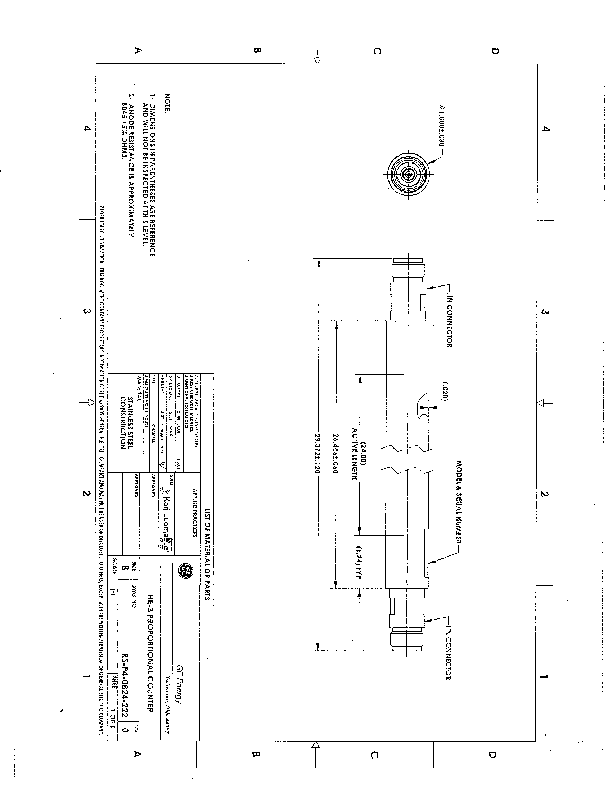
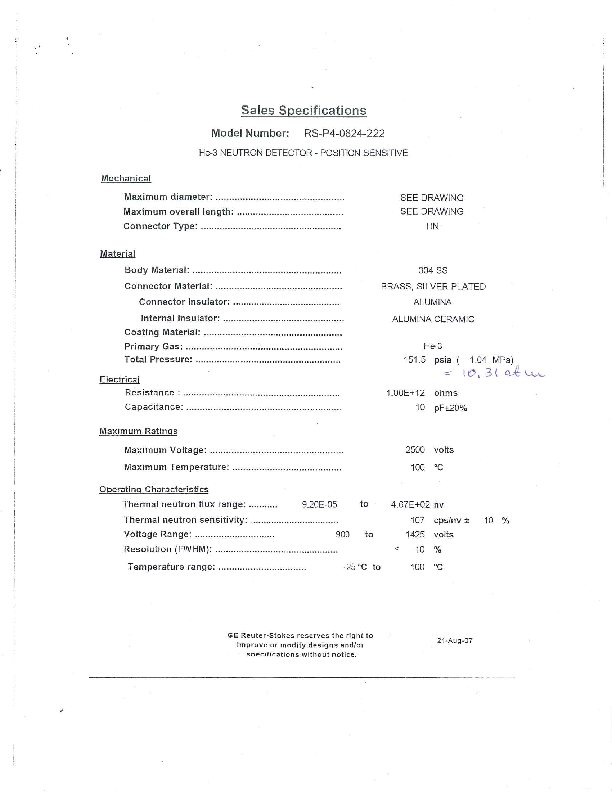
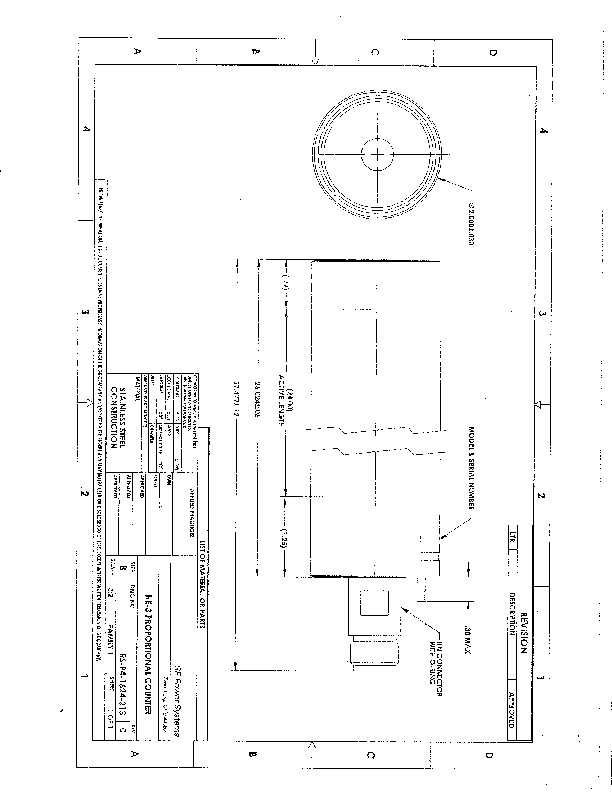
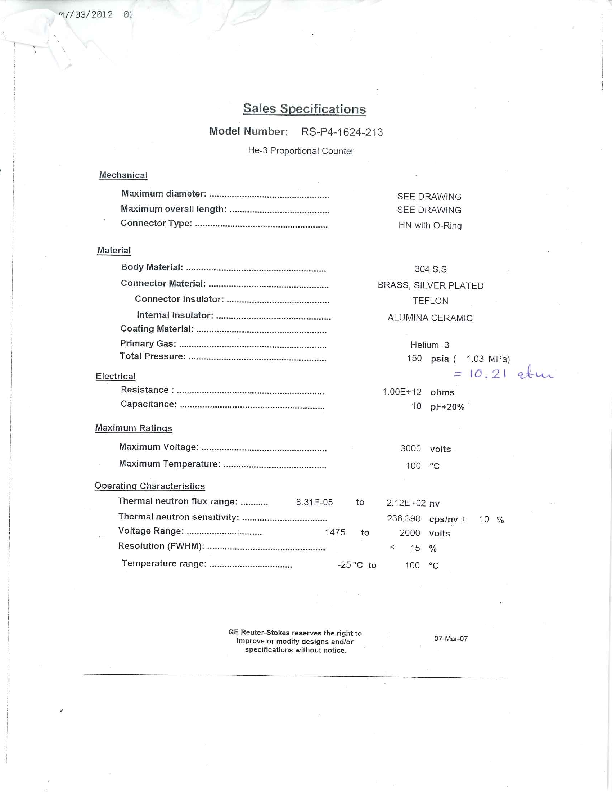
J.L. Tain | 3He tube description | 3He tube drawings and technical details:
RIKEN, UPC, GSI, ORNL-1, ORNL-2 |
| Attachment 1: He3_GE_30cm.pdf
|


|
| Attachment 2: He3-252248.pdf
|



|
| Attachment 3: 1inch3He.pdf
|
|
| Attachment 4: 2inch3He.pdf
|
|
|
9
|
Mon Apr 27 10:18:21 2015 |
K.Gabor S.Nishimura J.Agramunt | ORNL 3He tube at RIKEN | |
| Attachment 1: photo-3.JPG
|

|
|
8
|
Mon Apr 27 04:40:43 2015 |
G. Kiss, J. Agramunt | neutron background at Eurica | Based on an about 8h long background measurement, the neutron background at the Eurica site was found to be about 0.006 neutron / sec (in the Riken tubes) and 0.019 neutron / sec (in the ORNL tubes). The beam was OFF. |
|
7
|
Sat Apr 25 08:25:42 2015 |
G. Kiss, J. Agramunt | BRIKEN Test setup | Altogether 16 tubes are mounted for the parasitic detector test (see the attached photos):
- two tubes (belonging to RIKEN) are in a 10 cm x 10 cm x 30 cm polyethylene matrix inside Eurica, the distance from AIDA is about 30 cm
- 12 tubes (belonging to RIKEN) are in a 20 xm x 30 xm x 30 cm matrix, outside (below) Eurica, at the closest possible place to AIDA, the distance is about 60 cm
- further two tubes (ORNL) are at the bottom of the Eurica support, about 1.2 m from the AIDA Silicon.
Furthermore, spectra measured using a 252Cf source is attached to this report, too (Jap1Cf-RIKEN tube, Us1Cf-ORNL tube). At the moment a background measurement is running. |
| Attachment 2: P1120023.JPG
|

|
| Attachment 3: Jap1Cf.pdf
|

|
| Attachment 4: US1Cf.pdf
|

|
|
6
|
Wed Feb 25 07:38:42 2015 |
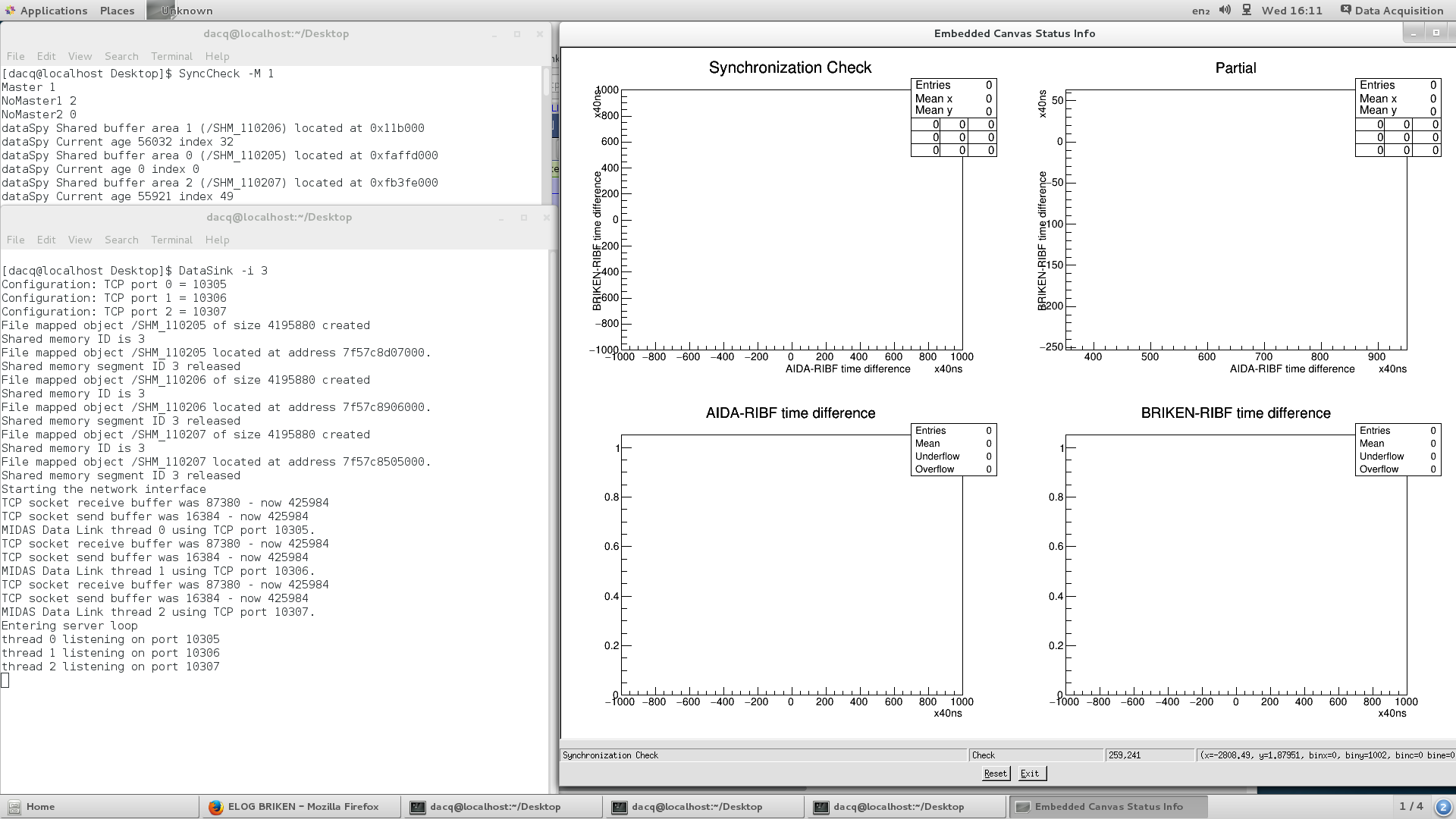
A. Estrade J. Agramunt | Usage of synchronization test programs | In order to access to the synchronization test, we prepare two programs in the PC briken1 ( 10.32.6.54).
To Launch the processes, in a terminal type: DataSink -i 3
In other terminal type SynCheck
By default this preform a test with difference RIBF-BRIKEN and AIDA-BRIKEN.
In case of BRIKEN is not running, the option "SynCheck -M 1" perform de differences AIDA-RIBF and BRIKEN-RIBF, and "SynCheck -M 2" RIBF-AIDA and BRIKEN-AIDA
AIDA Data Relay:
The programming transmitting the data from AIDA to the DataSink includes an intermediate filtering step. This selects only correlation scalars from one module (and possibly ADC values from one channel in that module).
To run the program from aidas1 PC:
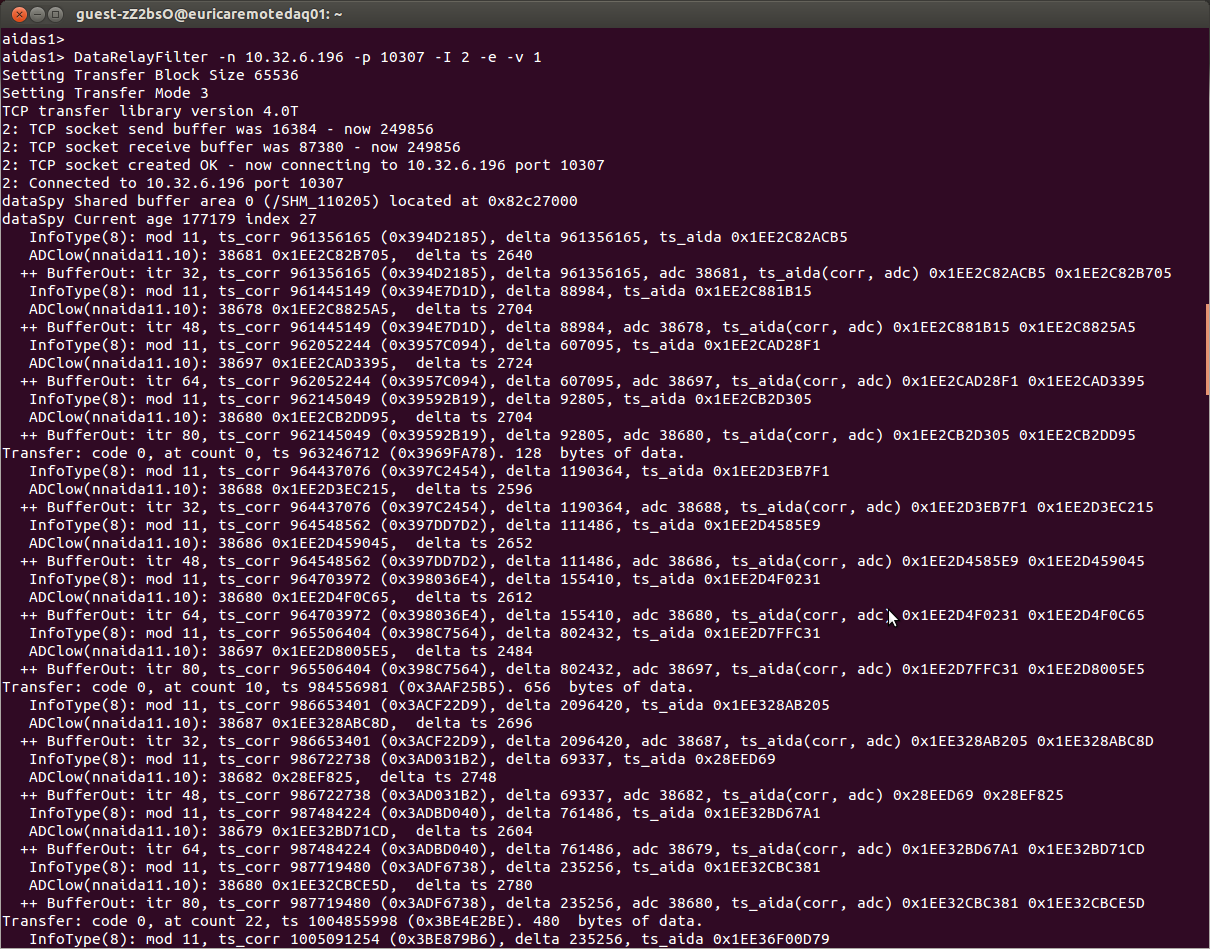
DataRelayFilter -n 10.32.6.54 -p 10307 -I 2
"-I 2" selects ID 2 as the one for the AIDA data stream, which must correspond to the one expected by the DataSink in the briken1 PC.
The attached screenshot show the terminal when running the code in verbose mode (-v 1), and also sending the ADC energy of the pulser in channel 10 of NNAIDA11 (adc ~38600 ch). This was for random pulser; for a fixed pulser delta will show constant value of delta (timestamp difference between consecutive correlationpulses).
|
| Attachment 1: 15.png
|
|
| Attachment 2: DataRelayFilter_terminal.png
|
|
|
5
|
Tue Feb 24 09:34:54 2015 |
J. Agramunt, H. Baba, A. Estrade | [DAQ] DAQ correlation test |
We have performed a successful test of the integration of independent DAQ systems based on a correlation
scalar counted from a common clock signal. The principles of the integration method are described in the
following AIDA elog entry: https://elog.ph.ed.ac.uk/AIDA/29

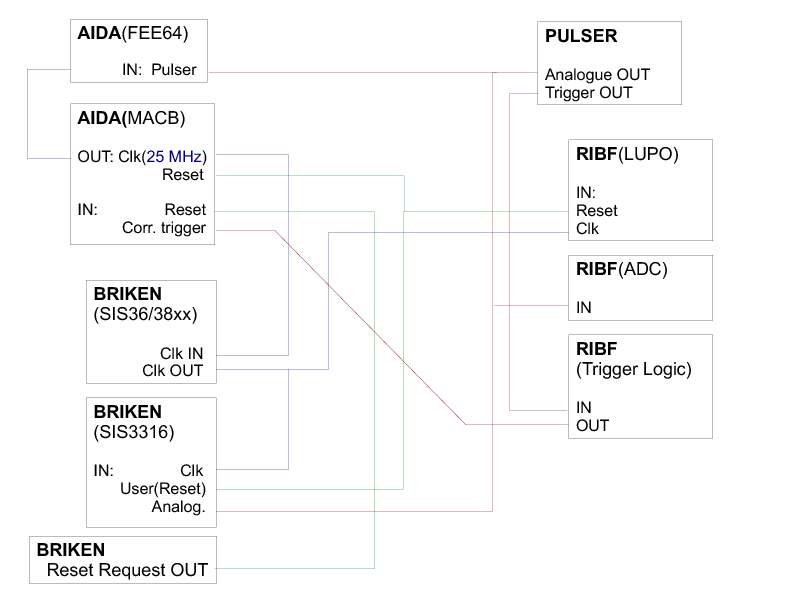
The configuration of the setup we used in the RIKEN test is described by the attached figure:
DAQcorrelation_diagram.pdf. The chosen solution was to use a 25 MHz clock generated by the MACB modules of
AIDA, which was distributed to the other two systems by a SIS36/38xx module in the BRIKEN VME crate (a
slightly modified versio of the method proposed by PCS in AIDA Elog#29).

The correlation can be monitored online using the MIDAS DataXfer and DataSpy toolkits
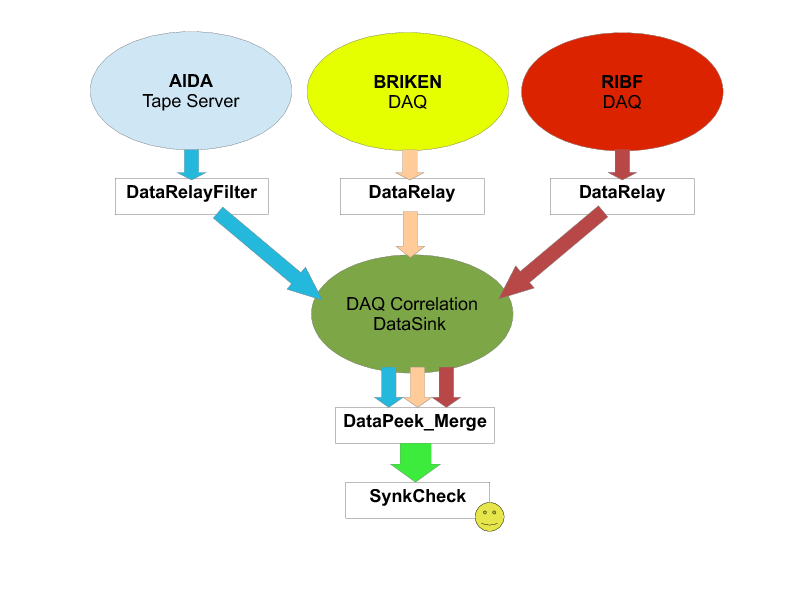
(http://npg.dl.ac.uk/MIDAS/DataAcq/Data.html). Each system operates a DataRelay program that sends a data
stream consisting only of IDs and time-stamps to a common DataSink (this requires a DataRelay code that
does
some filtering of the raw data). The scheme is shown in the attached diagram (DAQsoftware.pdf).

The DataPeek_Merge and SyncCheck codes use C++11 for parallelization of tasks, which is a helpful feature
to
improve the efficiency of finding coincidences between the correlation pulses. Thus,  the code will not
run
in PCs with any Linux version. For example, it requires version 7 of ScientificLinux, which installed in
the
PC being used for BRIKEN DAQ control that will stay at RIBF for the time being.


++ SYNCHRONIZATION RESULTS ++

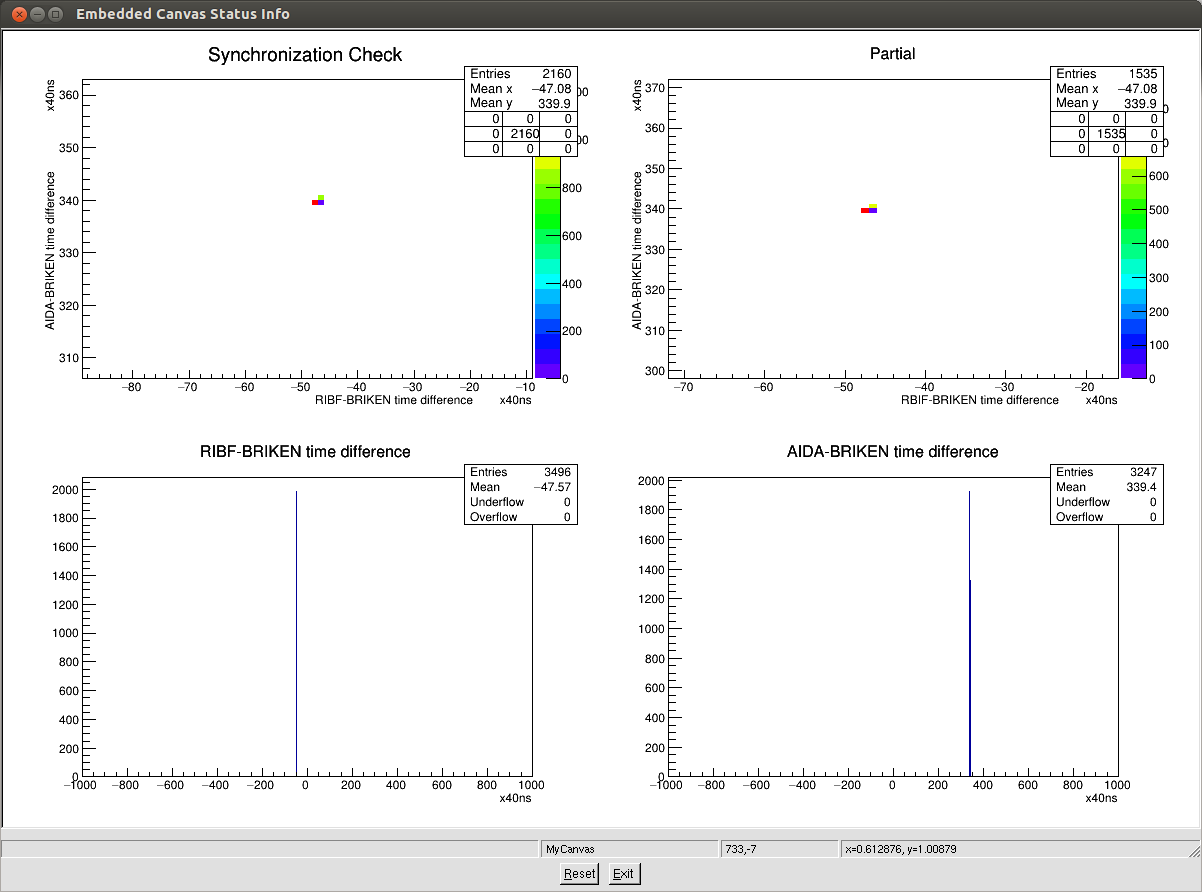
The figure correlation_25Hz.png shows a correlation plot for the BRIKEN+RIBF+AIDA running with
correlations
done by a pulser at 25 Hz. A large fraction of the pulsers appear in the double-coincidence plots (top
row;
same plots, except the 'Partial' one is automatically cleared every ~10seconds).

The bottom plots show the pair-wise correlations between BRIKEN and RIBF or AIDA. BRIKEN was defined as
the
'master' in this test, but current version of the program is flexible to select any stream as the master
one.

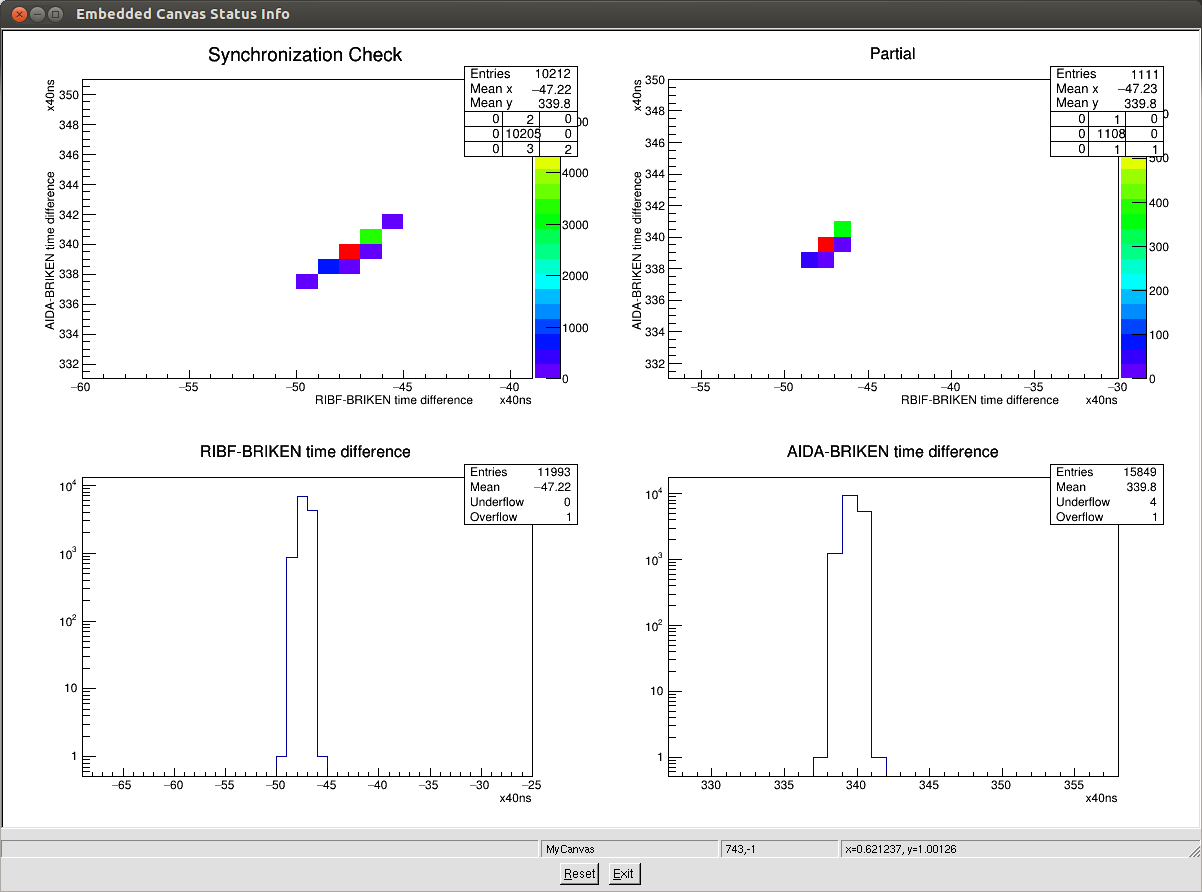
The second figure (correlation_random.png) shows the same test, but using a non-periodic pulser to trigger
the correlation scalar. We observed the same level of synchronization (peaks look broader because of the
zoom level). |
| Attachment 1: DAQcorrelation_diagram.pdf
|
|
| Attachment 2: DAQsoftware.pdf
|
|
| Attachment 3: correlation_25Hz.png
|
|
| Attachment 4: correlation_random.png
|
|
|
4
|
Mon Feb 16 00:29:00 2015 |
Gabor KISS | Polyethyelene | The polyethelene arrived at RIKEN. Except 4 neighboring holes (located at the inner ring) the alignment is OK. |
| Attachment 1: bottom1.JPG
|

|
| Attachment 2: small2.JPG
|

|
|
3
|
Fri Oct 31 12:58:49 2014 |
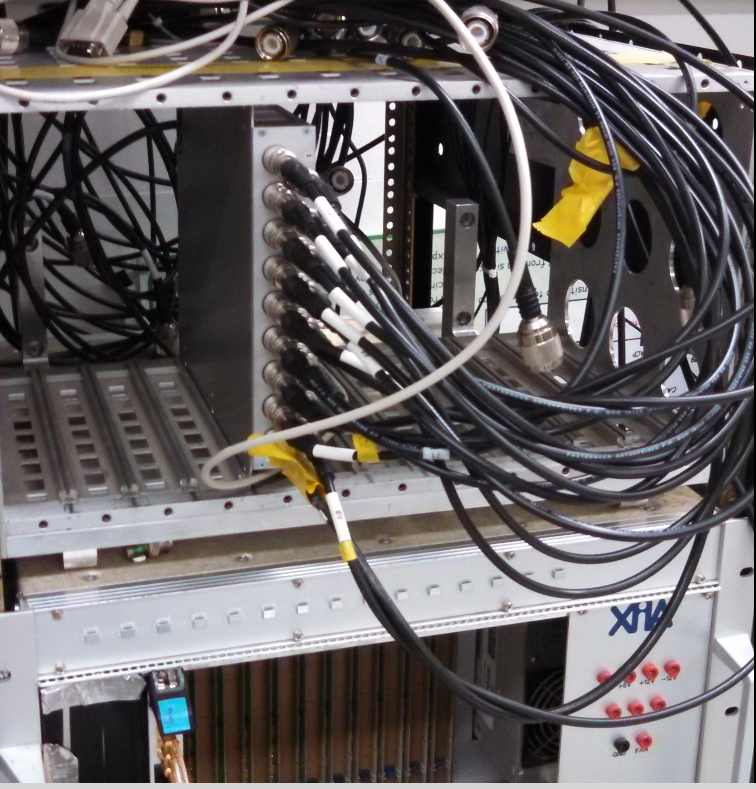
Robert Grzywacz | Entry test - preamps | Here is a picture of one of our Mesytec preamplifiers. We have located all seven of them.
They have 16 input channels and a common SHV per board.
<p> <a href="141031_125516/24.png?lb=BRIKEN"><img border="0" alt="24.png" src="141031_125516/24.png?
lb=BRIKEN&thumb=1" name="att0" id="att0" /></a></p> |
| Attachment 1: 24.png
|
|
|
2
|
Fri Oct 31 11:36:57 2014 |
Alfredo Estrade | BRIKEN elog: take 2 | A elog for the setup of the BRIKEN detector is now operational at https://elog.ph.ed.ac.uk/BRIKEN/
We have setup a list of emails that will receive automatic updates for each new entry to the logbook: C. Domingo, G. Lorusso, T. Davinson, A. Estrade, K. Rykaczewski, J.L. Tain, C. Griffin, S. Nishimura, I. Dillman, F. Montes, J. Agramunt, G. Cortes, F. Calvino, M. Marta
Please let us know the contact info for any other person that would like to be included in this list, or if you would like your email to be removed from it (should the new entries be too frequent for your inbox traffic!). |
|
1
|
Fri Oct 31 09:47:59 2014 |
Alfredo Estrade | BRIKEN elog: Hello world! | A elog for the setup of the BRIKEN detector is now operational at https://elog.ph.ed.ac.uk/BRIKEN/
We have setup a list of emails that will receive automatic updates for each new entry to the elog:
C. Domingo, G. Lorusso, T. Davinson, A. Estrade, K. Rykaczewski, J.L. Tain, C. Griffin, S. Nishimura, I. Dillman, F. Montes, J. Agramunt, G. Cortes, F. Calvino, M. Marta
Please let us know about any other person that would like to be included in this list, or if you would like your email to be removed from it (should the new entries be too frequent for your inbox traffic!).
|
|