| |
ID |
Date |
Author |
Subject |
|
|
163
|
Wed Feb 24 15:46:11 2016 |
PJCS | OR64 - OR of all the ASIC discriminator channels after application of a mask |
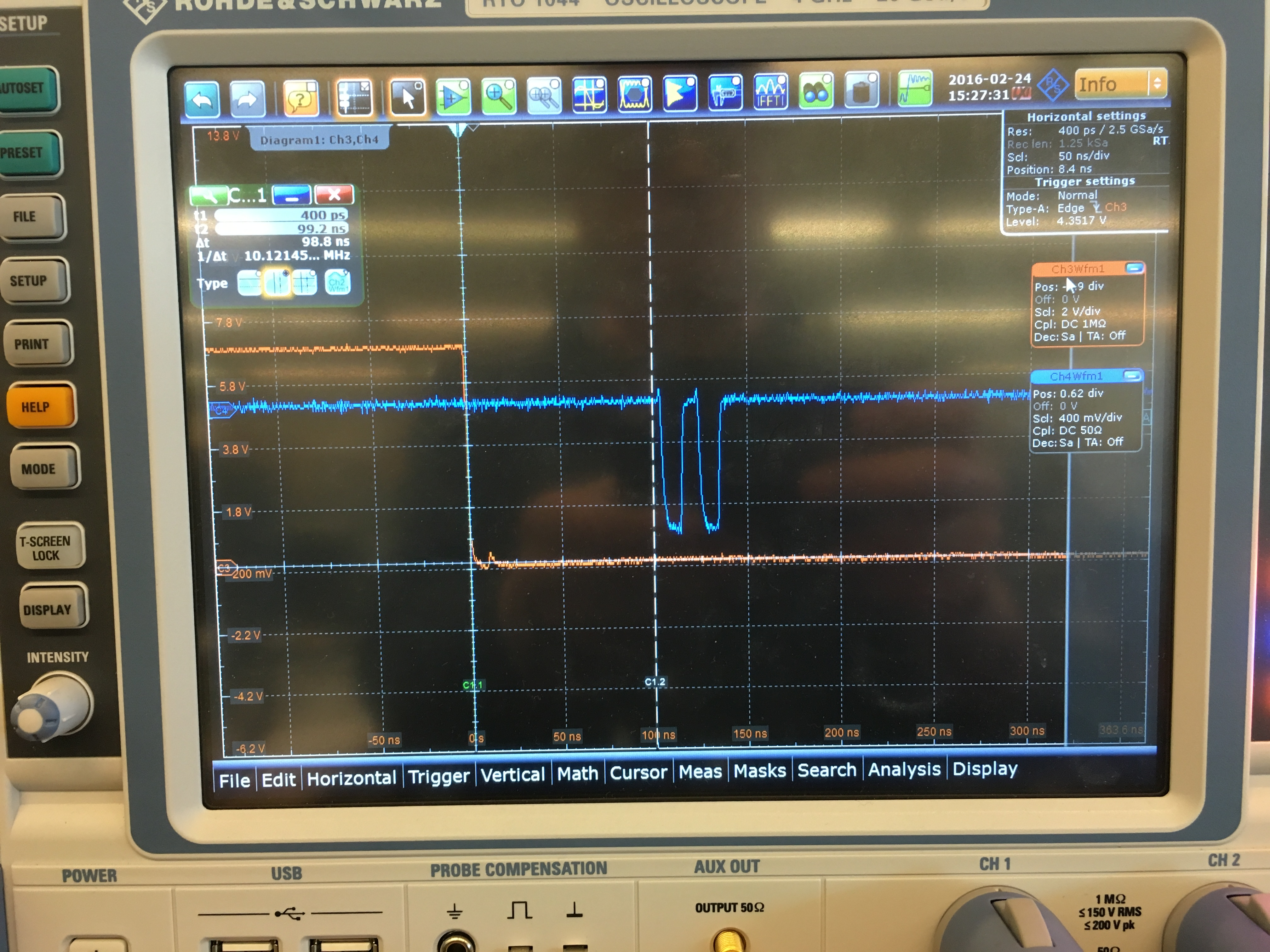
Firmware version8 number 8 has an OR64 added which can be routed, using the Local control, to the Trigger output and hence seen at the front panel Fast NIM LEMO00 connector.
The OR64 is the OR of all the ASIC Discriminators. Each rising edge of a discriminator signal will give a 10ns pulse on the Fast NIM signal. If two coincide there will be one pulse.
The attached 'scope photograph shows the pulser trigger output ( orange trace ) and the OR64 signal ( blue trace) .
The delay shown is 98nS.
nnaida2 has no ASICs mounted so this timing is for the VHDL and MACB system.
Further tests will be run with the full T9 system ( nnaida11 -> 14 + detector ) and this entry updated with that result.
|
| Attachment 1: IMG_0290.JPG
|
|
|
|
361
|
Wed Sep 28 07:51:45 2016 |
TD & CG | New spectrum display software installed |
Spectrum display software updated
    maximum number of galleries increased to 30
    layouts may be saved to, and restored from, files /tmp/LayOut<n>.mlf where <n> = 1..8

mv /MIDAS/TclHttpd/Html/Spectrum /MIDAS/TclHttpd/Html/Spectrum.BAK-29.0916
mv /MIDAS/TclHttpd/Html/Spectrum_new_22Aug /MIDAS/TclHttpd/Html/Spectrum

aidas1> ls -l /MIDAS/TclHttpd/Html/Spectrum
total 136
-rw-r--r--. 1 npg npgstaff 32620 Aug 22 20:08 analysis.tcl
-rw-r--r--. 1 npg npgstaff  2179 Aug 22 20:08 example.html
drwxr-sr-x. 2 npg npgstaff  4096 Aug 22 20:11 images
-rwxr-xr-x. 1 npg npgstaff  5851 Aug 22 20:08 show.tcl
-rw-r--r--. 1 npg npgstaff  1246 Aug 22 20:08 SP2.txt
-rw-r--r--. 1 npg npgstaff     0 Aug 22 20:08 SP3.txt
-rw-r--r--. 1 npg npgstaff     0 Aug 22 20:08 SP4.txt
-rw-r--r--. 1 npg npgstaff     0 Aug 22 20:08 SP5.txt
-rw-r--r--. 1 npg npgstaff  6631 Aug 22 20:08 Spectrum.js
-rw-r--r--. 1 npg npgstaff 44386 Aug 22 20:08 Spectrum.tcl
-rw-r--r--. 1 npg npgstaff 30765 Aug 22 20:08 Spectrum.tml

aidas1> ls -l /MIDAS/TclHttpd/Html/Spectrum.BAK-280916
total 152
-rw-r--r--. 1 npg npgstaff 29462 Feb  2  2016 analysis.tcl
drwxr-sr-x. 2 npg npgstaff  4096 Oct  9  2013 flot
-rw-r--r--. 1 npg npgstaff   214 Mar 15  2016 fort.12
-rw-r--r--. 1 npg npgstaff   678 Mar 15  2016 fort.8
-rw-r--r--. 1 npg npgstaff  1253 Feb  2  2016 Global.tcl
drwxr-sr-x. 2 npg npgstaff  4096 Oct  9  2013 images
-rw-r--r--. 1 npg npgstaff  2173 Feb  2  2016 options.html
-rwxr-xr-x. 1 npg npgstaff  5851 Feb  2  2016 show.tcl
-rw-r--r--. 1 npg npgstaff  1246 Feb  2  2016 SP2.txt
-rw-r--r--. 1 npg npgstaff     0 Feb  2  2016 SP3.txt
-rw-r--r--. 1 npg npgstaff     0 Feb  2  2016 SP4.txt
-rw-r--r--. 1 npg npgstaff     0 Feb  2  2016 SP5.txt
-rw-r--r--. 1 npg npgstaff  6438 Feb  2  2016 Spectrum.js
-rw-r--r--. 1 npg npgstaff 43204 Feb  2  2016 Spectrum.tcl
-rw-r--r--. 1 npg npgstaff 29496 Feb 2 2016 Spectrum.tml |
|
|
720
|
Sat Jun 23 02:28:13 2018 |
TD, OH | New fuses fitted to USB-controlled ac mains relay |
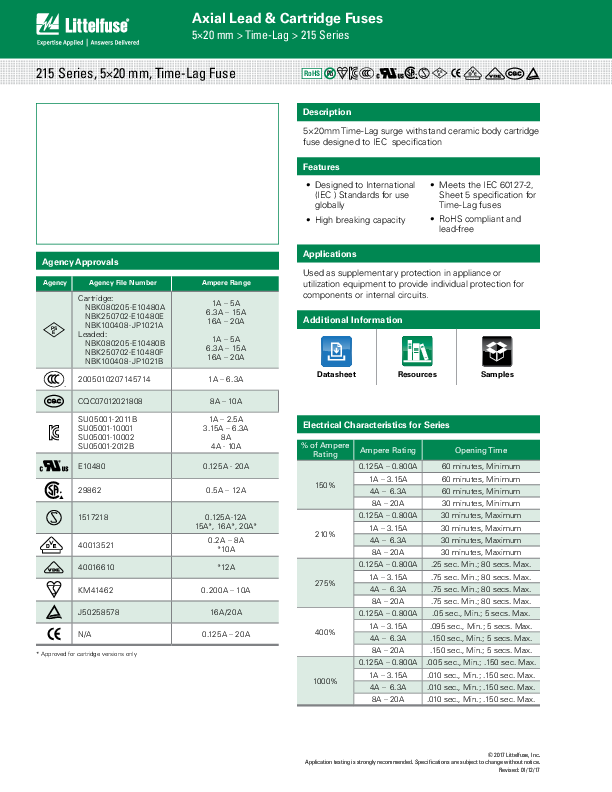
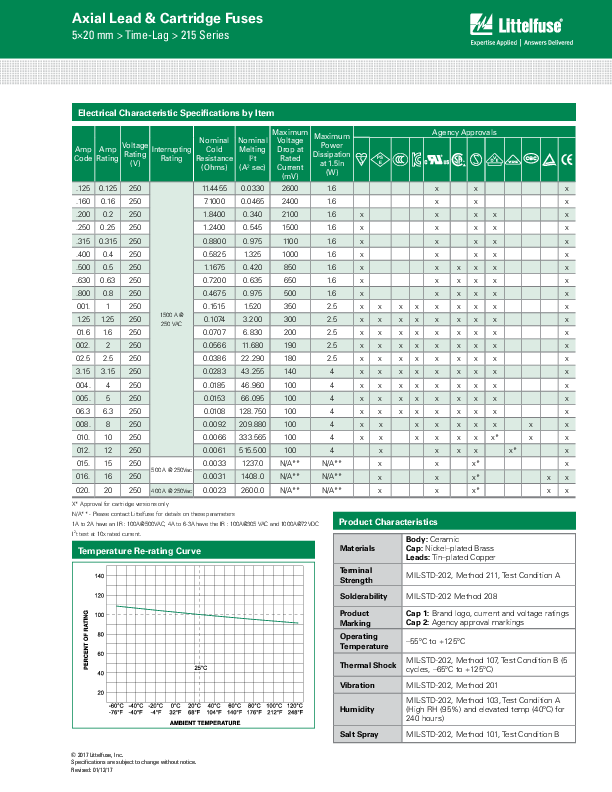
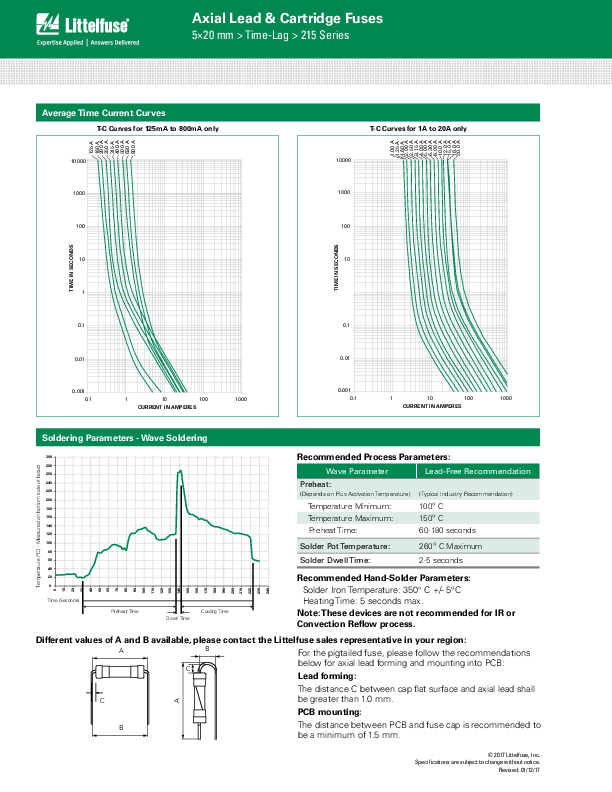
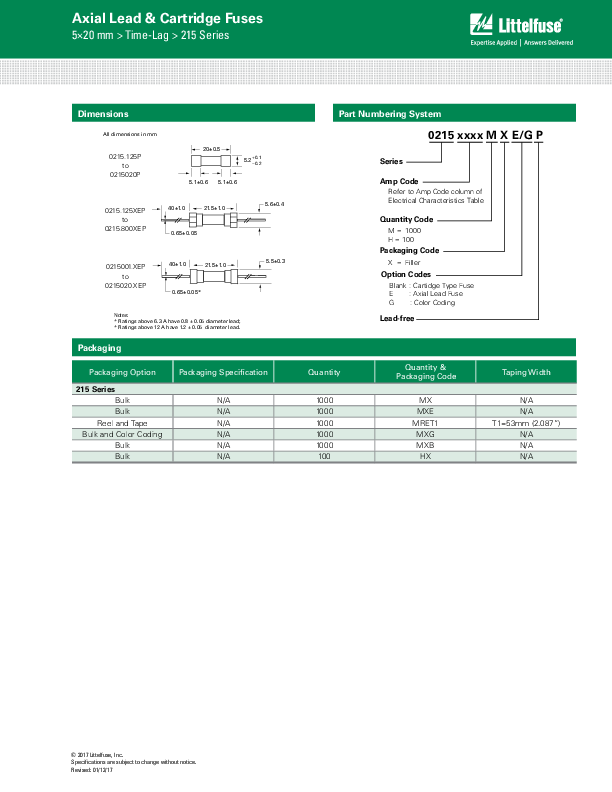
The input fuses of the USB-controlled ac mains relay have been changed from 2x 5x20mm 250V/16A to 2x 5x20mm
250V/20A cartridge, time-lag Littelfuse 0215020.MXP |
| Attachment 1: 2290195.pdf
|
|
|
|
121
|
Wed Nov 18 18:18:26 2015 |
CG, TD | New Kapton cable tests at DL |
Note: kapton #7 may have broken pins next to (deliberately) broken ground pin. Unclear, but should not be used for bias until certain.
Detector BB18 2998-22 connected via 4 45cm kaptons and biased to +200V via nnaida12+14, with leakage current 4.310uA @ room temp 25.4oC.
Turned off FADCs as per PCS instructions in previous entry - no change. Turned back on.
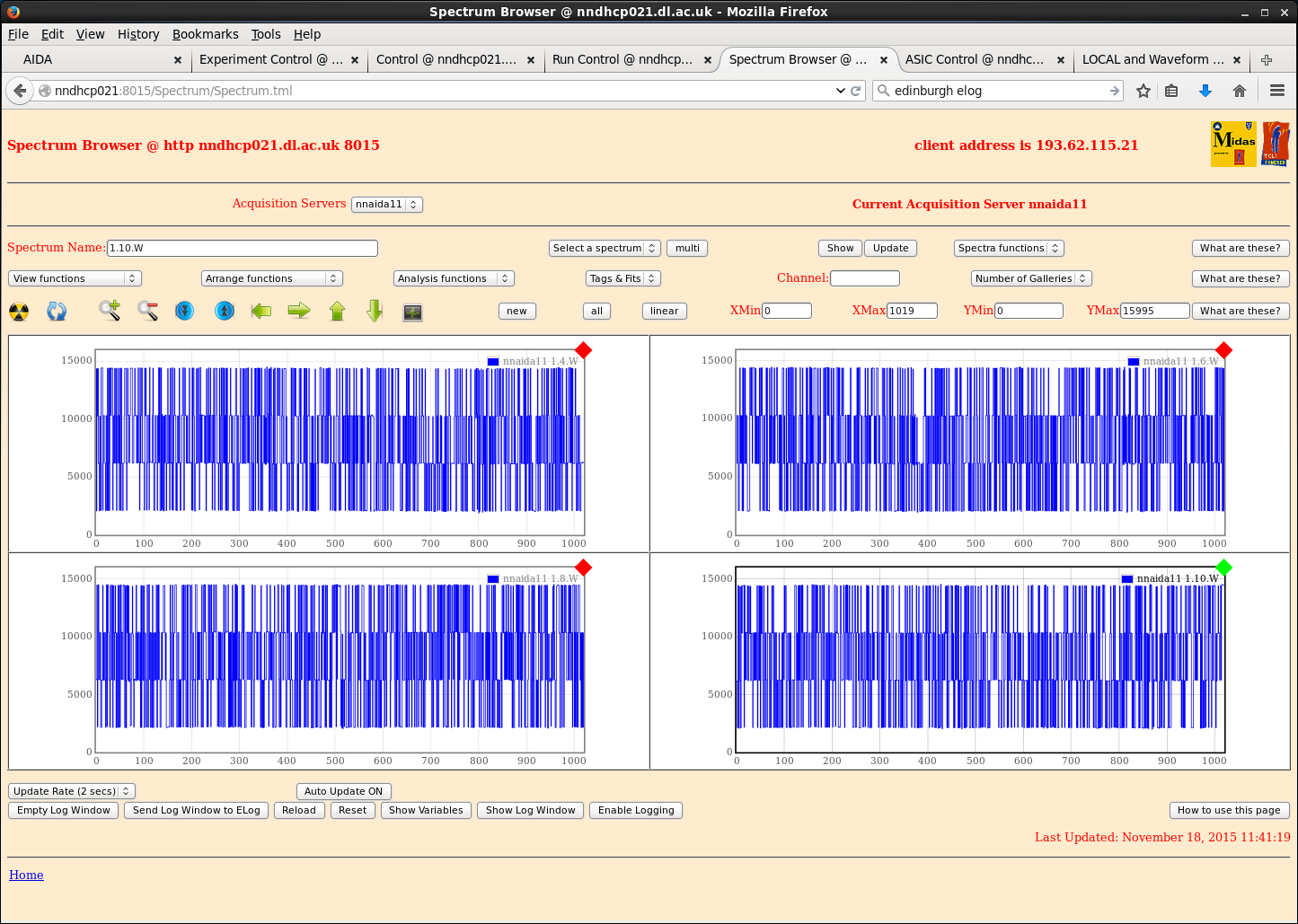
Braid grounding HV to pulser and all jumpers removed - makes performance much worse.
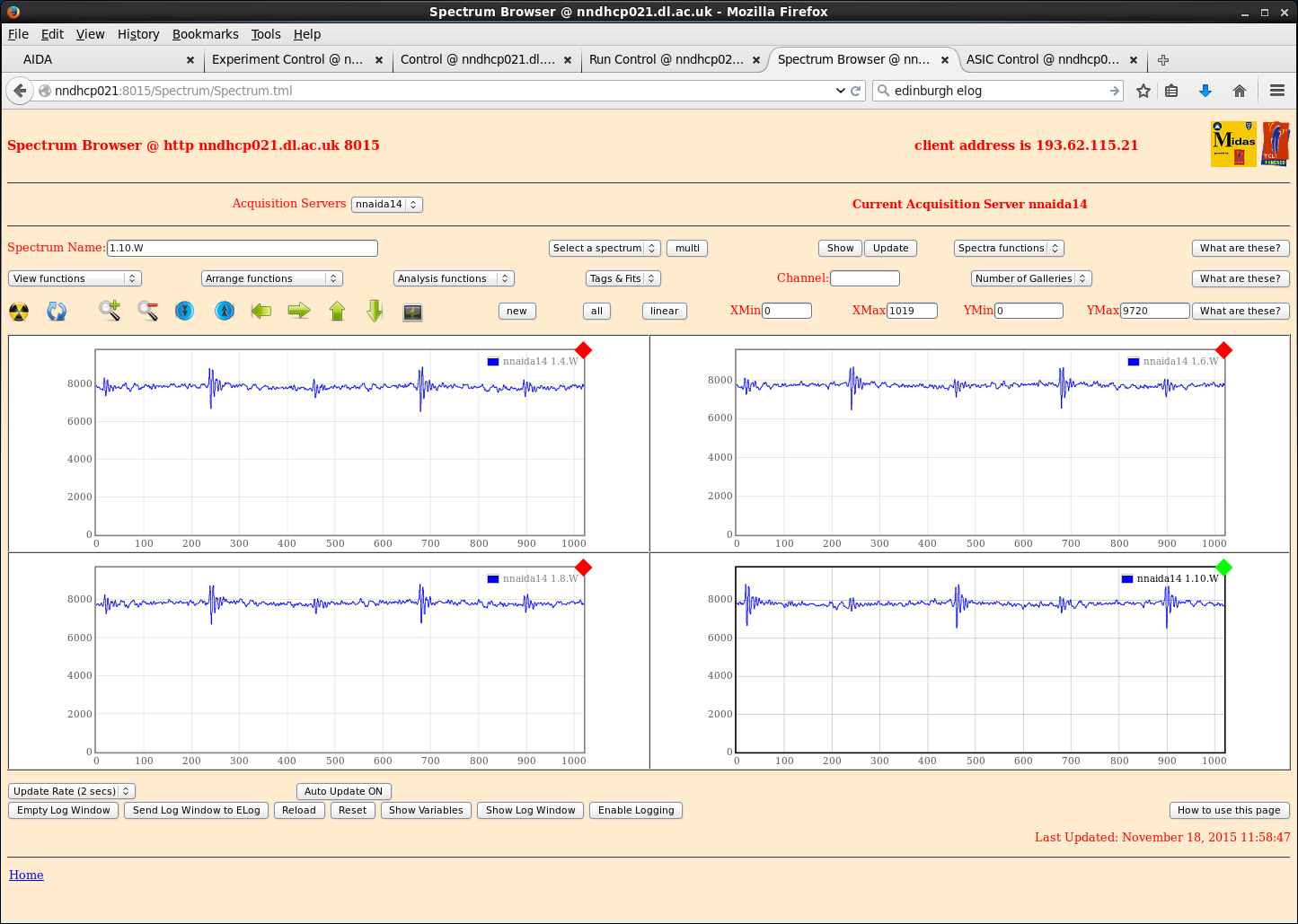
Connecting only jumper to ground detector brings performance back to moderate, but not good. Re-adding braid bring further improvement.
- other jumpers don't seem to have a considerable affect on performance.
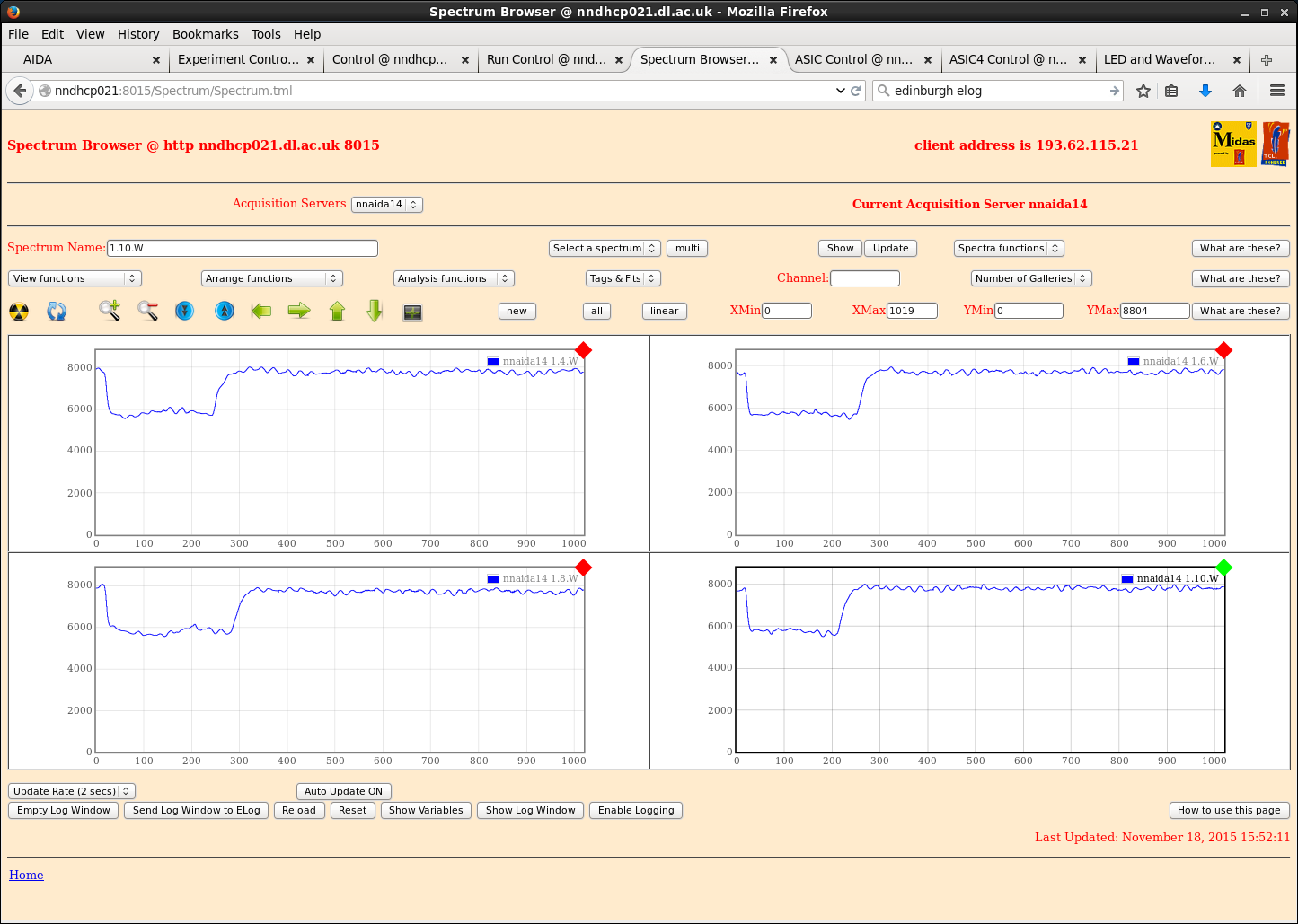
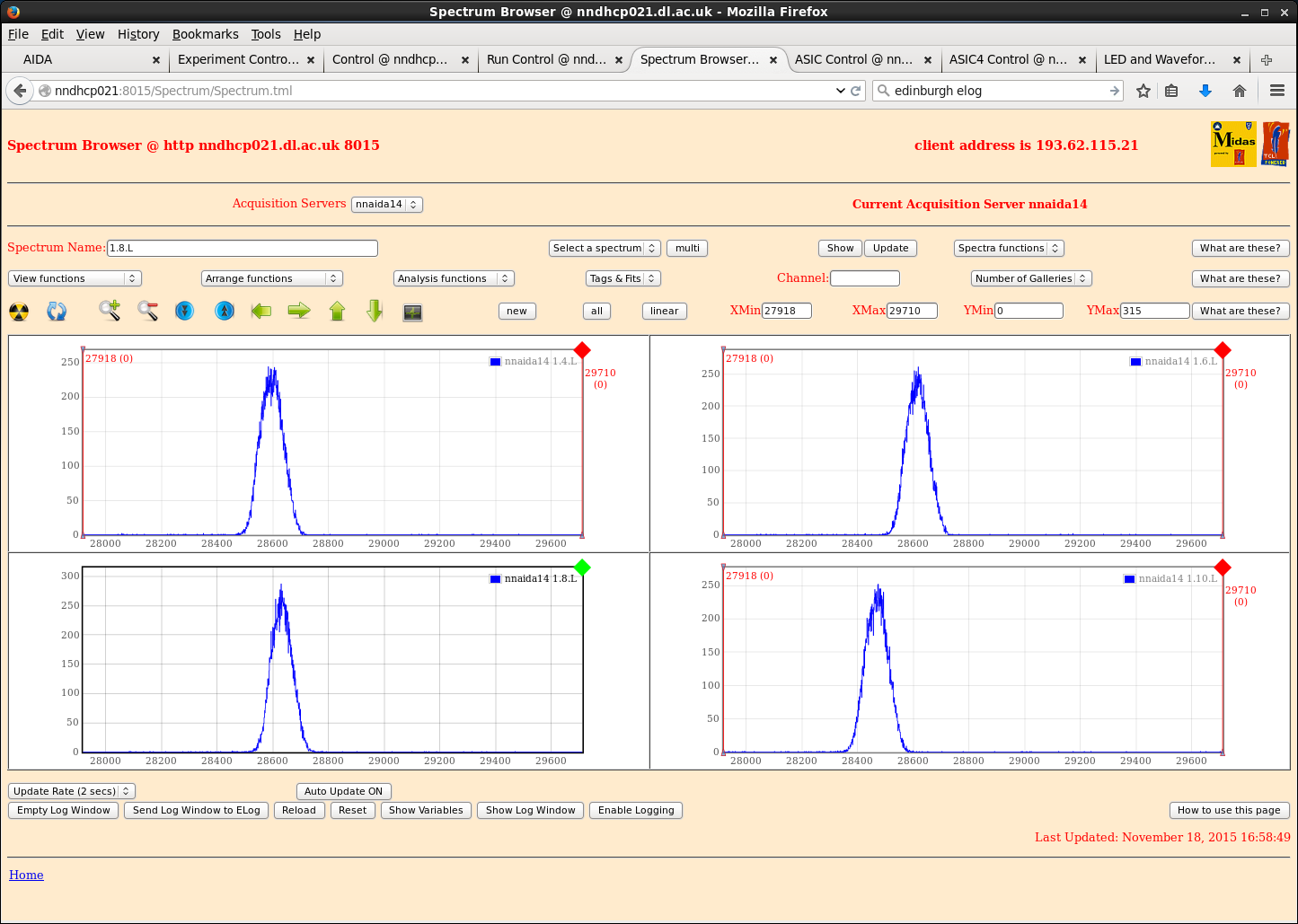
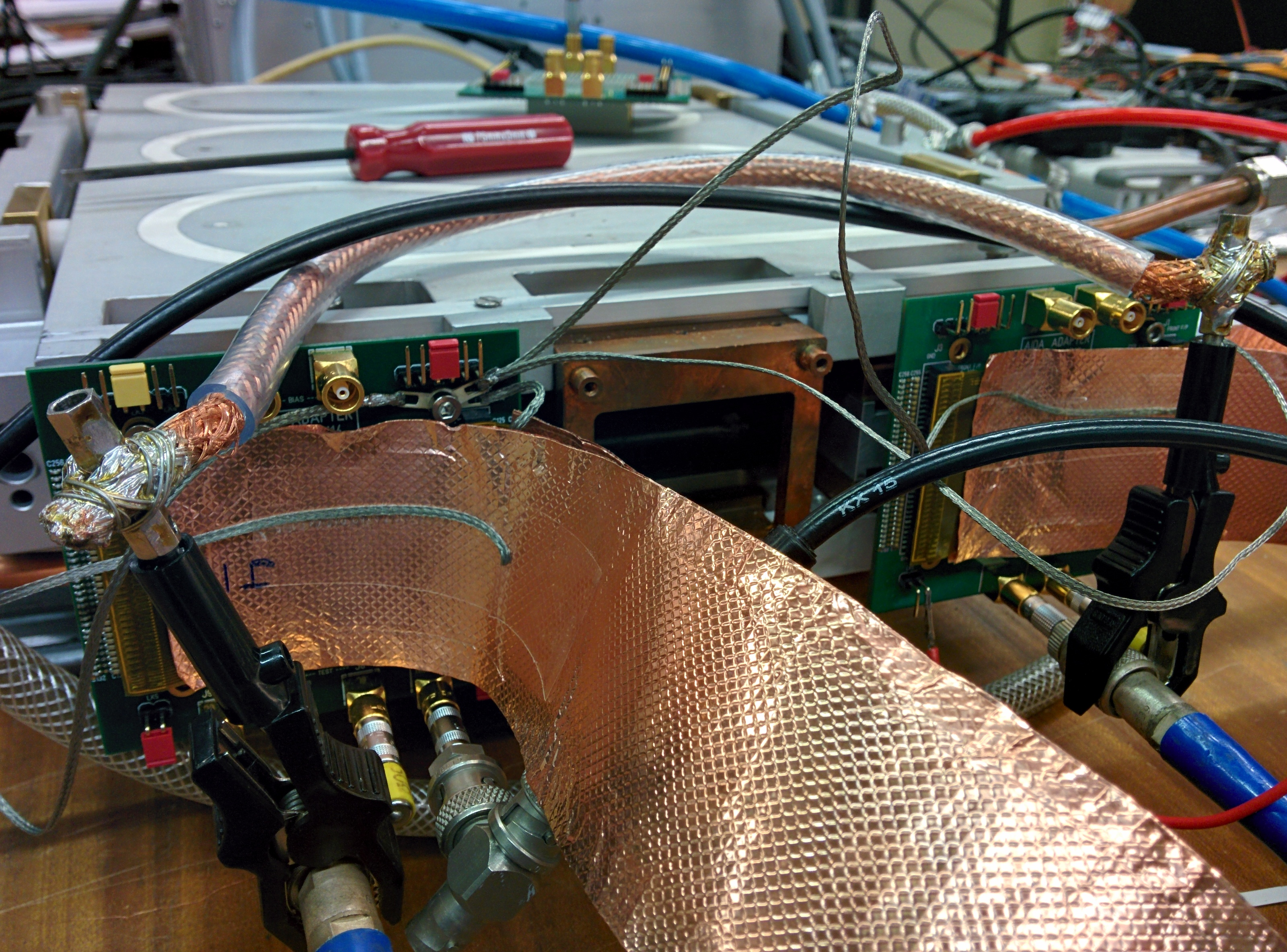
Added short (~few cm) drain wire to outside of Cu tape covering kaptons and attached to nearest allen bolt in adapter PCB, i.e. at the top of each connector, plus the jumper for the detector ground. Looked at variation with shaping time:
t_shape (us) || 0.5 | 1.0 | 2.0 | 4.0 | 8.0
Pulser FWHM (ch) || 715 | 687 | 448 | 246 | 124 (nnaida14)
- all peaks were non-Gaussian and double peaked apart from at 8us. @ 8us it was not quite Gaussian, but much closer than the rest.
Added ~20cm drain wires to each kapton and connected all at one point on mount screw above nnaida14 adapter PCB connector. Again looked at variation with shaping time.
t_shape (us) || 0.5 | 1.0 | 2.0 | 4.0 | 8.0
Pulser FWHM (ch) || 363 | 354 | 245 | 120 | 85 (nnaida14)
- again, at low shaping times all peaks started out double peaked, but moved closer to Gaussian as t_shape was increased. At 8us, not quite Gaussian, but close.
P-side performance much better than n-side.
- currently drain wires are connected to p-side adapter PCB. Will move these to n-side PCB tomorrow to see if this has any affect. |
| Attachment 1: nnaida11_noJumpers.png
|
|
| Attachment 2: nnaida14_detectorGNDjumper.png
|
|
| Attachment 3: nnaida14_shortDrainWires.png
|
|
| Attachment 4: nnaida14_shortDrainWiresSinglePoint_8us.png
|
|
| Attachment 5: IMG_20151118_164436.jpg
|
|
|
|
124
|
Thu Nov 19 17:31:24 2015 |
CG, TD | New Kapton cable tests at DL |
Powered system on from the state it was in last night. Biased to +200V with leakage current 3.9uA at room temp 22.8oC.
Performance of nnaida14 at shaping time of 8us slightly worse than last night - peak now non-Gaussian and double peaked. New source of noise?
Trying different permutations of grounding options initially led to no improvements.
- tried various jumper combinations and taking the braids from the kaptons to various different points on the adapter PCBs - no appreciable changes.
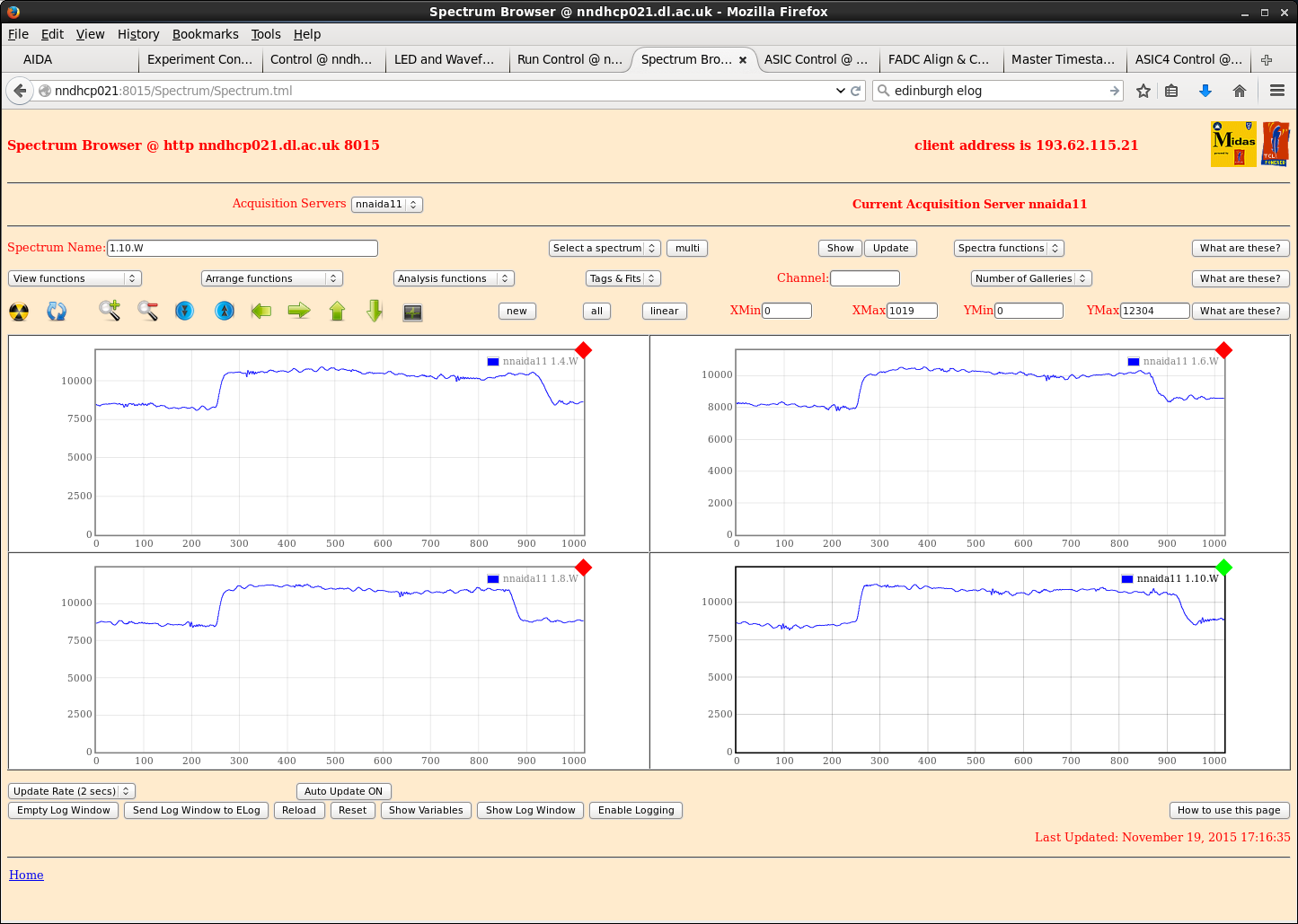
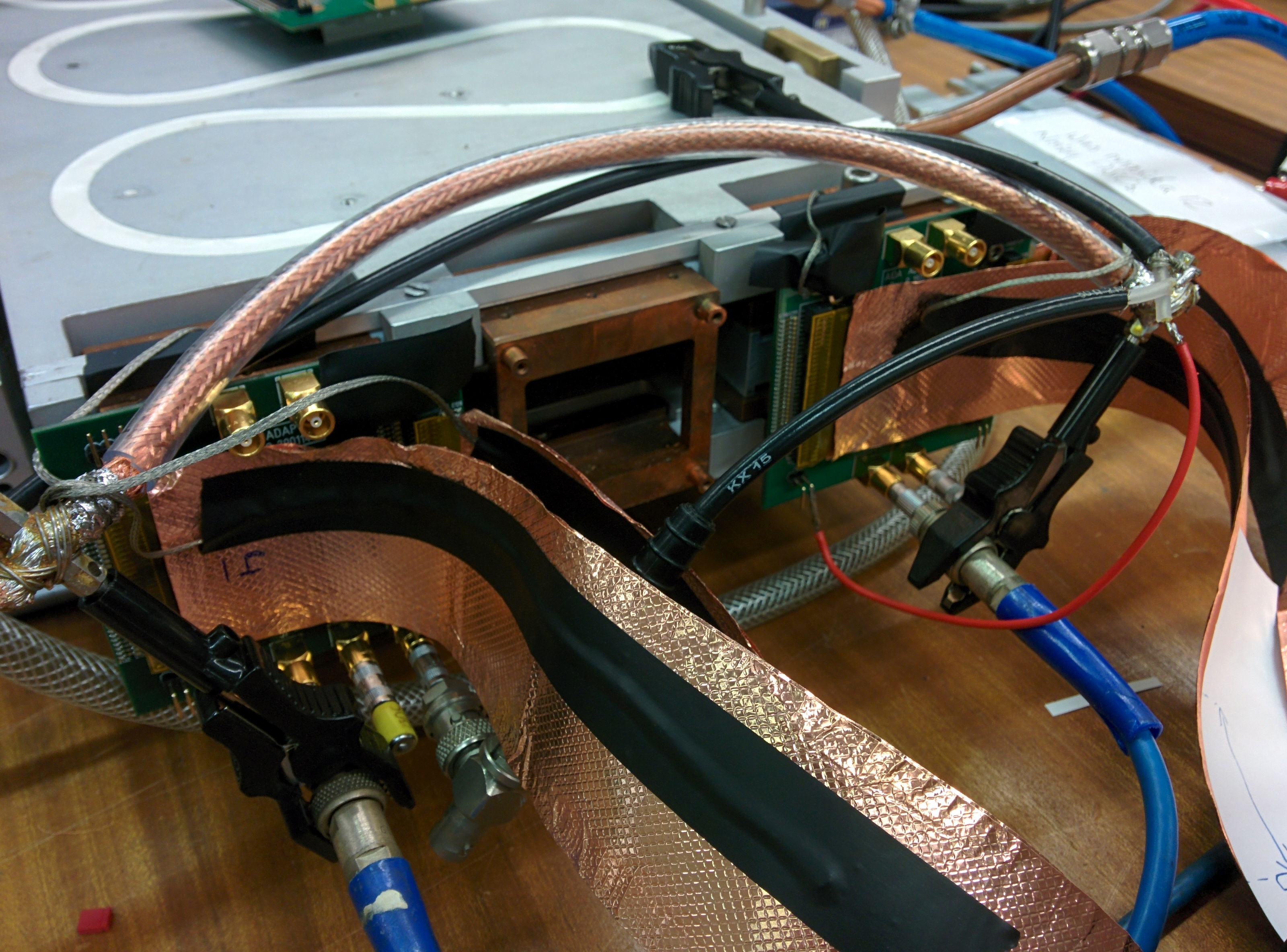
However, connected the braids from the kaptons to the thick Cu braid with a crocodile clip and the noise in the back side FEEs significantly reduced.
Throughout, both sides of the detector saw improvements, but the front side performed much better than the back (rear waveforms were still just noise, just slightly reduced noise).
Soldered 4 drain wires to the thick Cu braid to improve connection and taped them to the Cu tape on the kaptons so as to give the shortest possible distance between kapton and thick braid (attachment 2).
- performance in nnaida11 improved dramatically, the waveforms looked sensible instead of just noise (see attachment 1)
- however, nnaida14 waveforms have now just gone to noise... We have swapped the performance of the front/rear strips.
In investigating this, we have found poor connections and high resistance between the Cu blocks and adapter PCBs, despite all screws connecting them -> a good connection cannot always be assumed it seems.
However, taking a braid from the PCBs directly to the Cu blocks makes little difference to performance. Neither did putting an Al plate on the front of the detector.
The Al detector box was previously floating, but now is not - the effect of this will be investigated tomorrow. |
| Attachment 1: nnaida11_wav.png
|
|
| Attachment 2: IMG_20151119_162831.jpg
|
|
|
|
125
|
Fri Nov 20 16:29:49 2015 |
CG | New Kapton cable tests at DL |
Powered system up from state it was left in last night. Biased to +200V with leakage current 3.9uA @ room temp 23.3oC.
nnaida14 now performing as it was at the beginning of yesterday, with nnaida11 back to having noisy waveforms.
Tried various combinations of grounding to ascertain minimum possible configuration to maintain (or improve) current performance.
- detector ground jumper required, noise in waveforms increases significantly if removed
- system seemingly has no preference of jumper combinations for the left-hand pairs of pins, other than all 4 at once increase noise. Any combination of 3 or fewer seems to have no effect
- fitted additional small braids to kaptons and took them directly to the PCBs (like in the previous ELog entry) which made no difference
Found LEMO connectors on both PCBs to show open circuit with the Cu adapter mount block (not mezzanine block). Wrapped thin braid round connectors and took attached directly to each respective Cu block.
Resistance between any two points between the detector and Cu mezzanine blocks now < 0.5 Ohm.
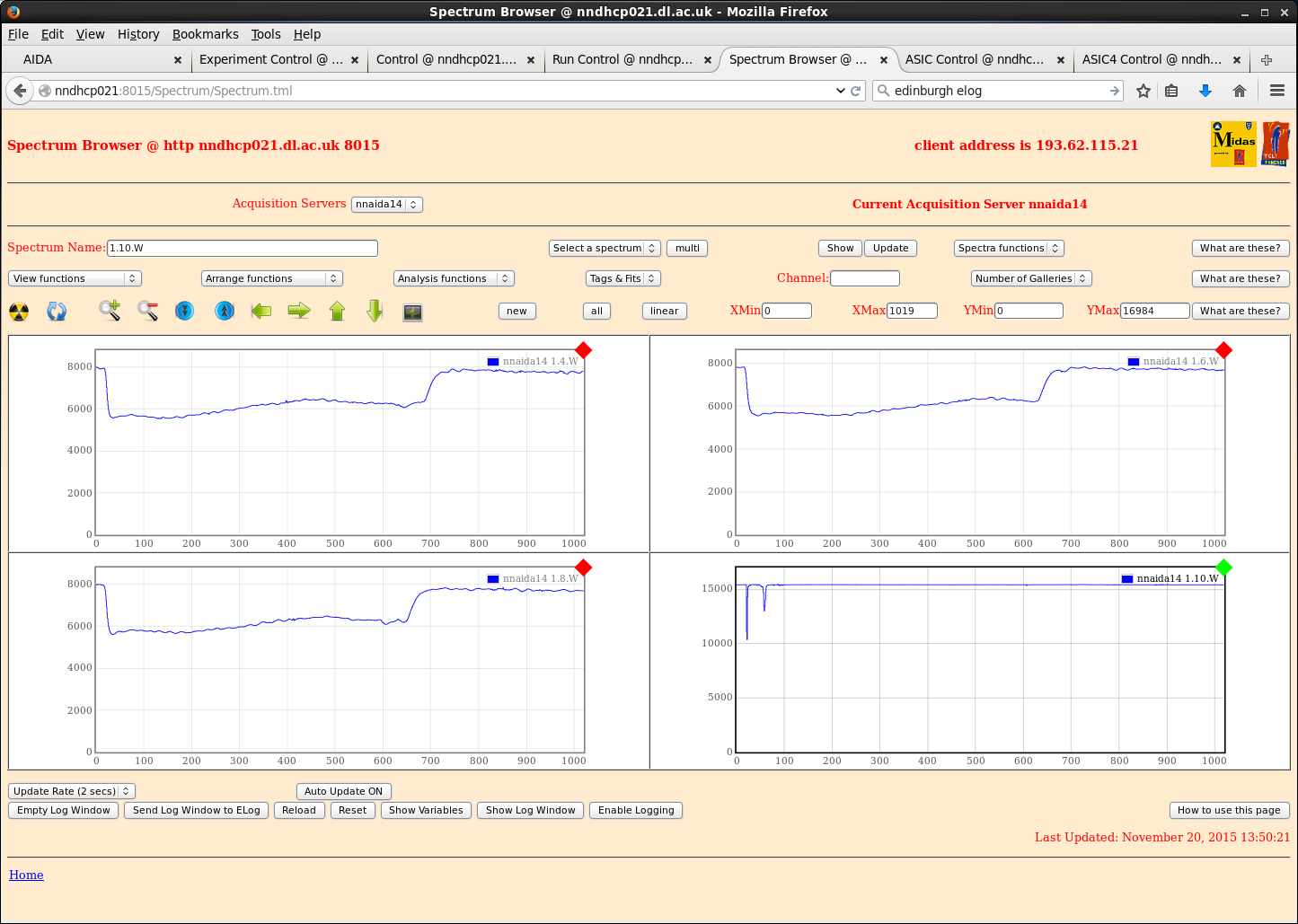
- when i left for lunch this had no effect on nnaida11, but nnaida14 showed improvement in fine noise on waveforms but none for the low frequency 'wave' (see attachment 1)
- after returning from lunch, both were noisy again and I was unable to repeat original improvement over a few attempts at the same or similar grounding. Subsequently removed completely and performance returned to normal...
When we arrived on Wednesday, detector box was floating and performance was OK. Box is now not floating, and attempts to make it so were unsuccessful, although nothing I did changed the noise situation.
Removing the Al plates either side of the detector made had no impact on the noise.
Didn't get chance to try swapping the PCBs over. |
| Attachment 1: nnaida14_goodGNDbetweenAll.png
|
|
|
|
126
|
Wed Nov 25 19:24:39 2015 |
CG, TD, PJCS | New Kapton cable tests at DL |
Powered system on and biased to +200V at room temp of 22.4oC. Leakage current of 3.37uA.
Waveforms very noisy and spectra dominated by low E noise. Upon taking a close look at front end found one of the kaptons to have broken a connection. Swapped it out for a spare.
Returned to same situation as last week. Peaks all have a shoulder at t_shape of 8us, but main peak has width ~80ch. Shorter shaping times lead to double peaking.
Removed FEEs from crate and properly seated adapter PCBs on Cu mounting block, with washers between plated part of PCB and allen screw.
- <0.4 ohm impedance betwee Cu mount block and washer/screw but ~20 ohms between screw and LEMO connector => 20 ohms between Cu mounting block and LEMO connectors
- plating around screw holes doesn't go anywhere.
Confirmed LEMOs are connected to ASIC ground (as they should be) on the Cu mezzanine block with <0.2 ohm impedance between mezzanine Cu and LEMO connectors.
With adapter PCBs removed, Cu mezzanine blocks of separate modules still have impedance < 0.3 ohm between them. How/why?
- found out MACB cables, power cables and network cables all connect the grounds of each FEE card/module. Was this expected? Does this cause us problems?
Swapped non-functioning nnaida12 for the former nnaida11 from the module featuring the other broken nnaida12 - all seems to work, although no waveforms are produced.
Very low impedance between ASIC grounds of FEE cards in same module.
To obtain a better ground connection between the ASIC grounds of separate modules, connected a thick braid to Cu mezzanine block of each. Operating at limit of multimeter so no noticeable difference in impedance. But...
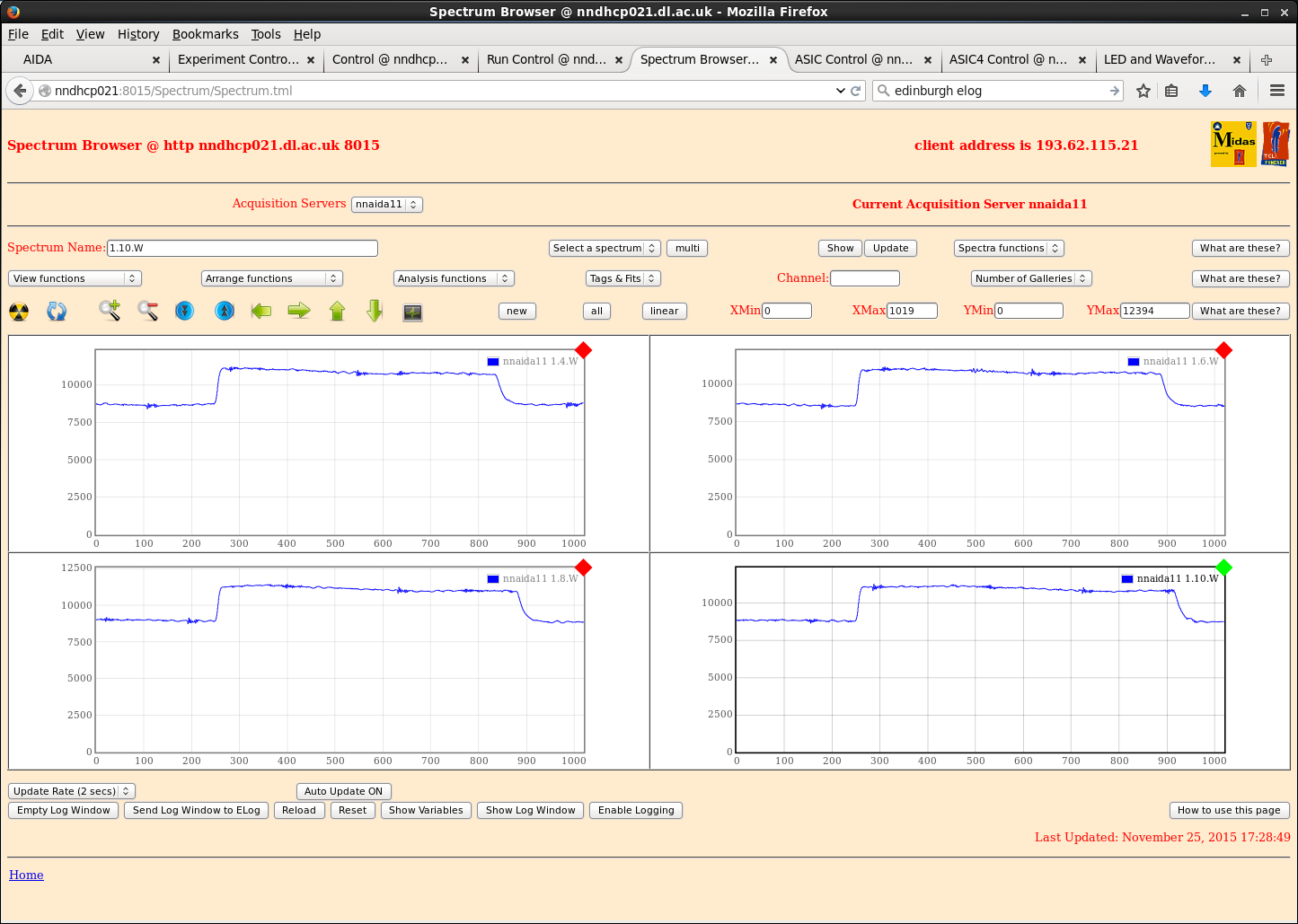
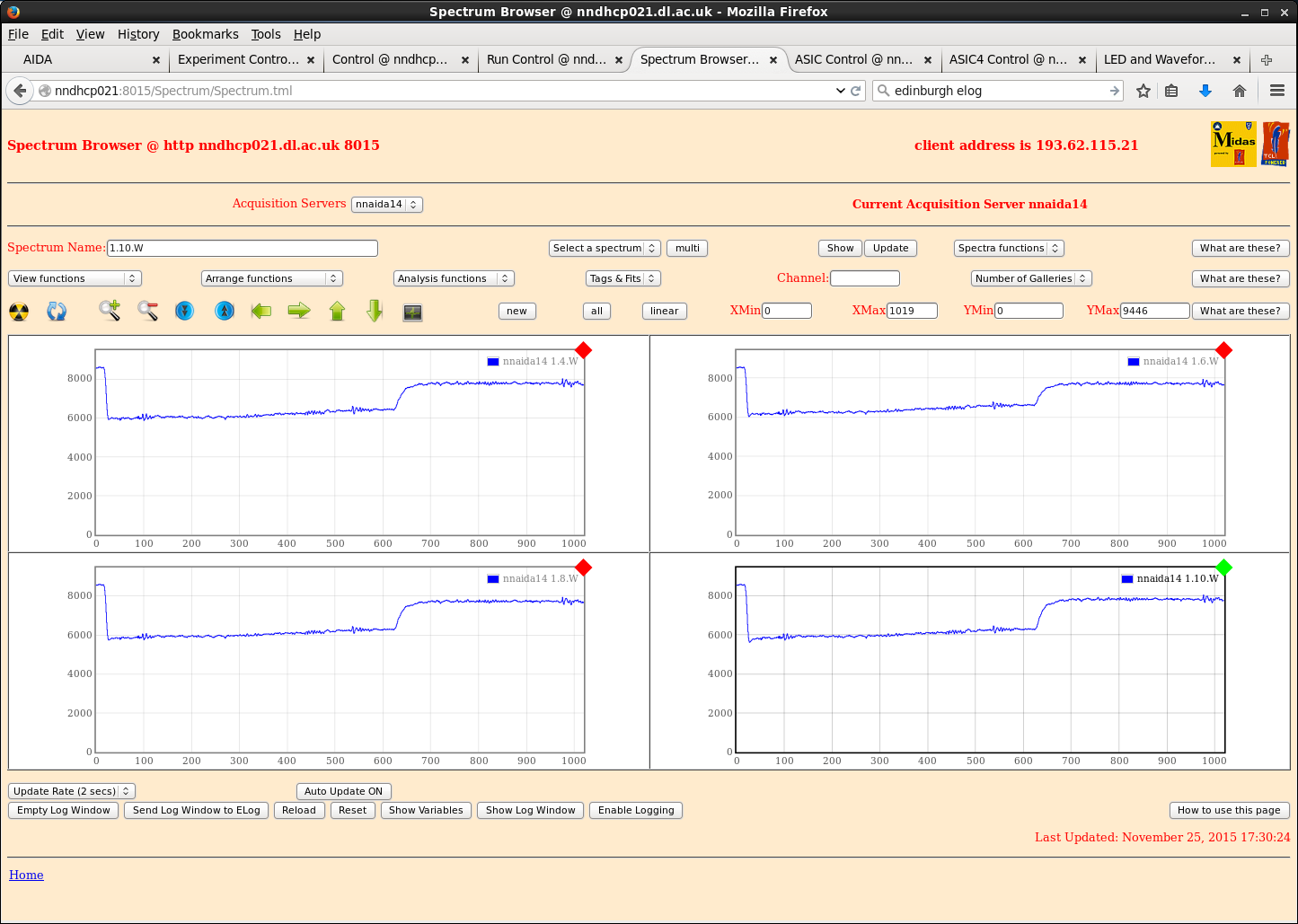
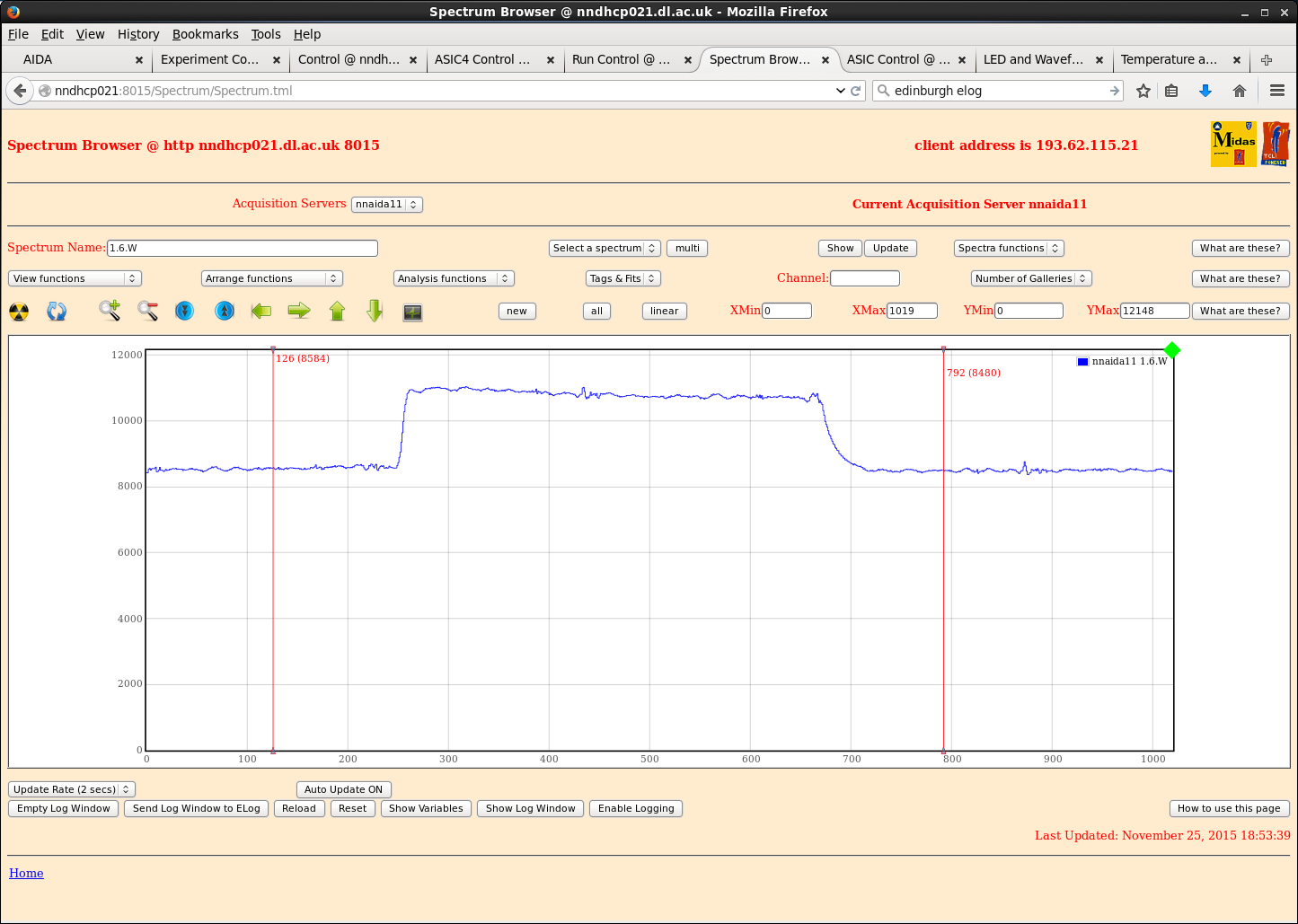
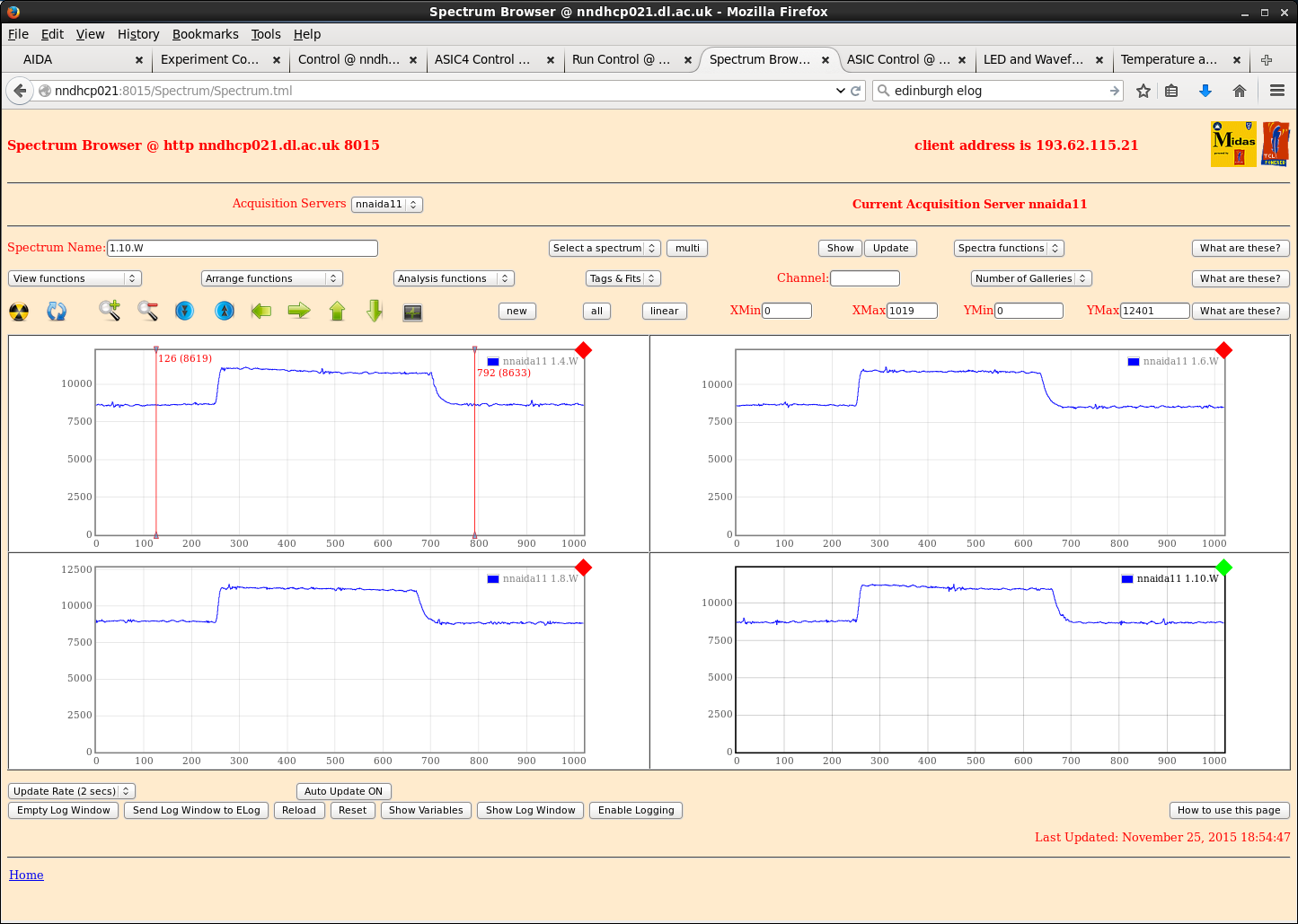
With mezzanines connected and thick braid connecting HV and pulser at LEMO connectors, see the best waveforms so far; very little noise, some transients (attachments 1+2).
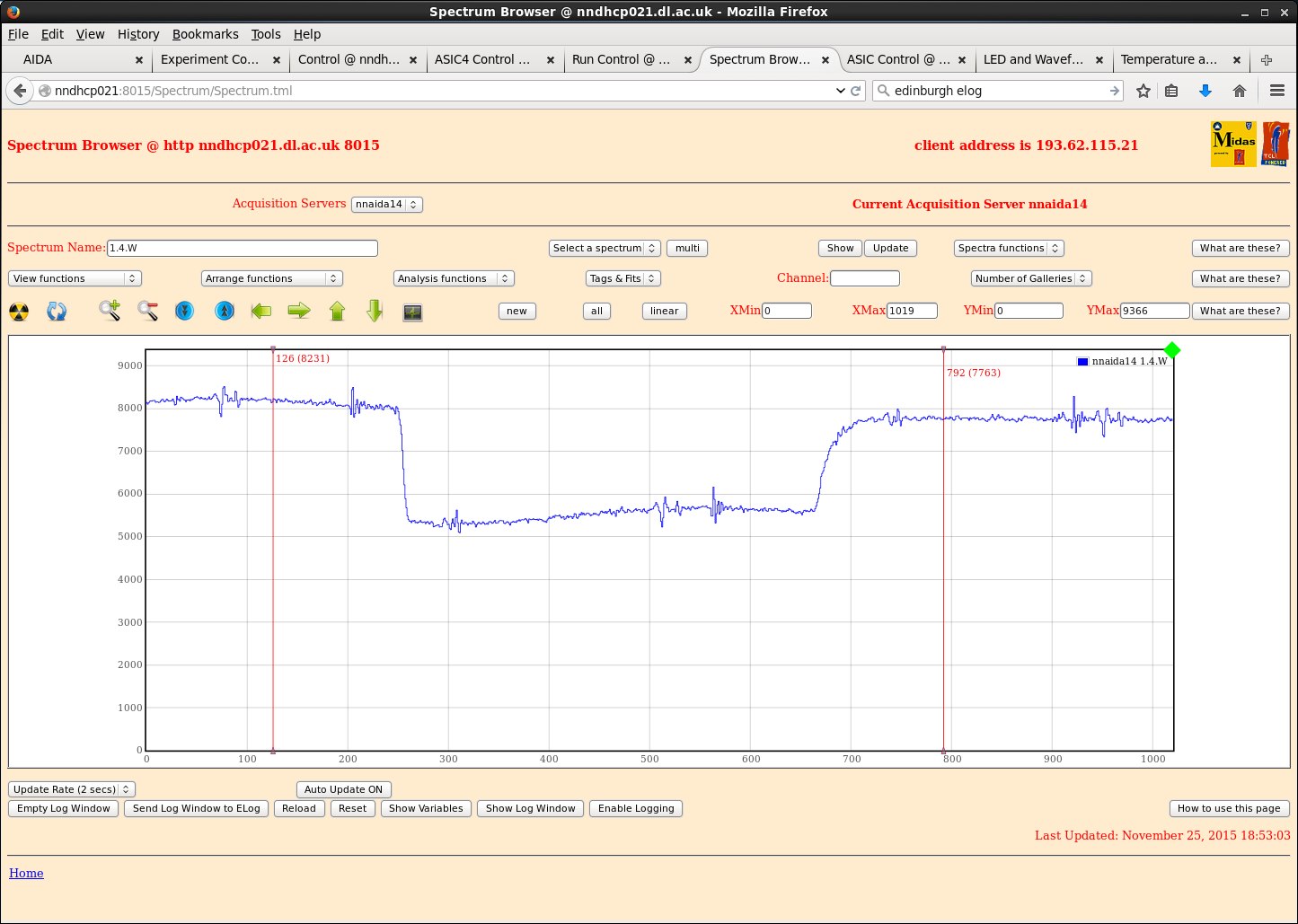
However, in nnaida14 waveform does not get back to baseline properly after a pulser event (attachments 2+3).
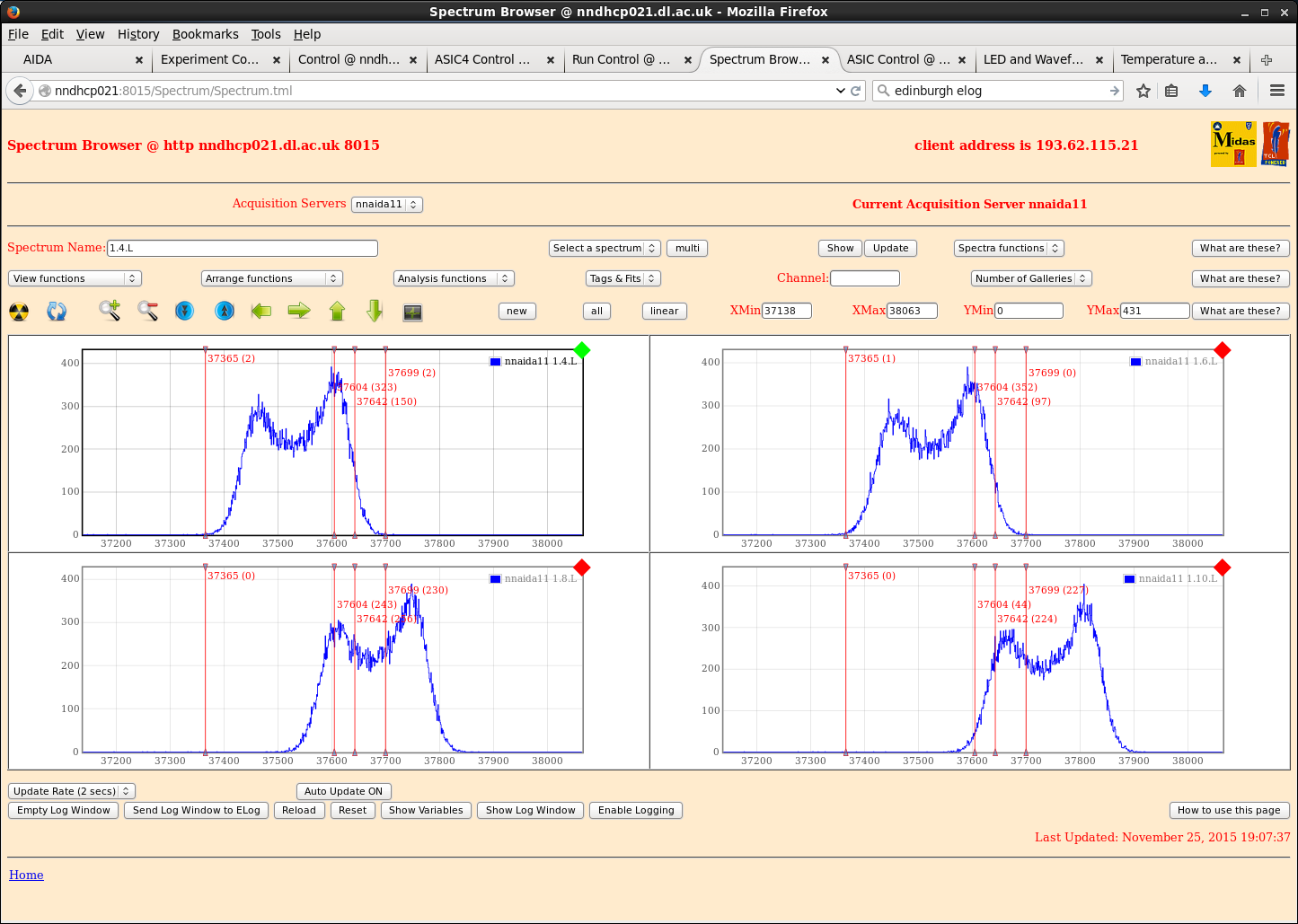
Despite very clean waveforms, still see double-peaking in spectra, although peak widths are fairly low (attachment 6).
|
| Attachment 1: nnaida11_wav_mezzConnectedPlusThickBraid.png
|
|
| Attachment 2: nnaida14_wav_mezzConnectedPlusThickBraid.png
|
|
| Attachment 3: nnaida14_wav_resetDiff.png
|
|
| Attachment 4: nnaida11_wav.png
|
|
| Attachment 5: nnaida1_wav_multi.png
|
|
| Attachment 6: nnaida11_spec4us.png
|
|
|
|
127
|
Thu Nov 26 16:32:52 2015 |
CG, TD | New Kapton cable tests at DL |
Powered on system without issue. biased detector to -200V. Leakage current not stable, bouncing around between ~3.66 - 3.74uA. Room temp 22.0oC -> Peak widths similar to yesterday.
Changed through various permutations of jumper connections (field planes, detector grounds, bias ground reference).
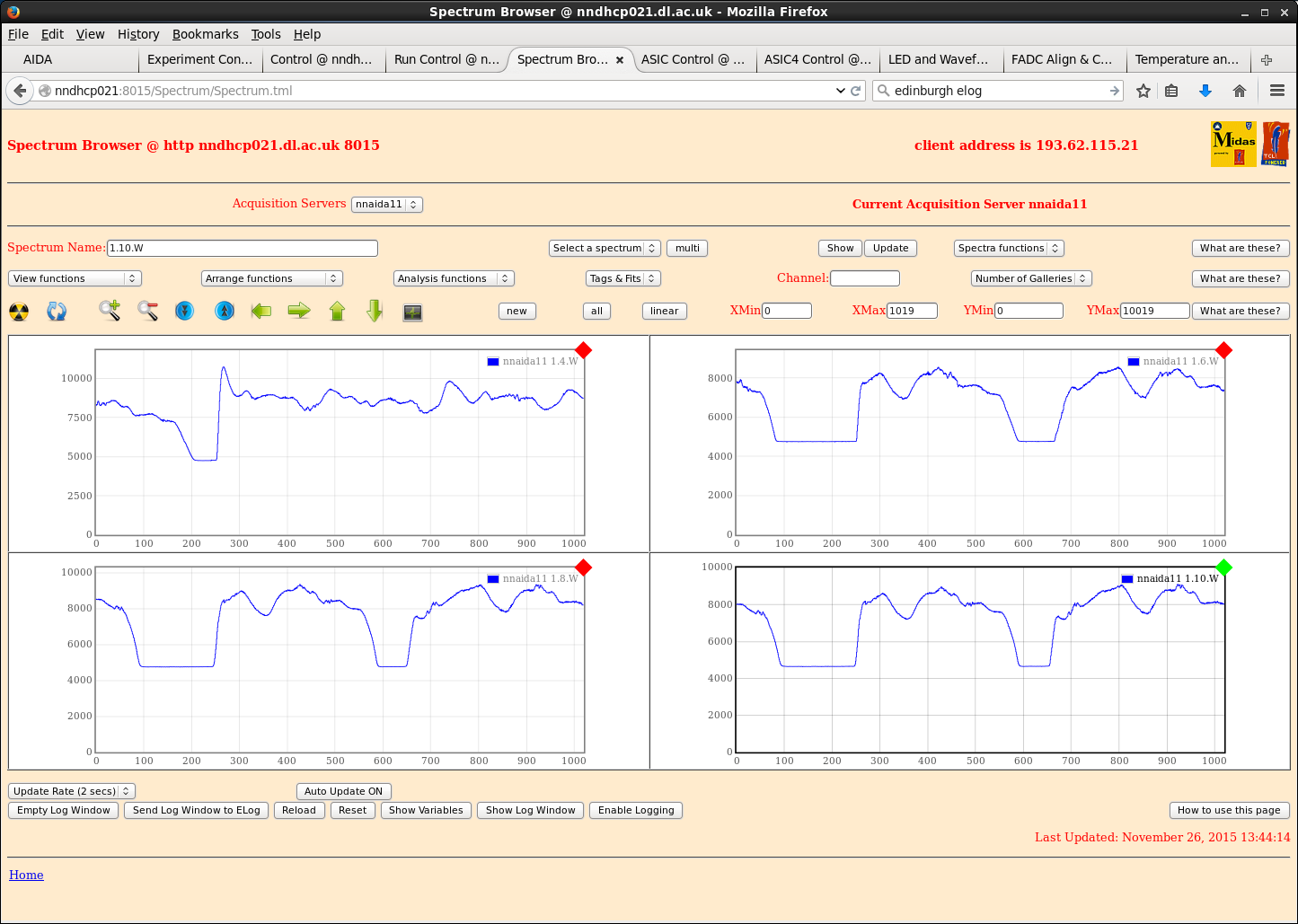
The only change that led to any change in performance was the removal of the bias ground reference jumper, this made the waveform noise much worse and increased peak widths (attachment 4).
Changed the network cables to unshielded (no ground connection) ones. No difference in performance.
Connecting thick Cu braid from NIM bin chasis to LEMO connectors makes noise worse.
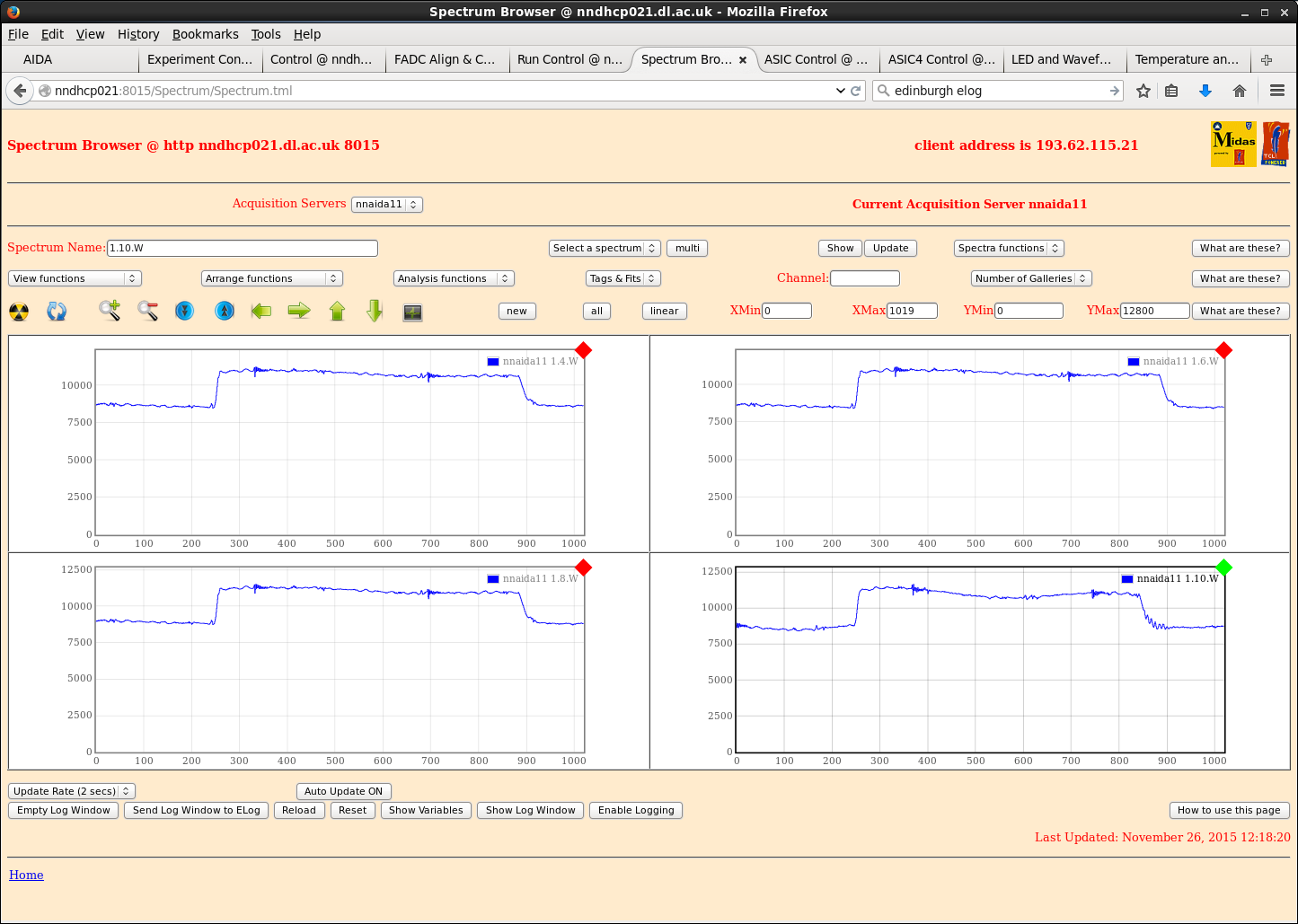
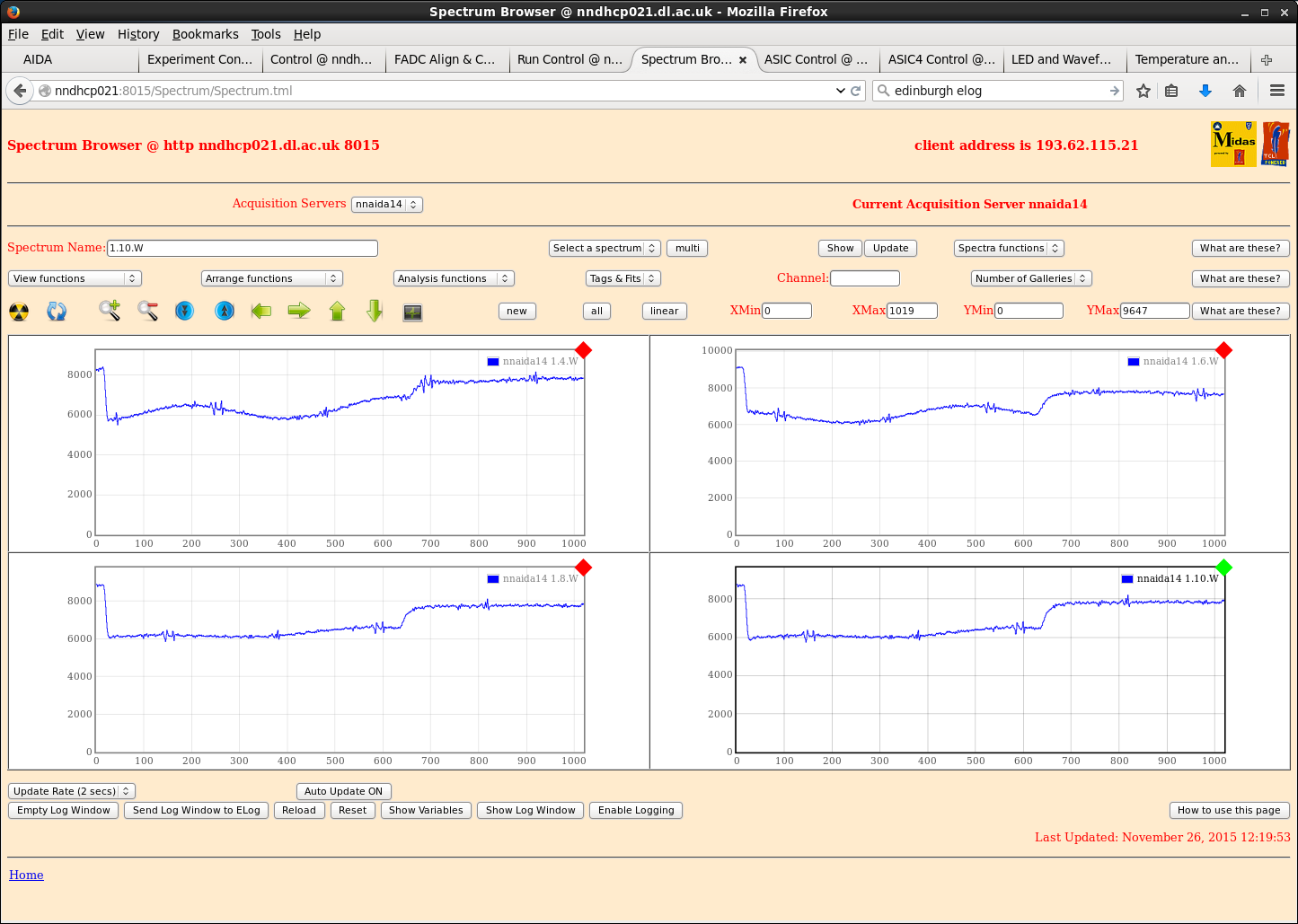
Moving this braid to the PSU case made peak widths larger and waveform noise in nnaida14 much worse. Traces do not return to baseline after a pulser event (attachment 2+3)
Reduced bias to -100V in an attempt to stabilise the jumpy leakage current -> made it worse.
Increased to -250V and the leakage current stability improved -> fluctuations of < 0.10uA @ 4.985uA.
Connected Al detector box with thick braid to braid connecting HV and pulser input -> no difference.
Replaced metal detector box with cardboard box so it was floating -> no difference.
Made sure kaptons were all separated with sheets of paper to prevent electrical contact of shielding -> no difference.
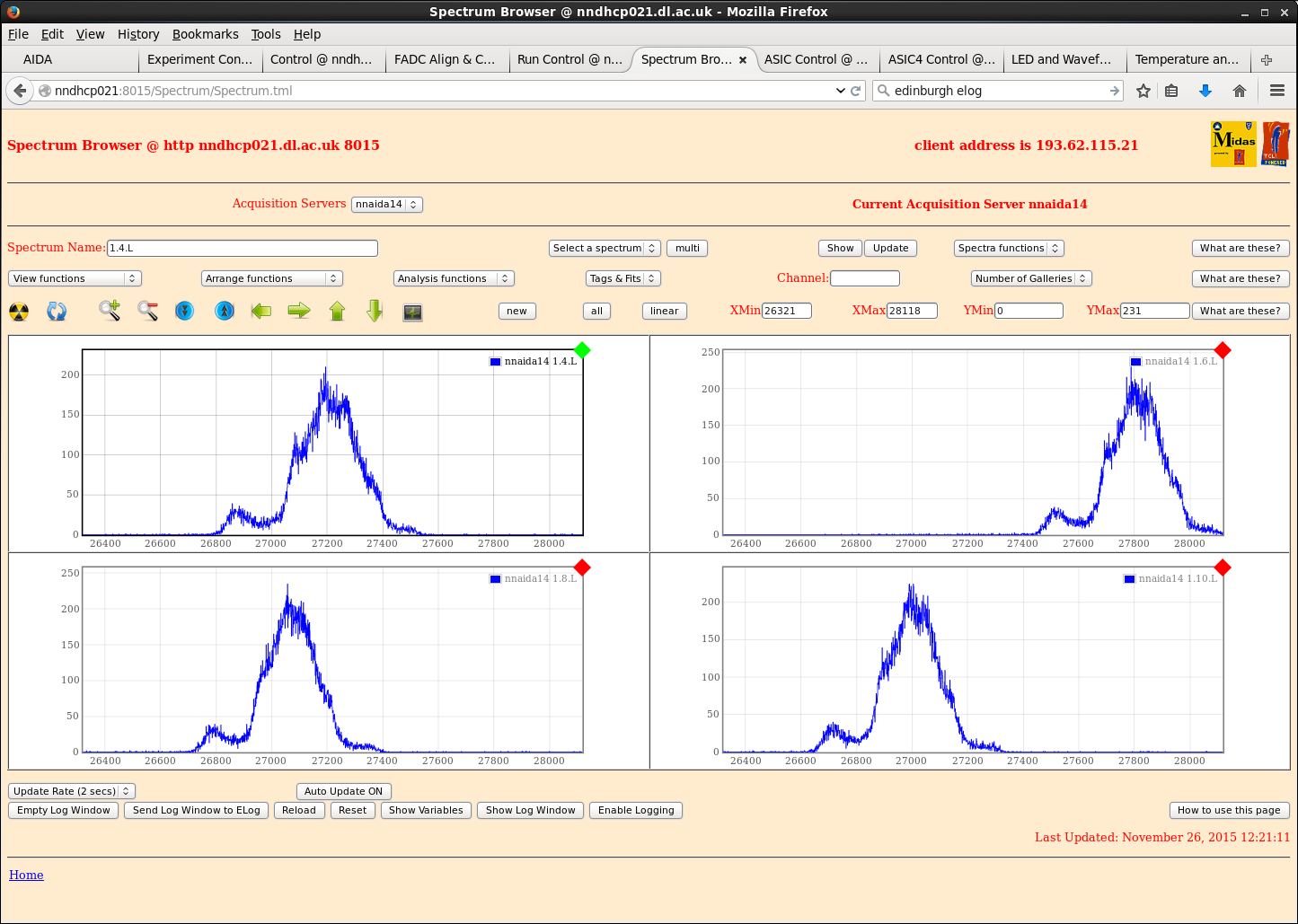
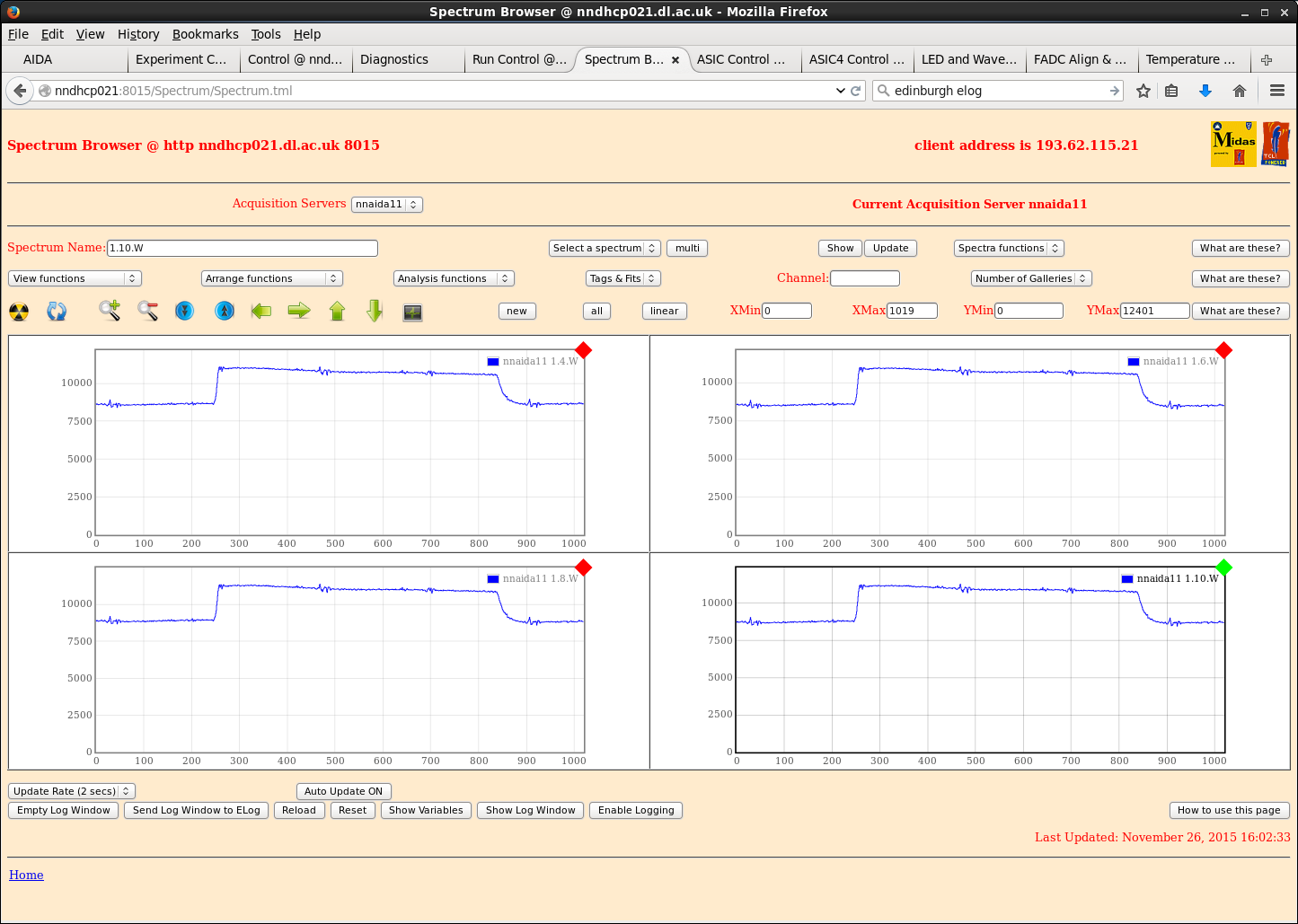
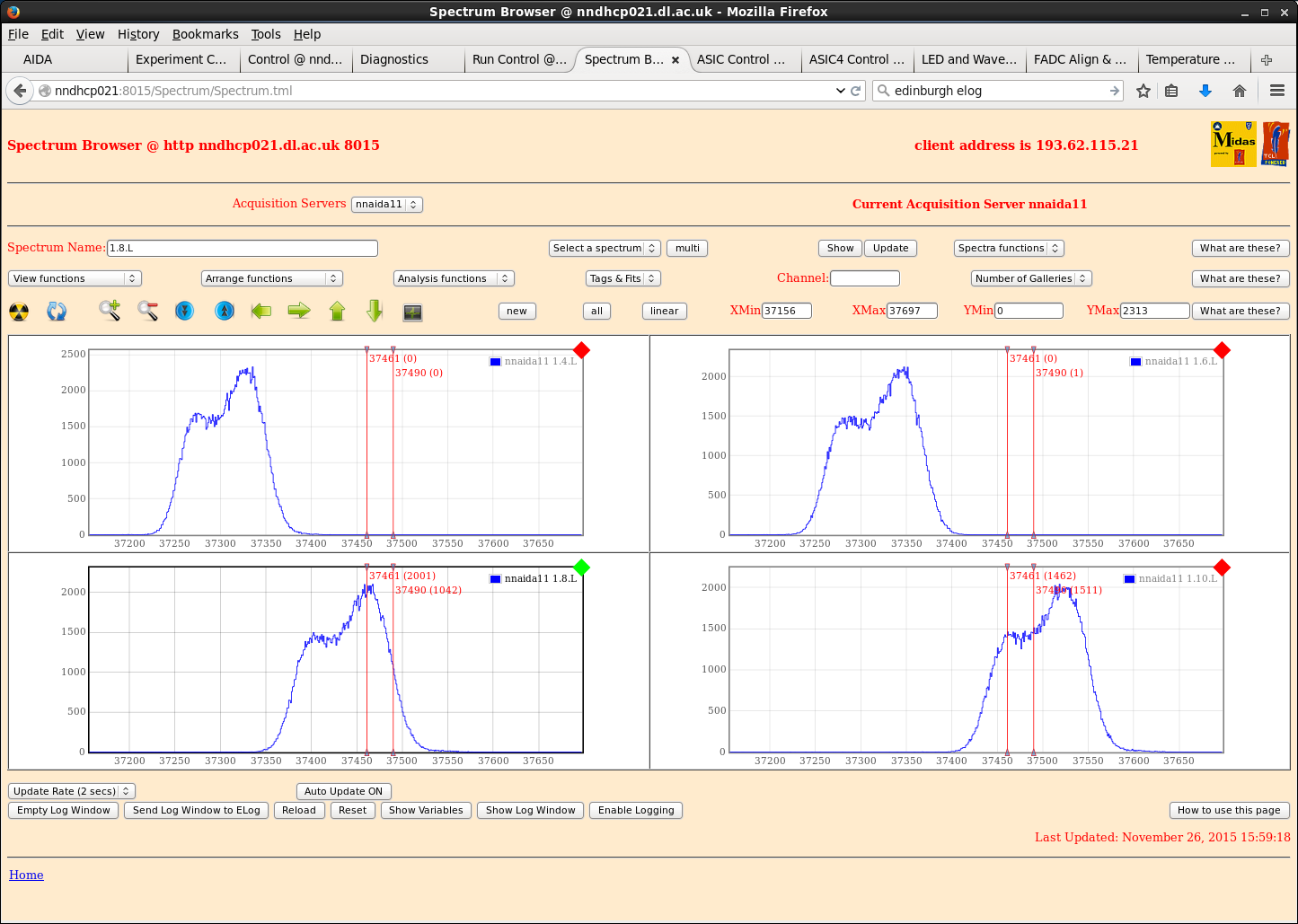
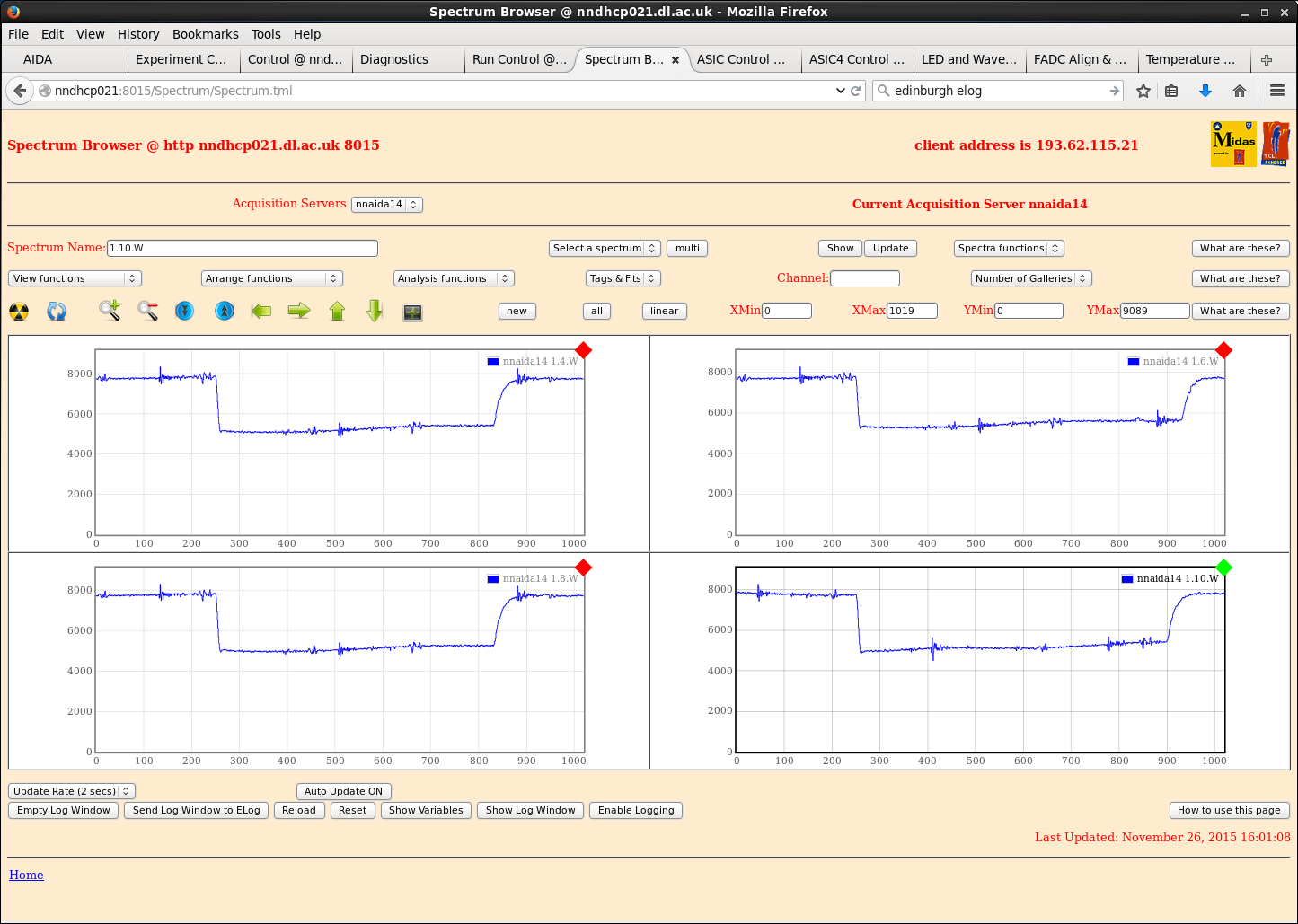
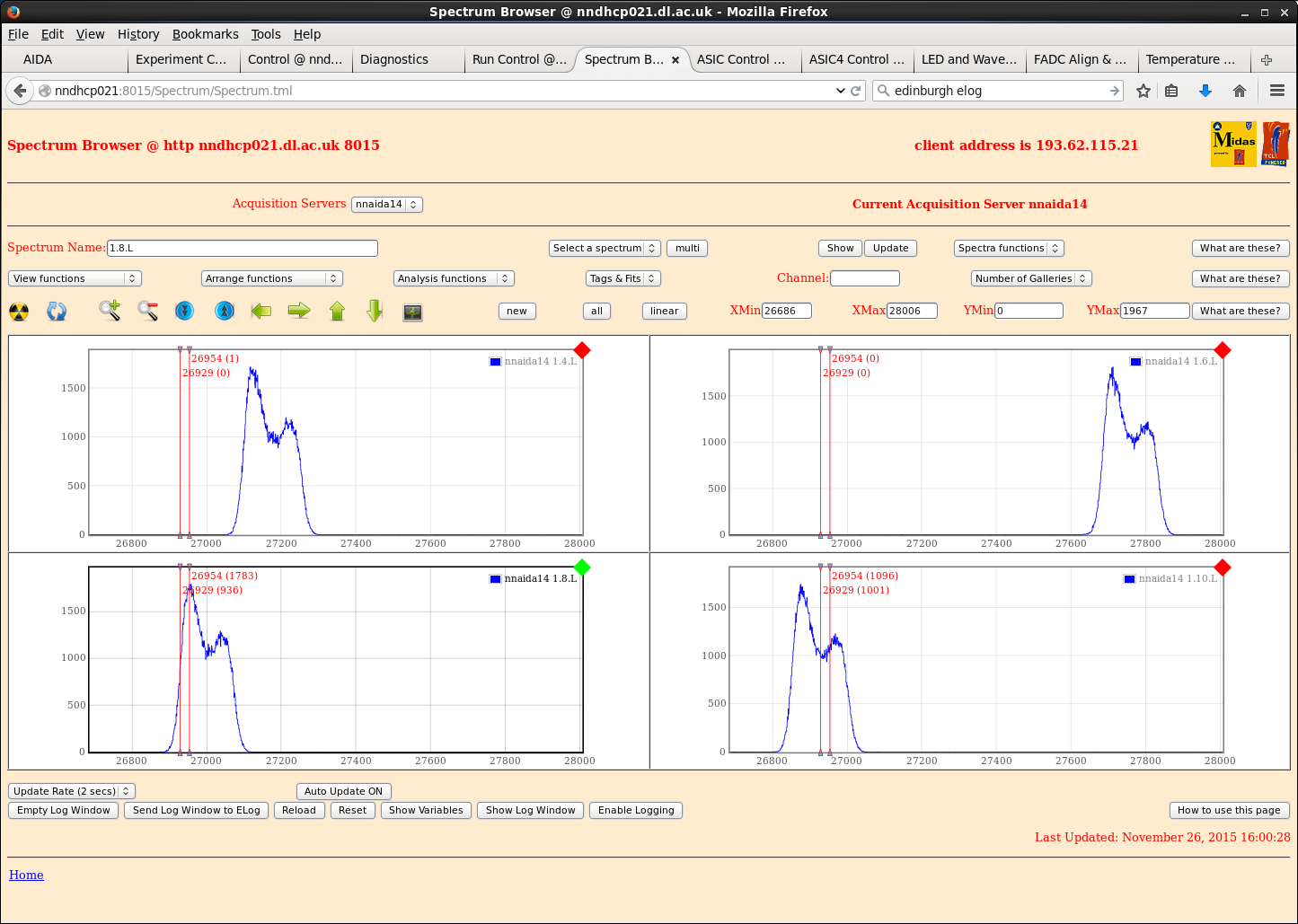
Disconnected detector and found double-peaking remains => this is not a detector issue, but intrinsic to the kaptons (with the kaptons removed, we observe Gaussian peaks of width ~14ch) (attachments 5-9).
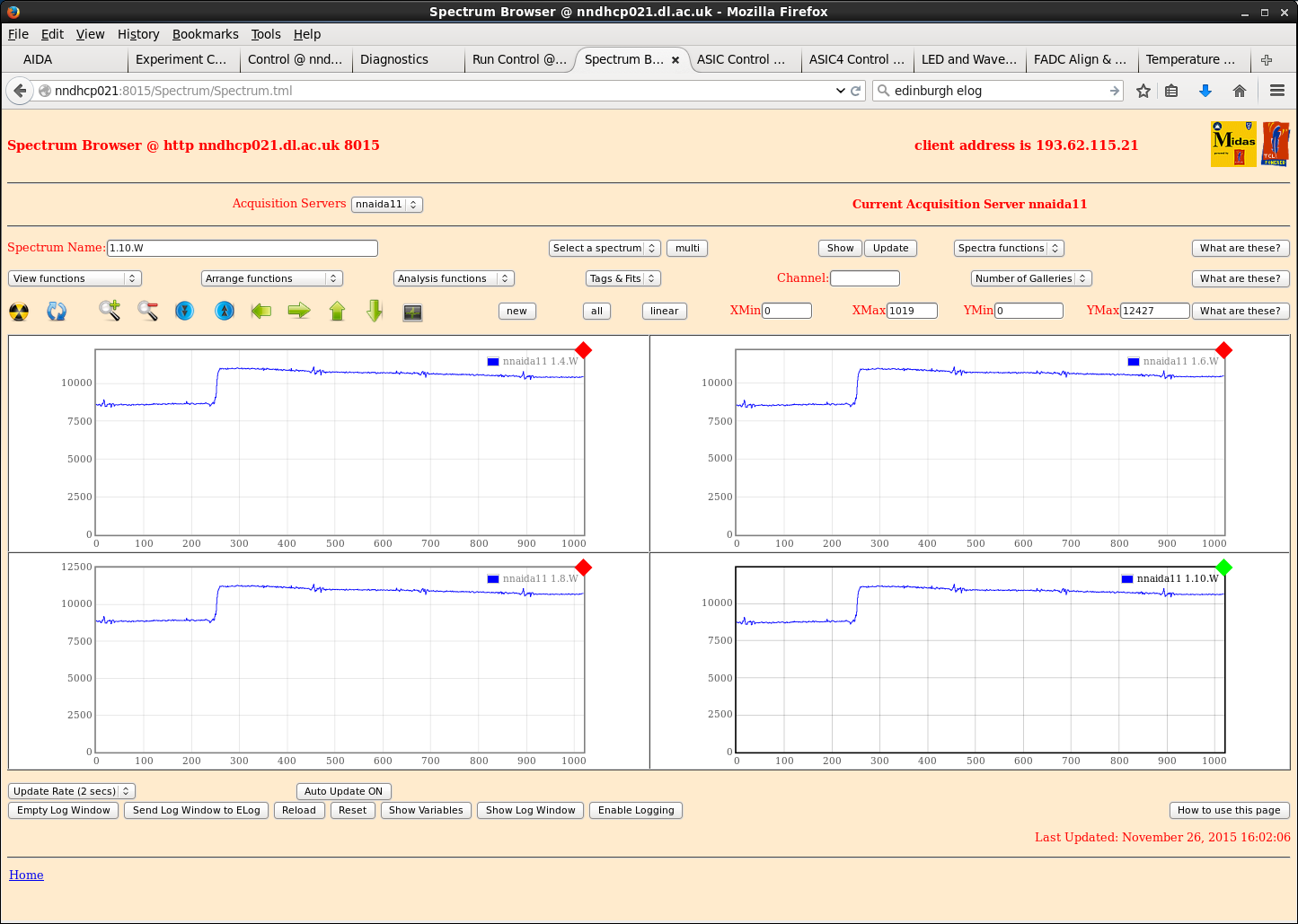
Occasionally, waveforms fail to reset correctly (attachment 7).
Cu mezzanine block and Al crate now no longer isolated from each other. Resistance between them ~6 Ohms with crate locked up, increases to ~300kOhms when crate opened. |
| Attachment 1: nnaida11_wav_braidToPSU.png
|
|
| Attachment 2: nnaida14_wav_braidToPSU.png
|
|
| Attachment 3: nnaida14_spec_braidToPSU.png
|
|
| Attachment 4: nnaida11_wav_biasGroundRefJumperOff.png
|
|
| Attachment 5: nnaida11_wav_noDetector.png
|
|
| Attachment 6: nnaida11_spec_noDetector.png
|
|
| Attachment 7: nnaida11_wav_notResetting.png
|
|
| Attachment 8: nnaida14_wav_noDetector.png
|
|
| Attachment 9: nnaida14_spec_noDetector.png
|
|
|
|
128
|
Wed Dec 2 18:39:44 2015 |
CG | New Kapton cable tests at DL |
Powered on system ok.
Electrical connection between crate and mezzanines still persists, but only to the top cool plate (no connection to the bottom or sides), eith resistance ~5-10 ohms
Seems to have no effect on performance though as without the kaptons connected, still see pulser widths of ~14ch at t_shape = 8us.
Connecting cables reinstates double peaking in n-side.
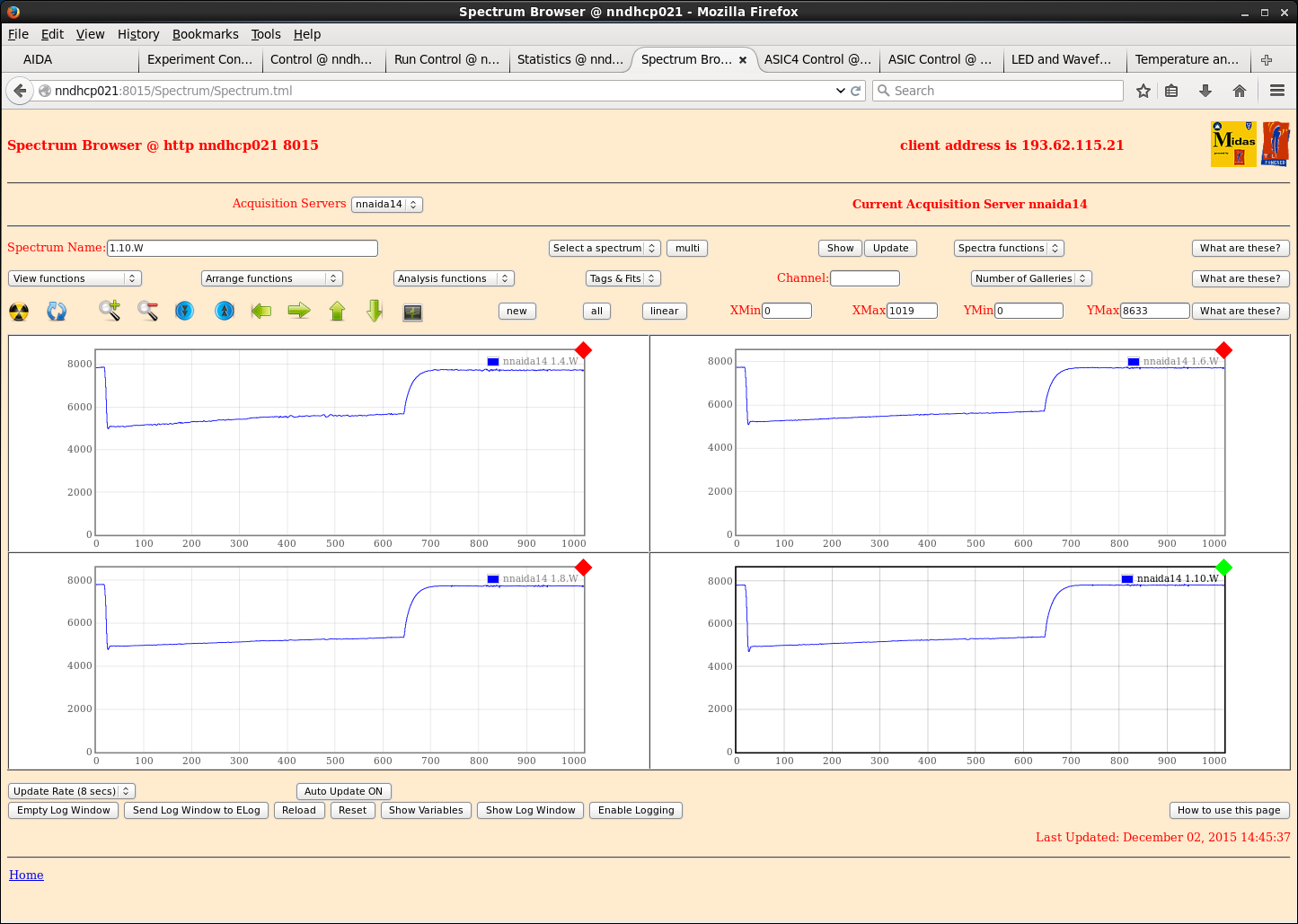
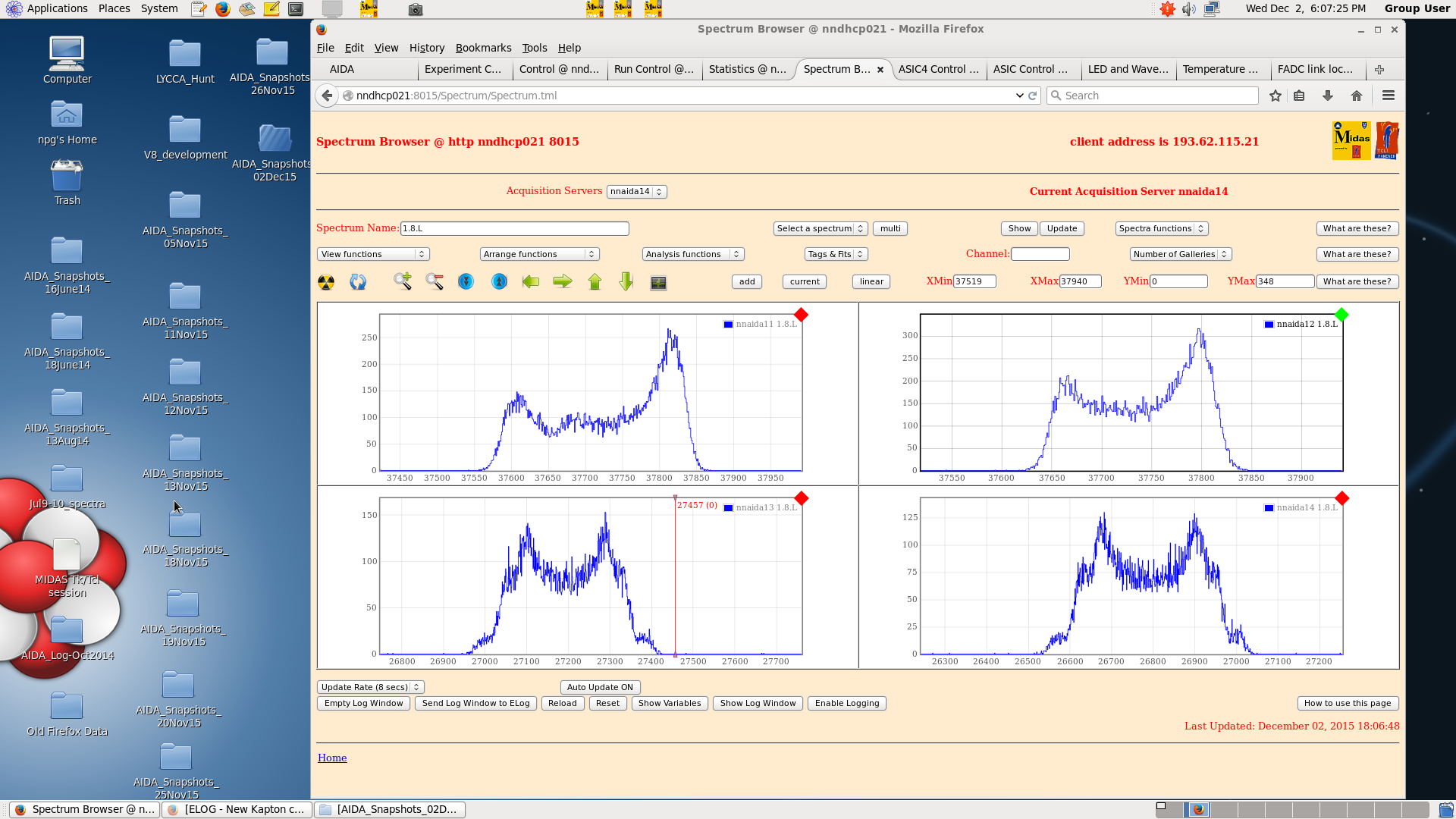
Without HV or detector connected, nnaida13+14 gibe single Gaussian peaks of width ~45ch, with almost perfect waveforms.
- Patrick saw this too, I'm not going crazy, but on zeroing histograms (didn't change a single other thing) it went back to having double peaks again.
Replaced nnaida13 shielded kapton with unshielded one to see if that is causing this effect
- still see double peaking but width of tallest peak is down by ~25% (likely just due to capacitance)
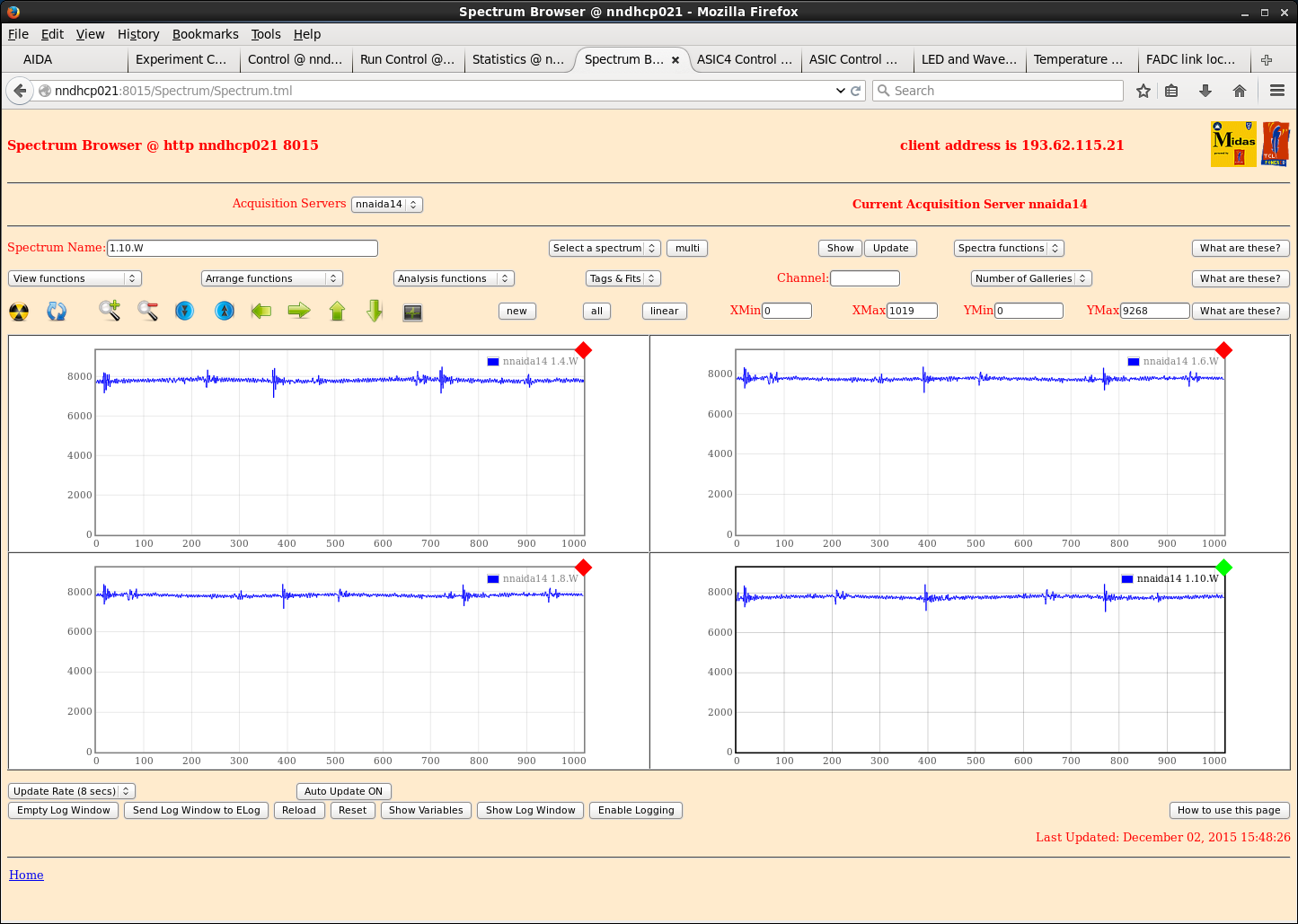
With shielding on, do see much noisier waveforms however.
- note: attachments 1 and 2 were taken using exactly the same threshold of 512. When shielded, bumping this up to 1000 still made little difference and 'actual' traces were only caught ~25% of the time
Changed firmware to V8.
No difference in performance.
|
| Attachment 1: nnaida14_wav_noHVnoDetNoShielding.png
|
|
| Attachment 2: nnaida14_wav_noHVnoDetWithShielding.png
|
|
| Attachment 3: all1.8.L_noDetShaping2us.png
|
|
|
|
130
|
Thu Dec 3 16:28:46 2015 |
CG, TD | New Kapton cable tests at DL |
Spent whole day trying to isolate mezzanines from cooling crate.
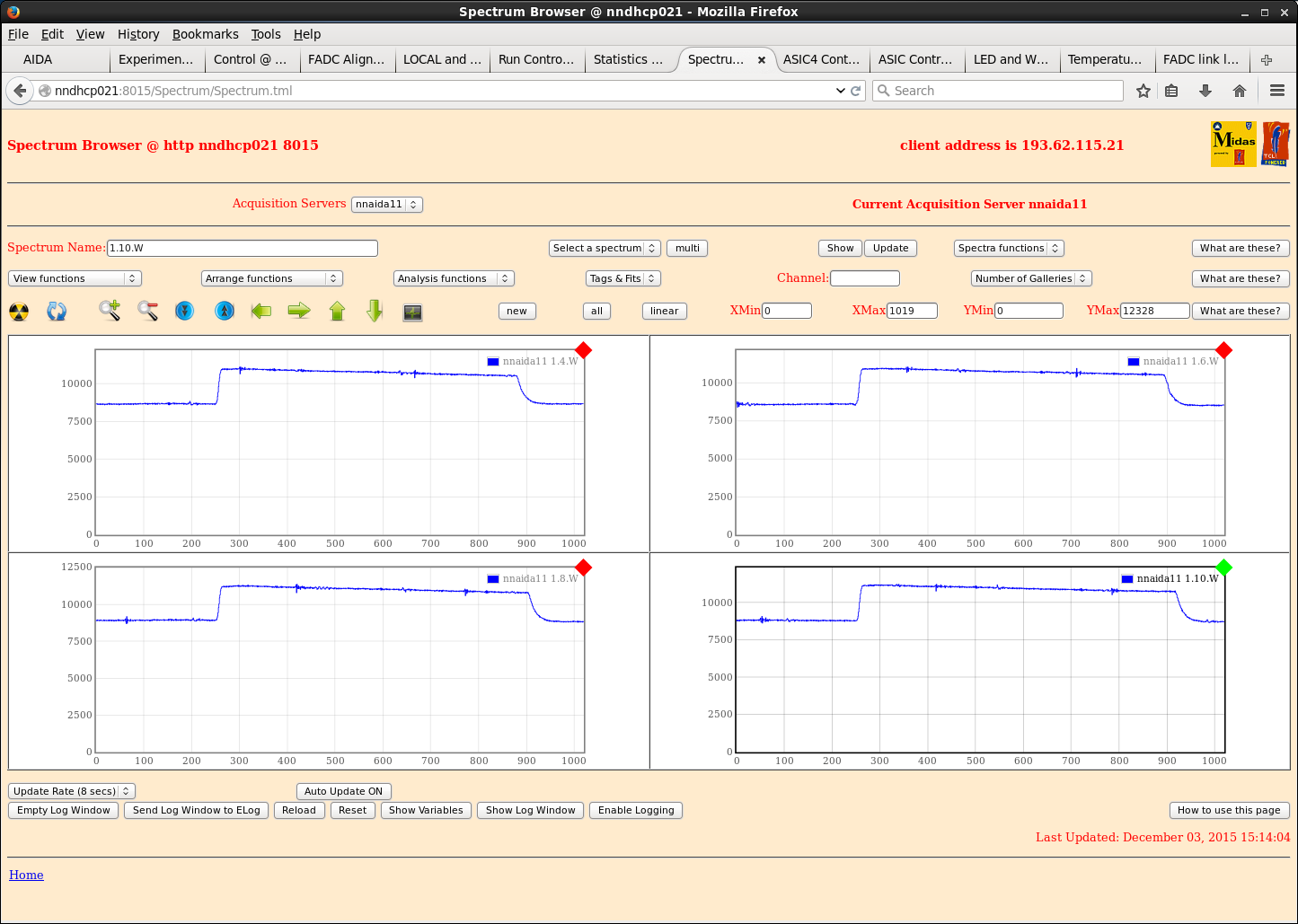
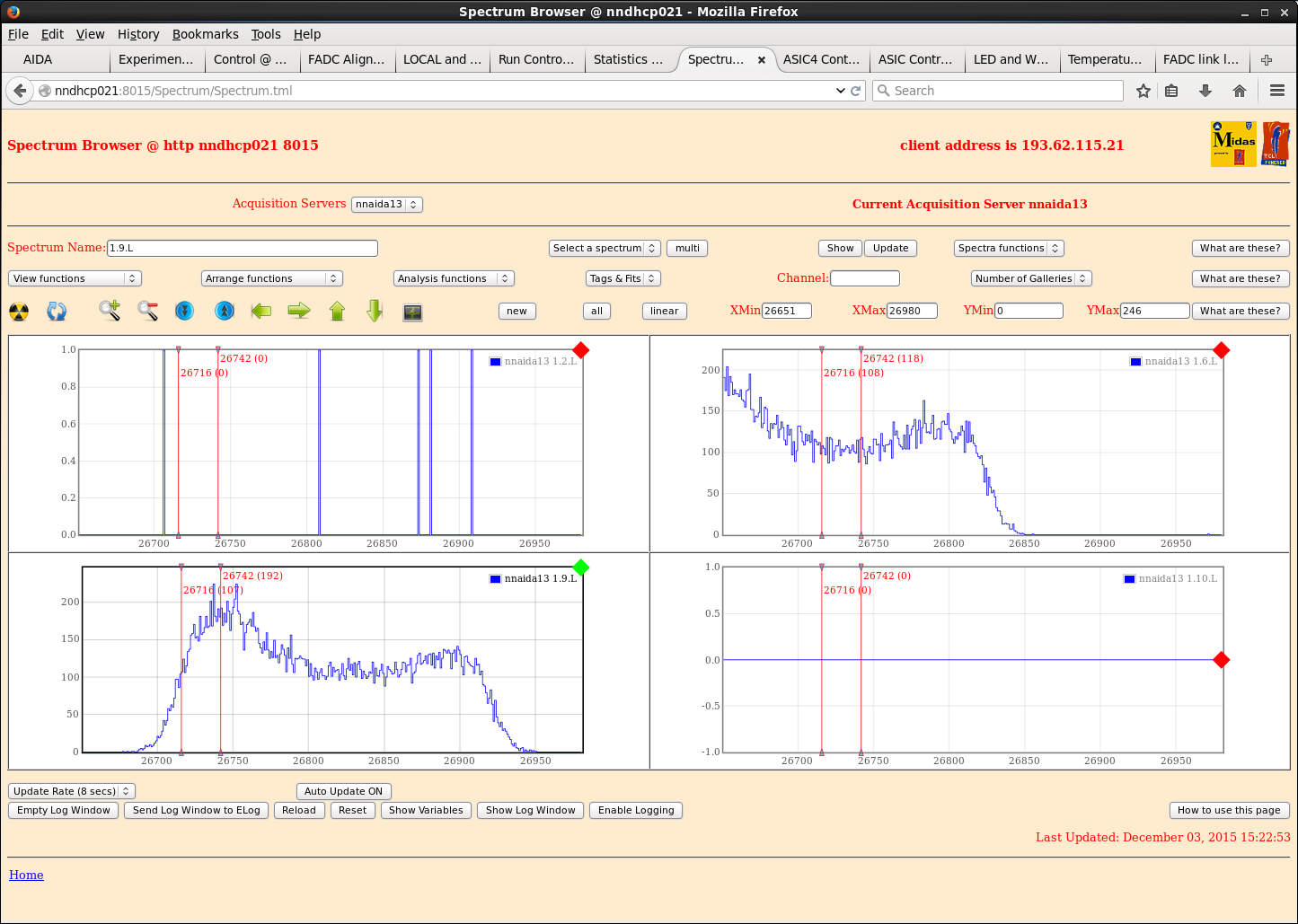
Finally managed to increase resistance between crate and mezzanines from ~5 Ohms to ~380 kOhms with some masking tape and parcel tape over the slots in the FEE modules in which rest the guide pins on the bottom of cooling crate.
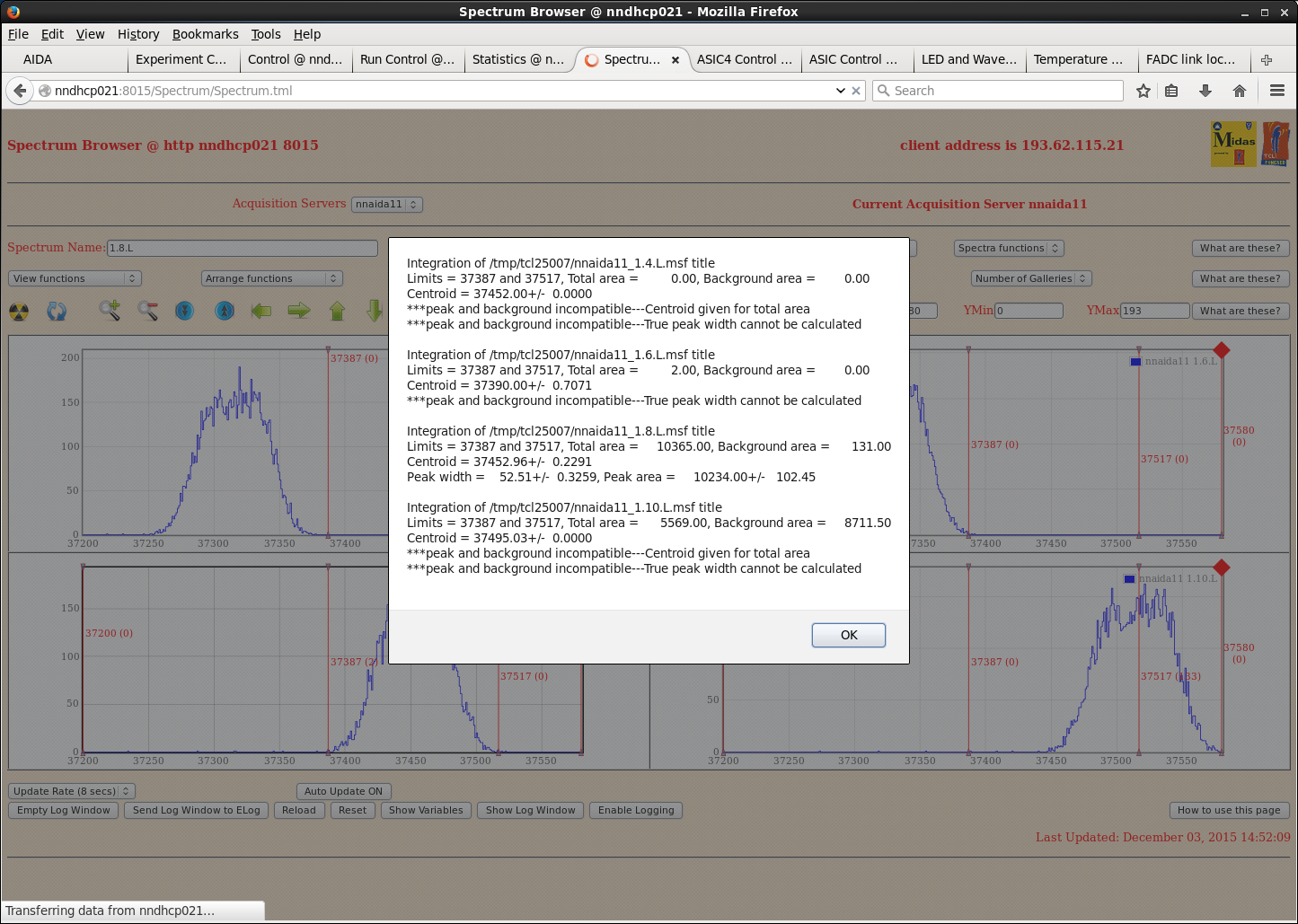
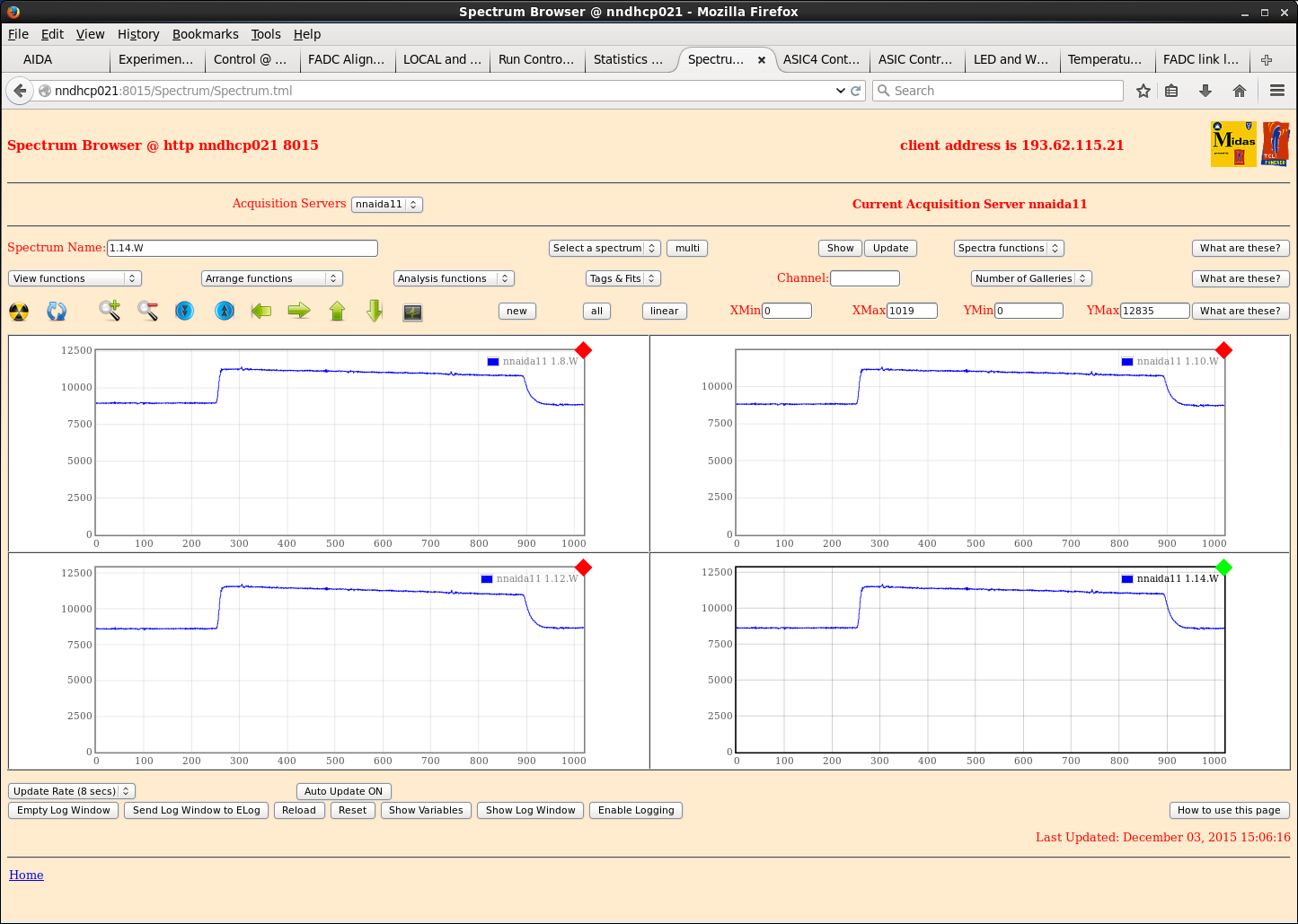
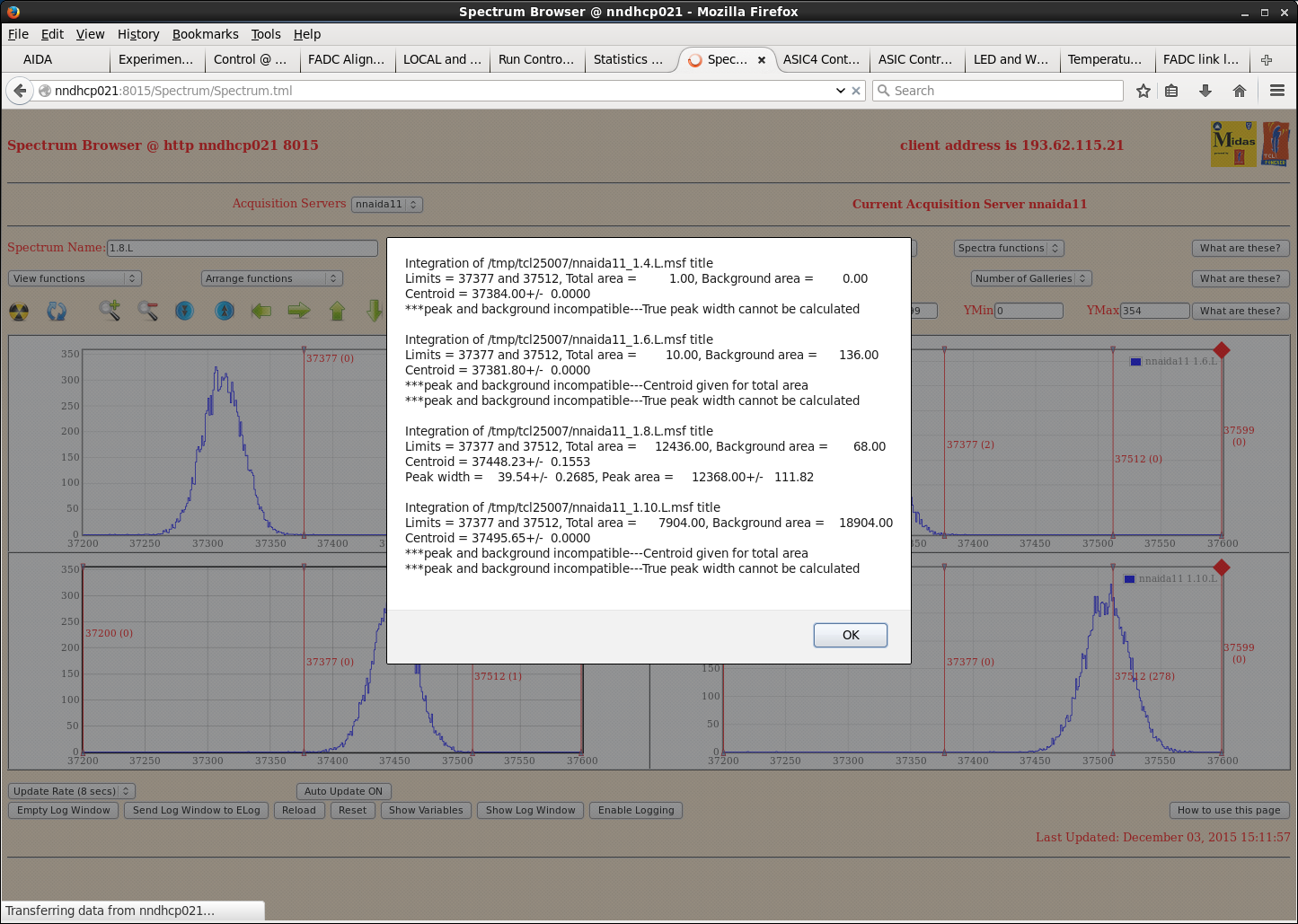
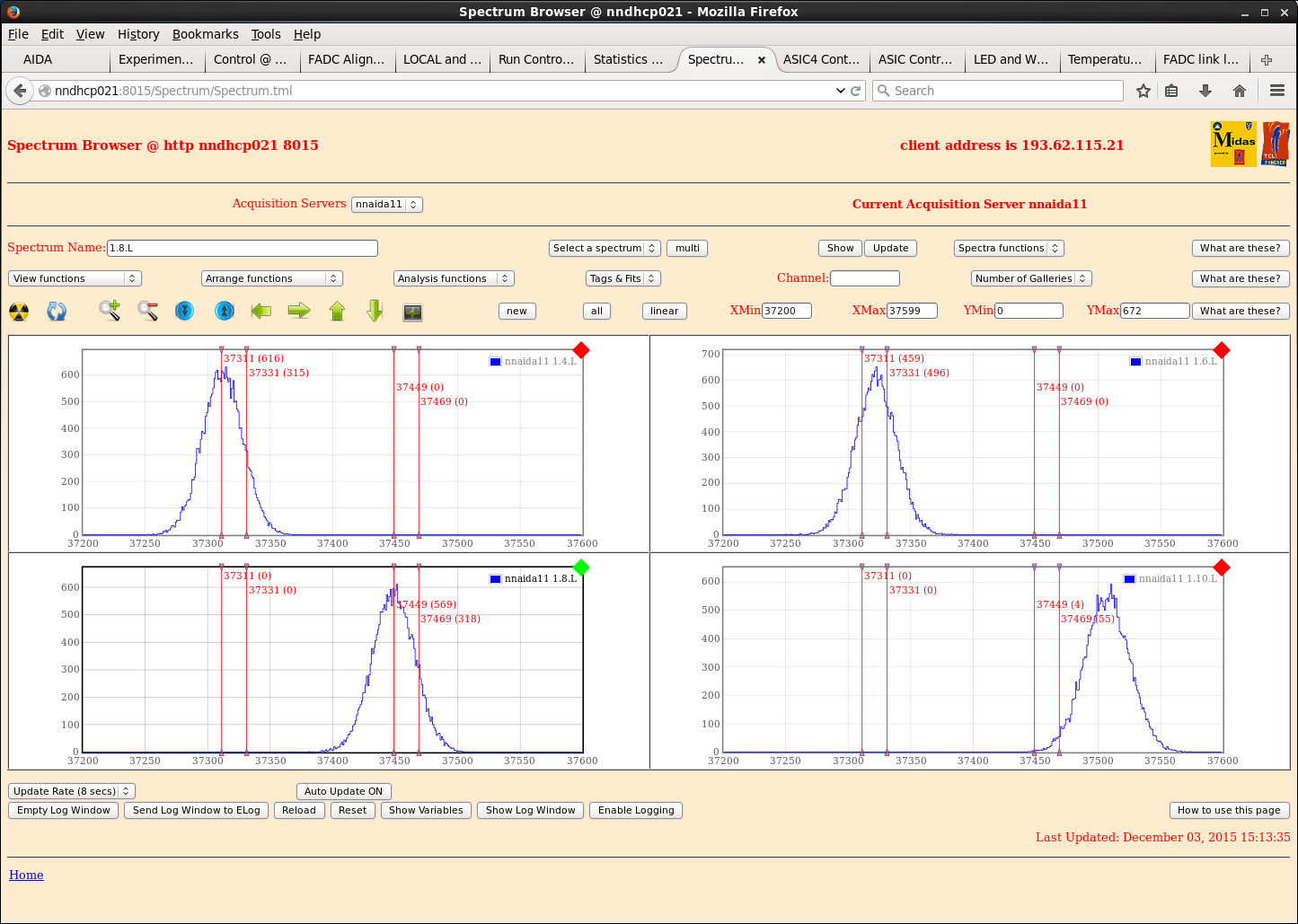
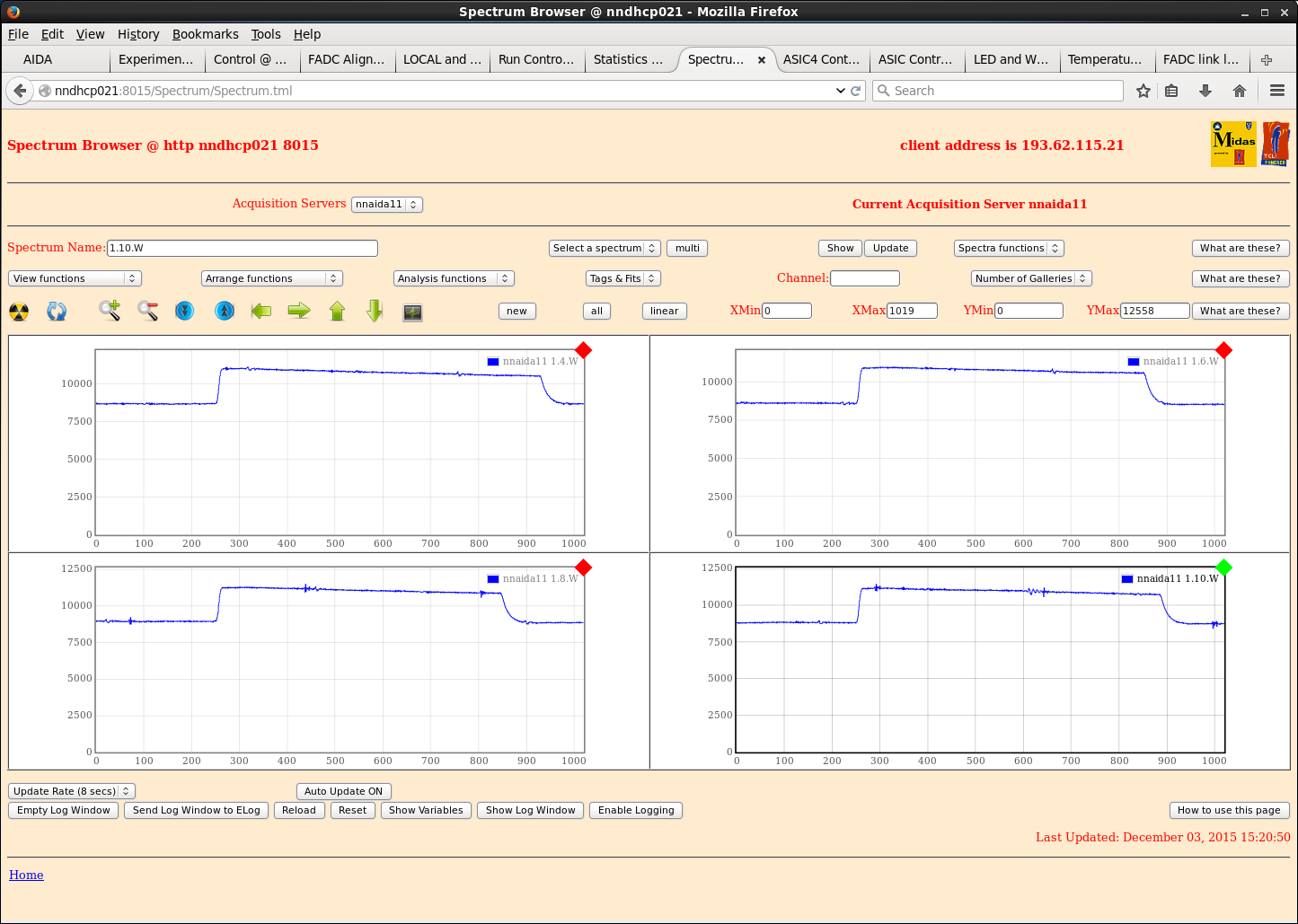
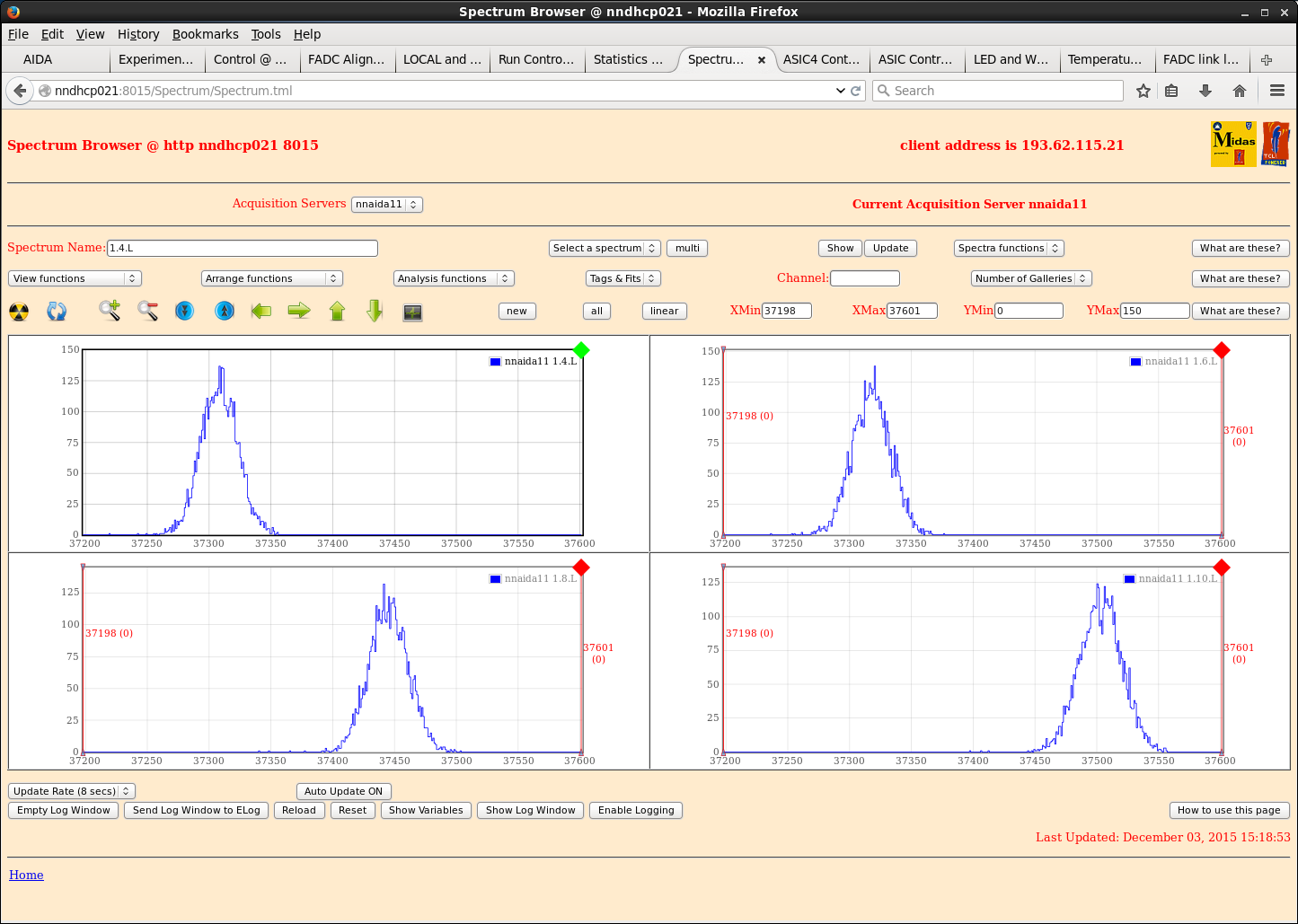
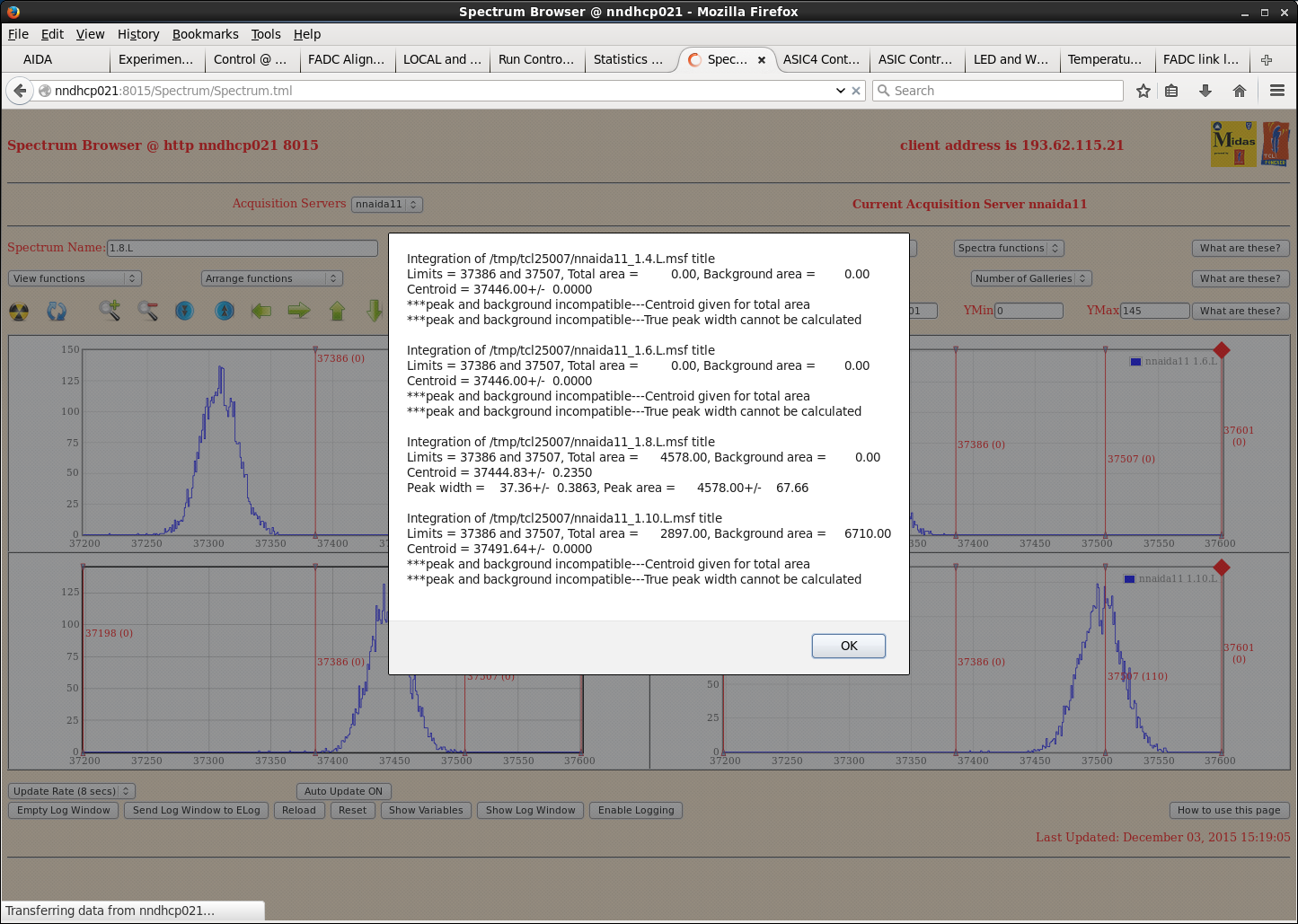
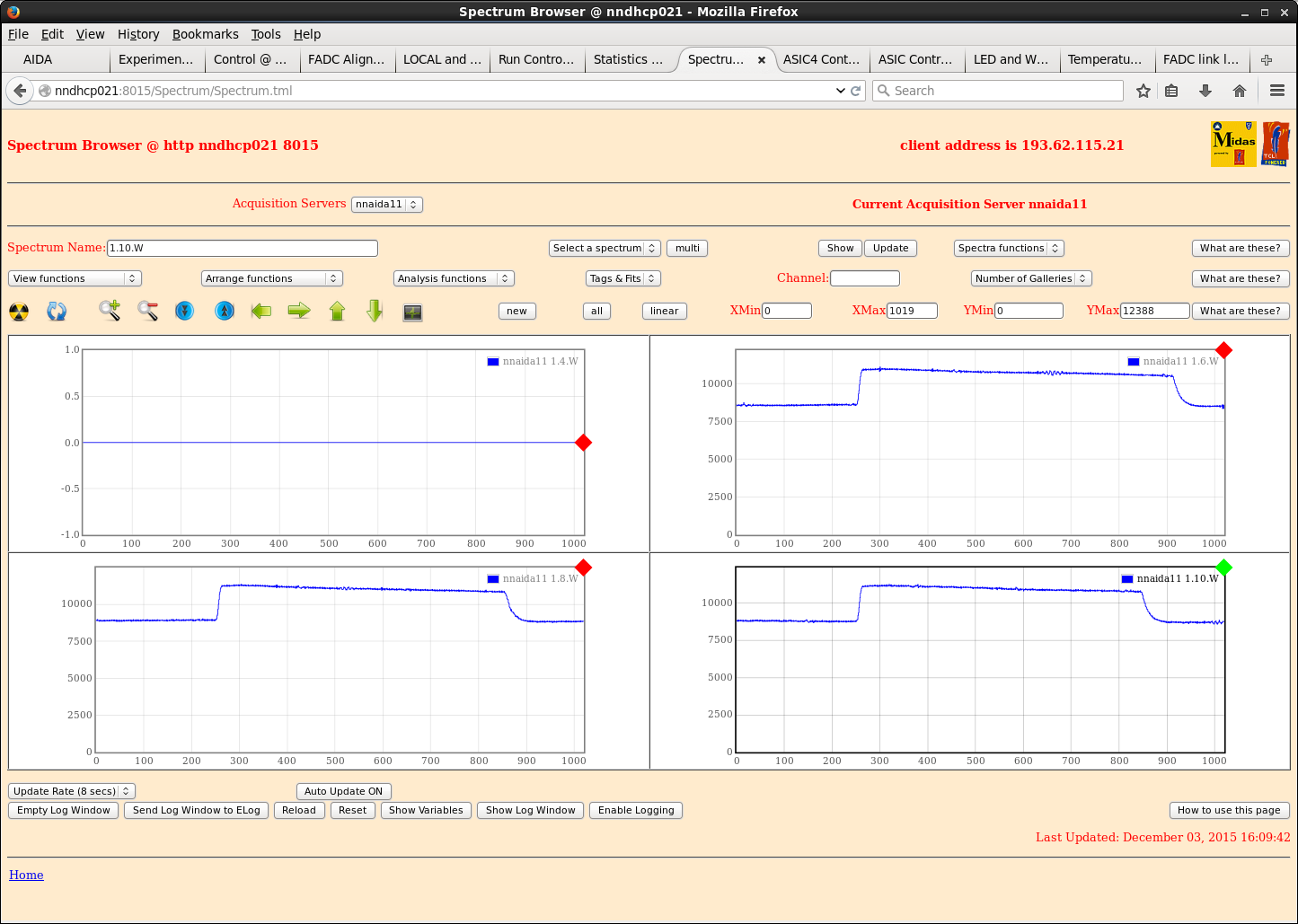
See excellent performance in nnaida11, with peak widths down to ~45ch and almost perfectly smooth waveforms.
- this is with just the kaptons connected (all of which are shielded with tape) and no detector. Shaping time of 8us.
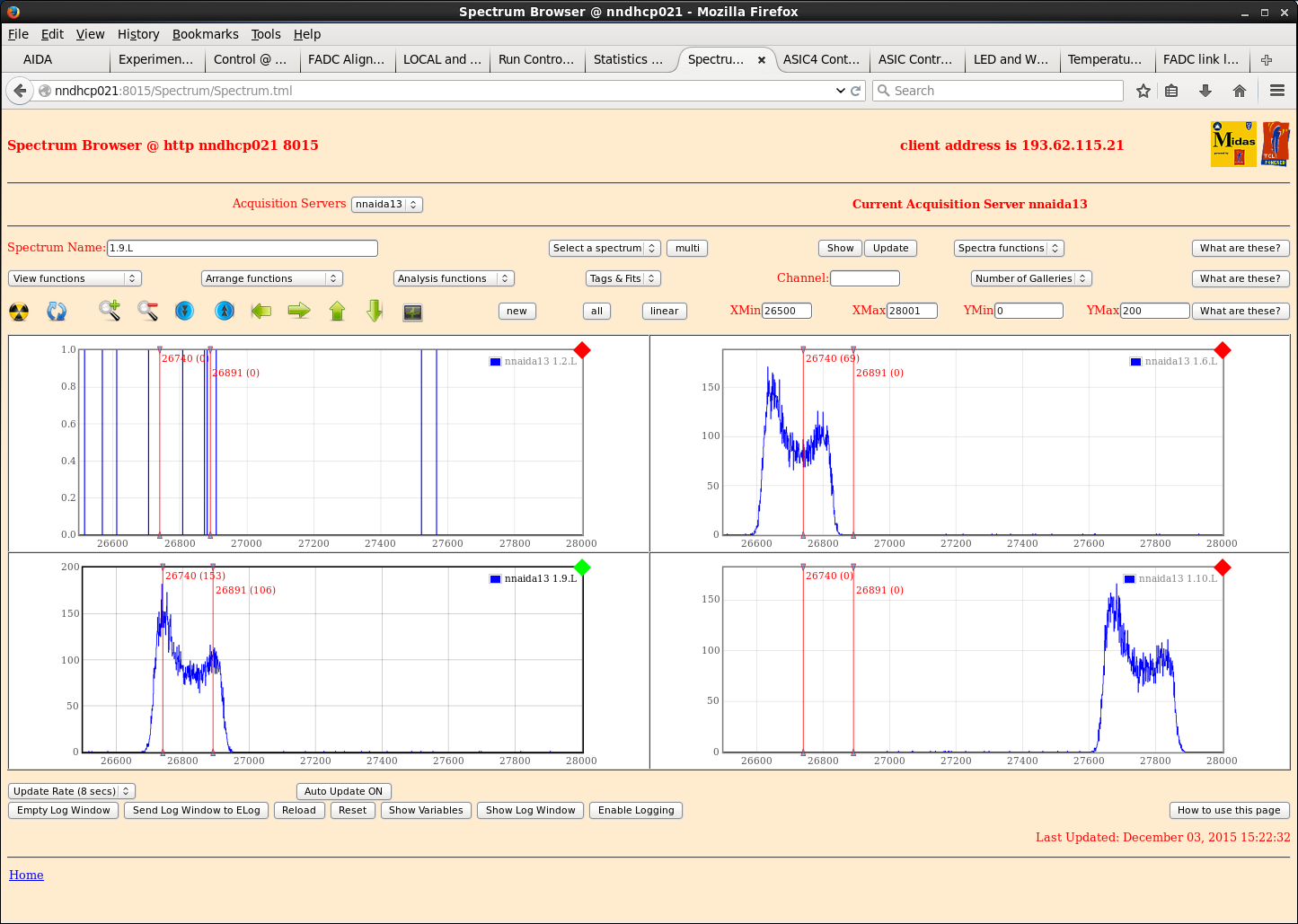
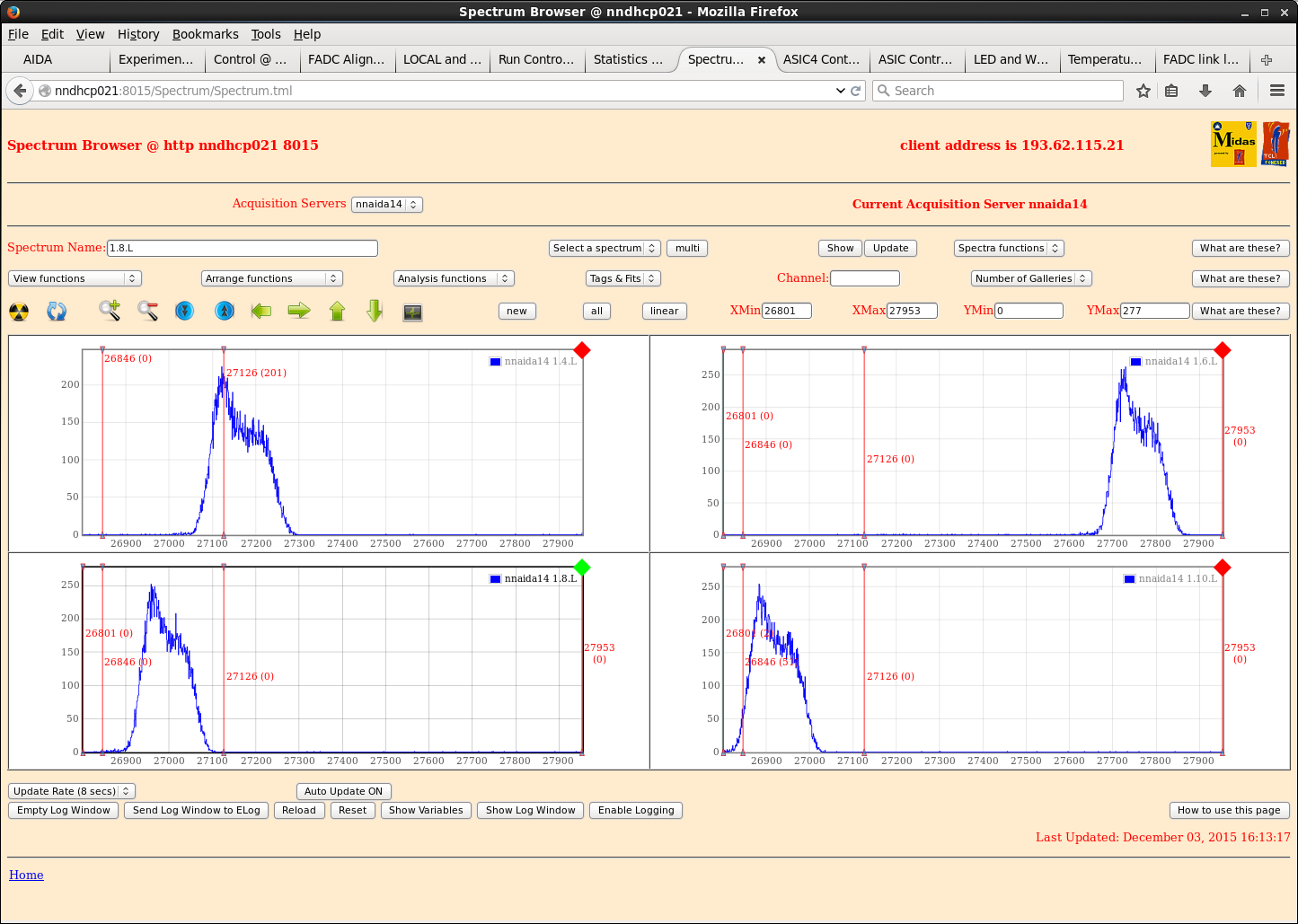
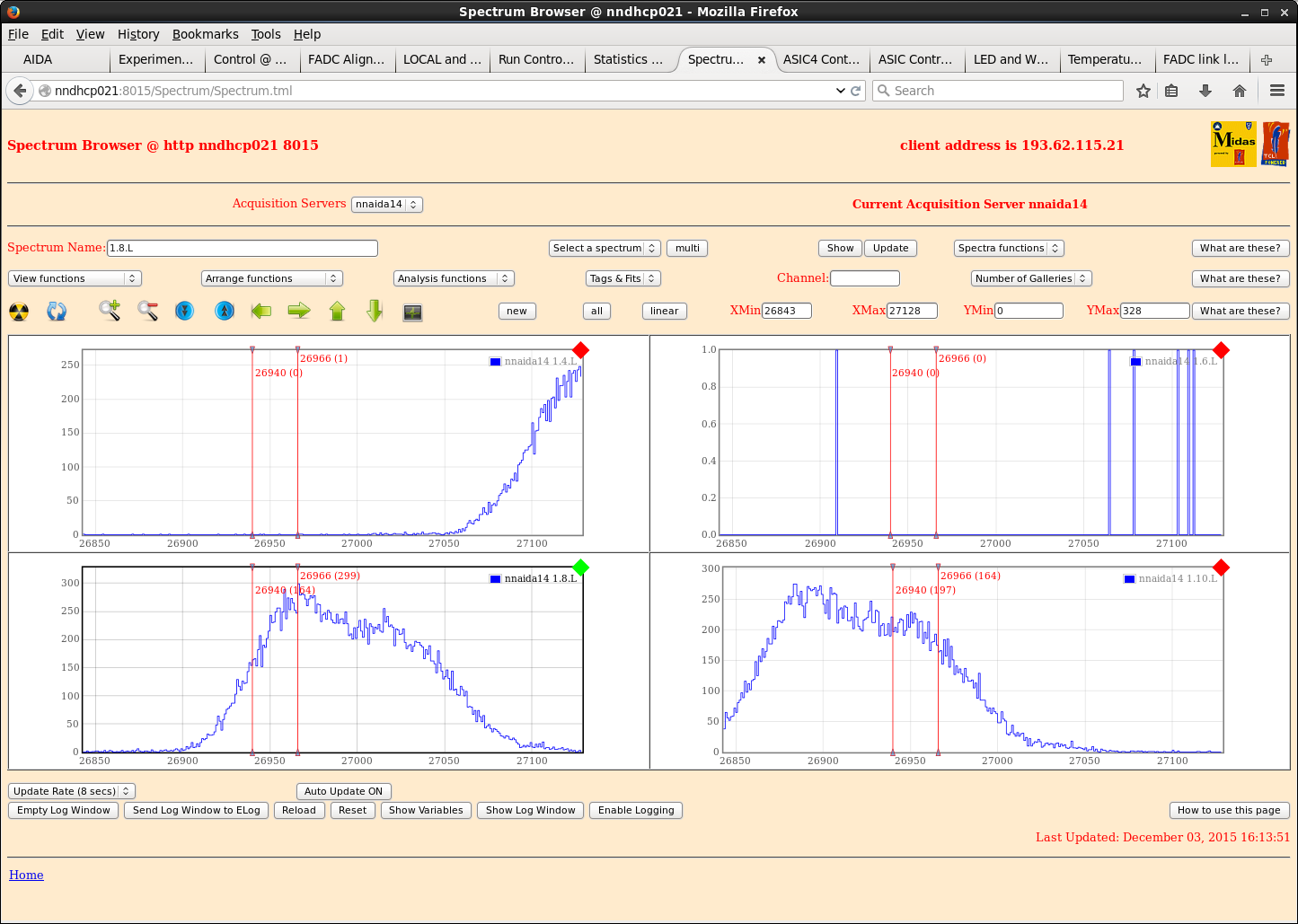
Performance in other FEEs remains largely unchanged. (Note: Yesterday saw similar performance in nnaida13+14 for 15mins but lost it and couldn't regain same performance.)
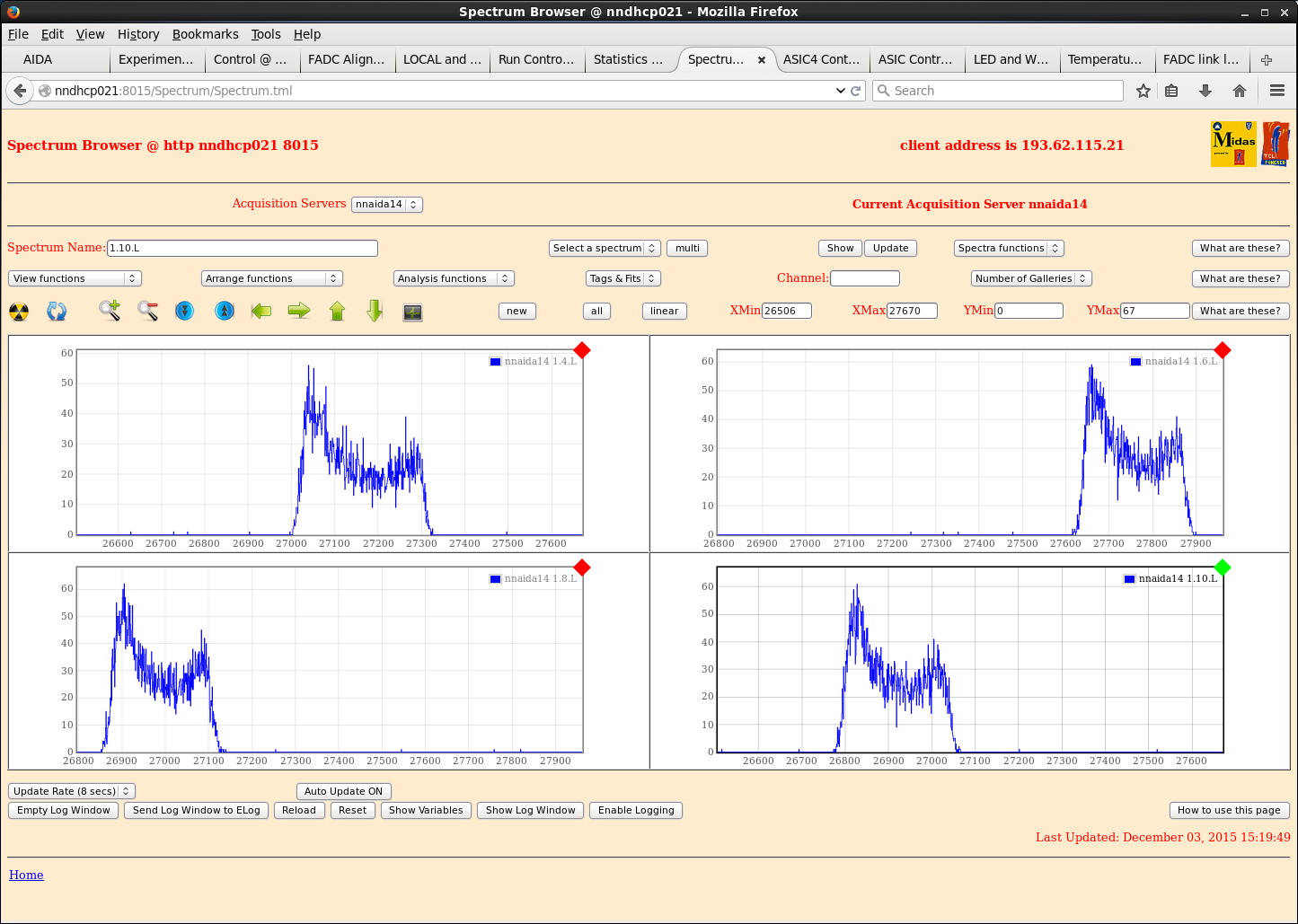
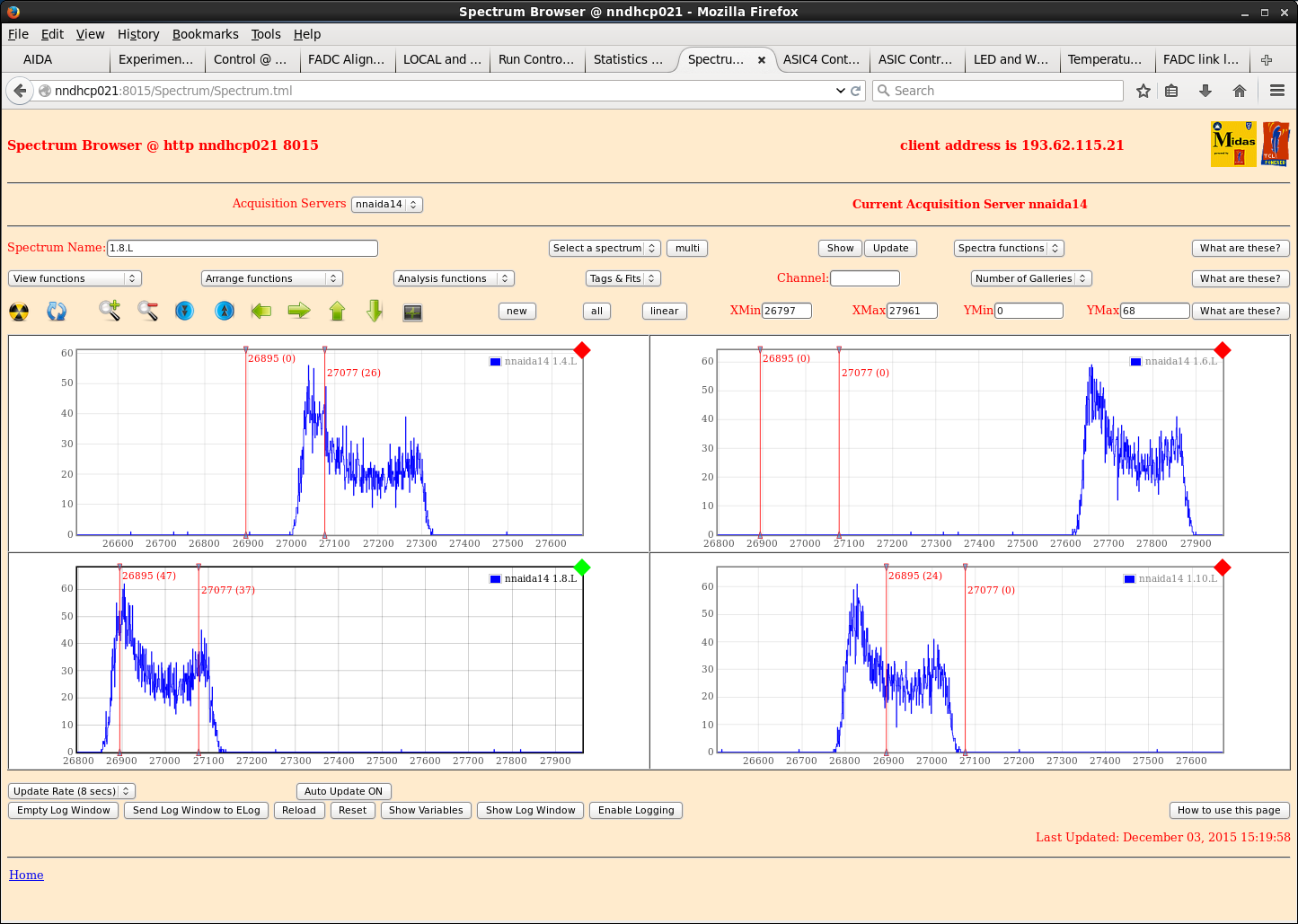
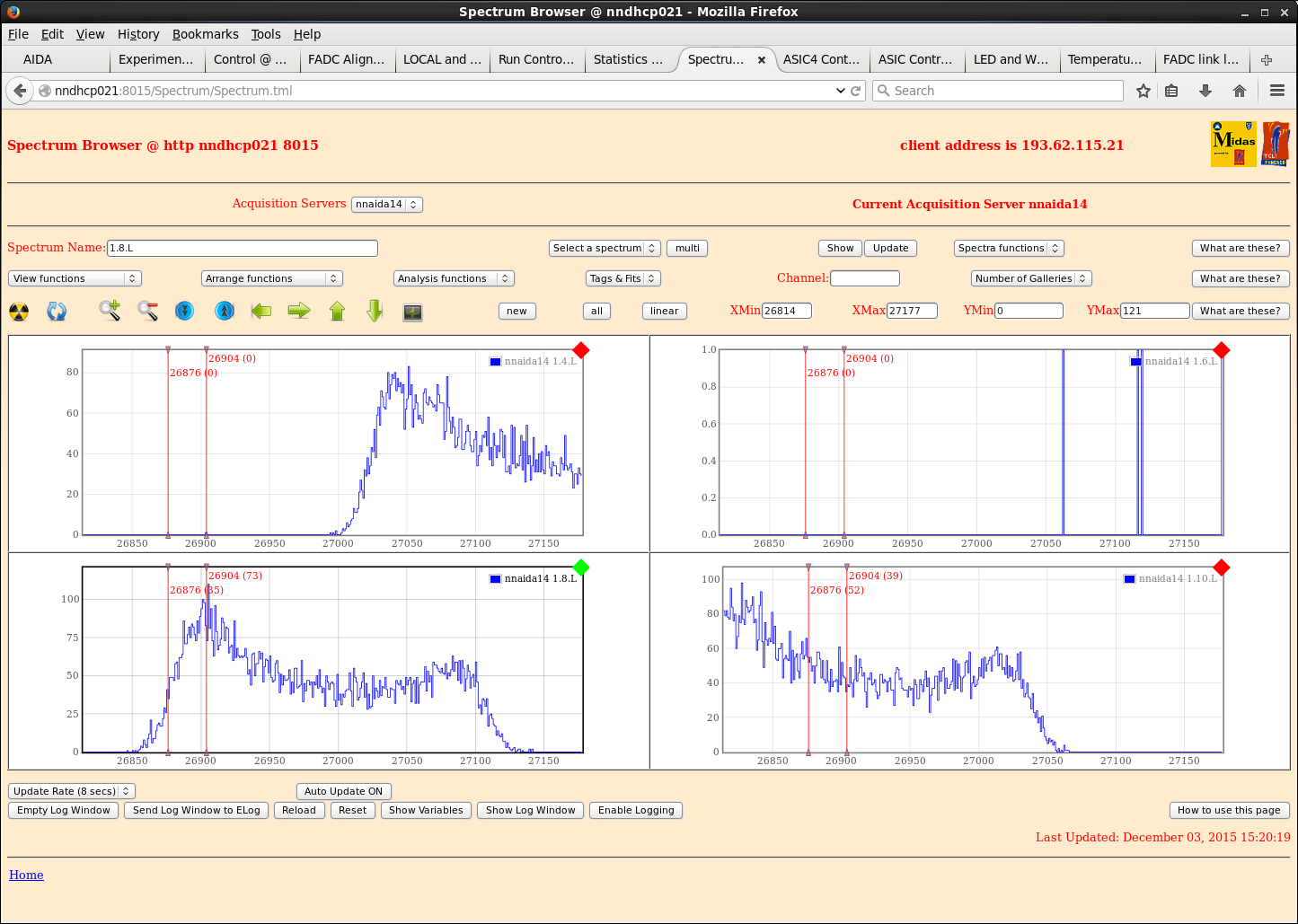
Turned off cooler to see what effect that had - no major changes to peak widths.
Turned off cooler and loosened crate lid - again no appreciable difference.
=> It seems this electrical connection between cooling crate and mezzanines could be the source of a lot of our noise.
Could remove pins completely to see effect that has, before trying with plastic ones when they arrive.
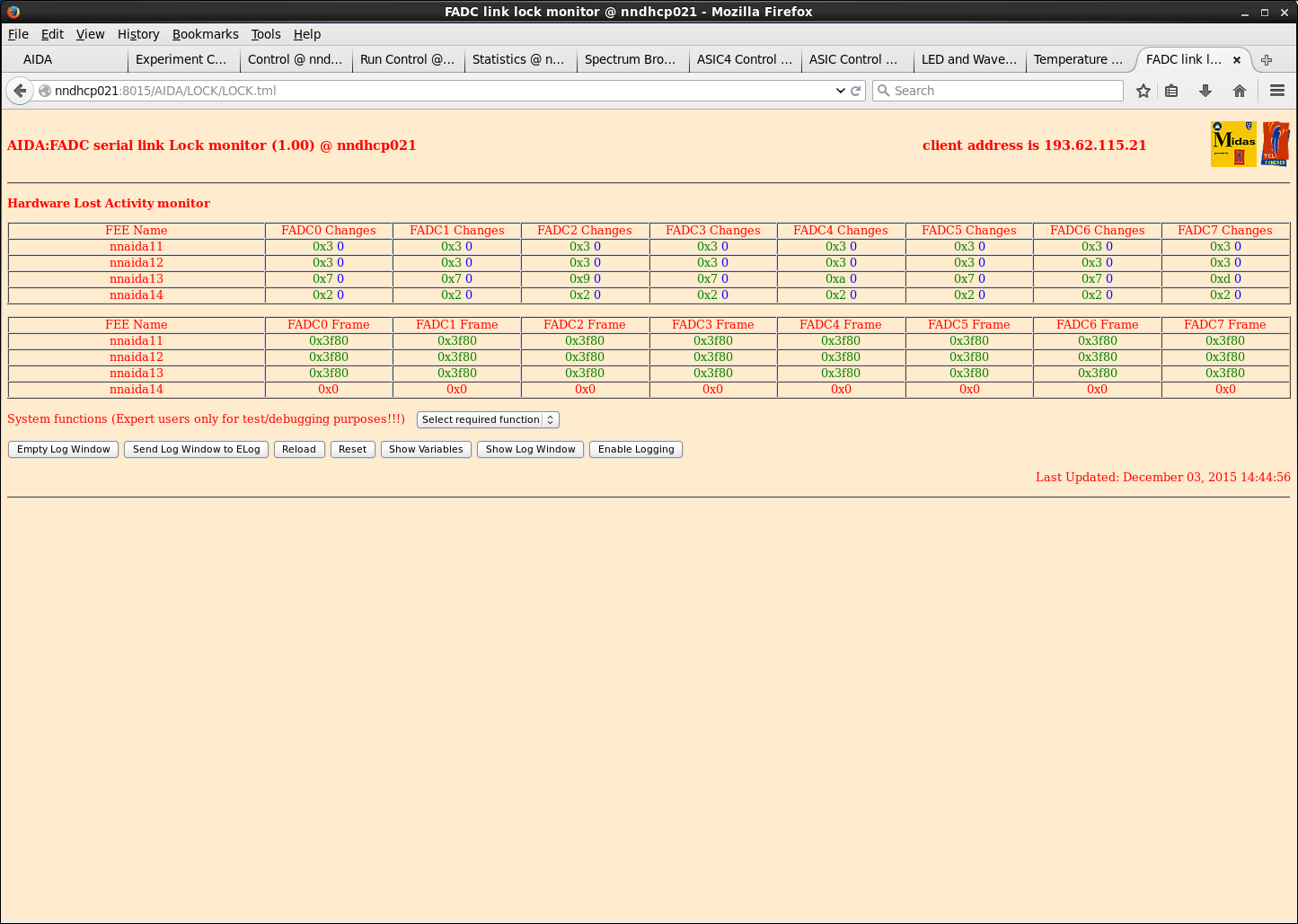
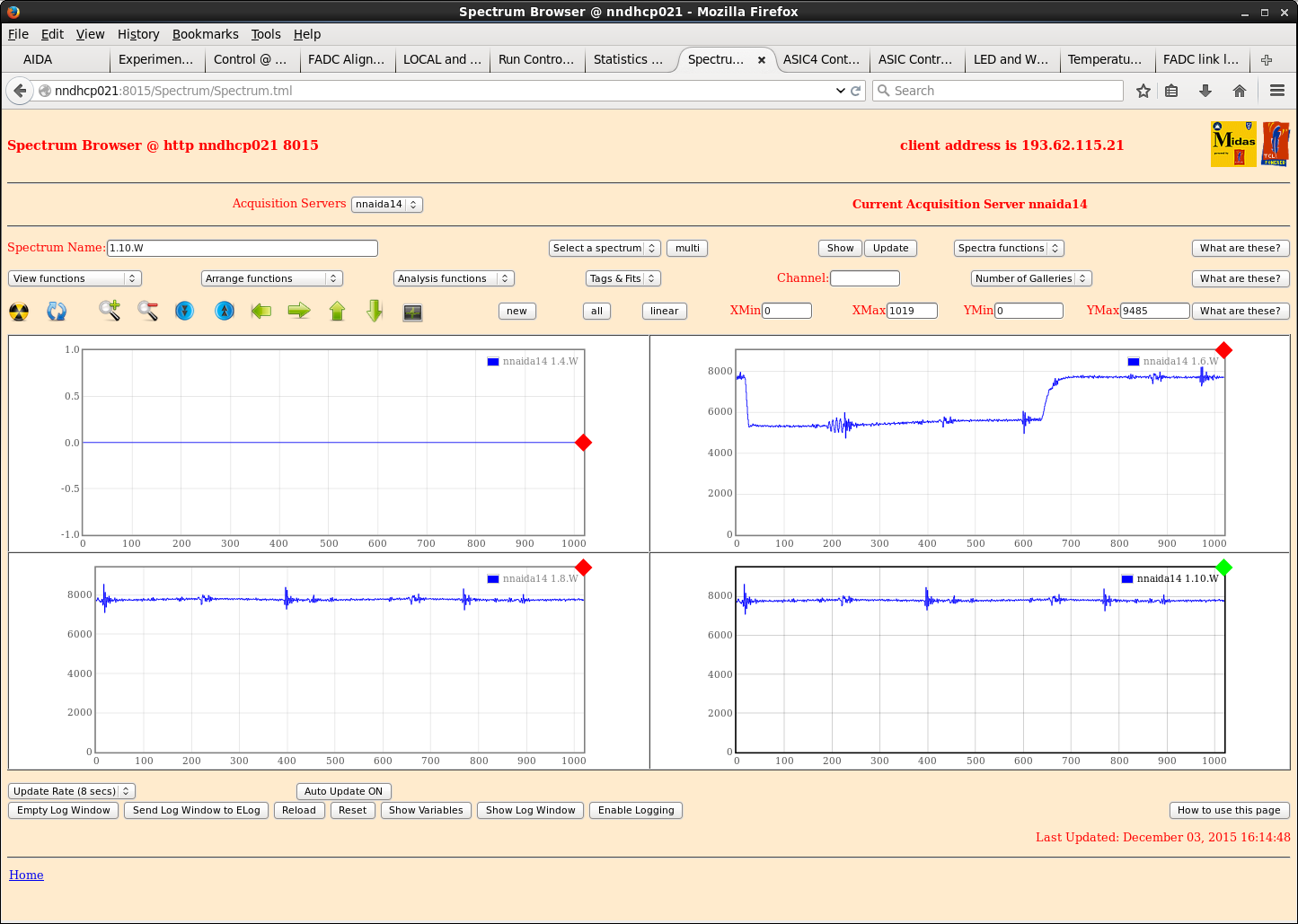
Attachment 1 shows FADC monitor during period in which ADCs in nnaida14 were not calibrated correctly. |
| Attachment 1: nnaida14_noWAV.png
|
|
| Attachment 2: nnaida11_spec_tapeOverGuidePins.png
|
|
| Attachment 3: nnaida11_wav_tapeOverGuidePins.png
|
|
| Attachment 4: nnaida11_spec_tapeOverGuidePins2.png
|
|
| Attachment 5: nnaida11_spec_tapeOverGuidePins3.png
|
|
| Attachment 6: nnaida11_wav_tapeOverGuidePins2.png
|
|
| Attachment 7: nnaida14_spec_doublePeaksChillerOff.png
|
|
| Attachment 8: nnaida14_spec_peakDiffChillerOff.png
|
|
| Attachment 9: nnaida14_spec_chillerOff.png
|
|
| Attachment 10: nnaida11_wav_chillerOff.png
|
|
| Attachment 11: nnaida11_spec_chillerOff.png
|
|
| Attachment 12: nnaida11_specWidth_chillerOff.png
|
|
| Attachment 13: nnaida13_spec_peakDiffChillerOff.png
|
|
| Attachment 14: nnaida13_spec_chillerOff.png
|
|
| Attachment 15: nnaida11_wav_chillerOffTopLoose.png
|
|
| Attachment 16: nnaida14_spec_chillerOffTopLoose.png
|
|
| Attachment 17: nnaida14_spec_chillerOffTopLoose2.png
|
|
| Attachment 18: nnaida14_wav_chillerOffTopLoose.png
|
|
|
|
53
|
Mon Mar 9 13:59:32 2015 |
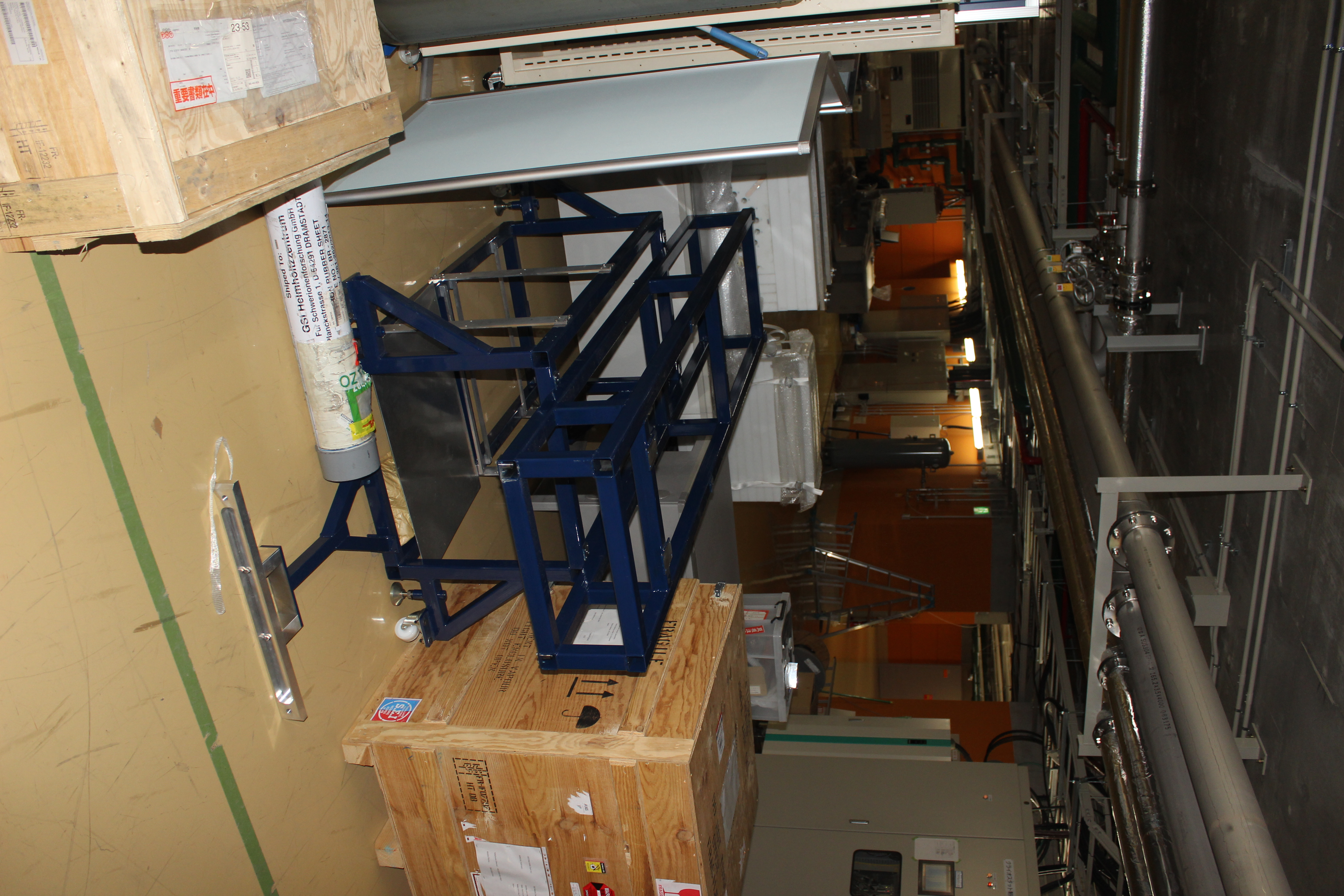
TD | New AIDA support frame for F11/F12 @ RIKEN |
|
| Attachment 1: IMG_2798.JPG
|
|
|
|
106
|
Sat May 9 11:47:40 2015 |
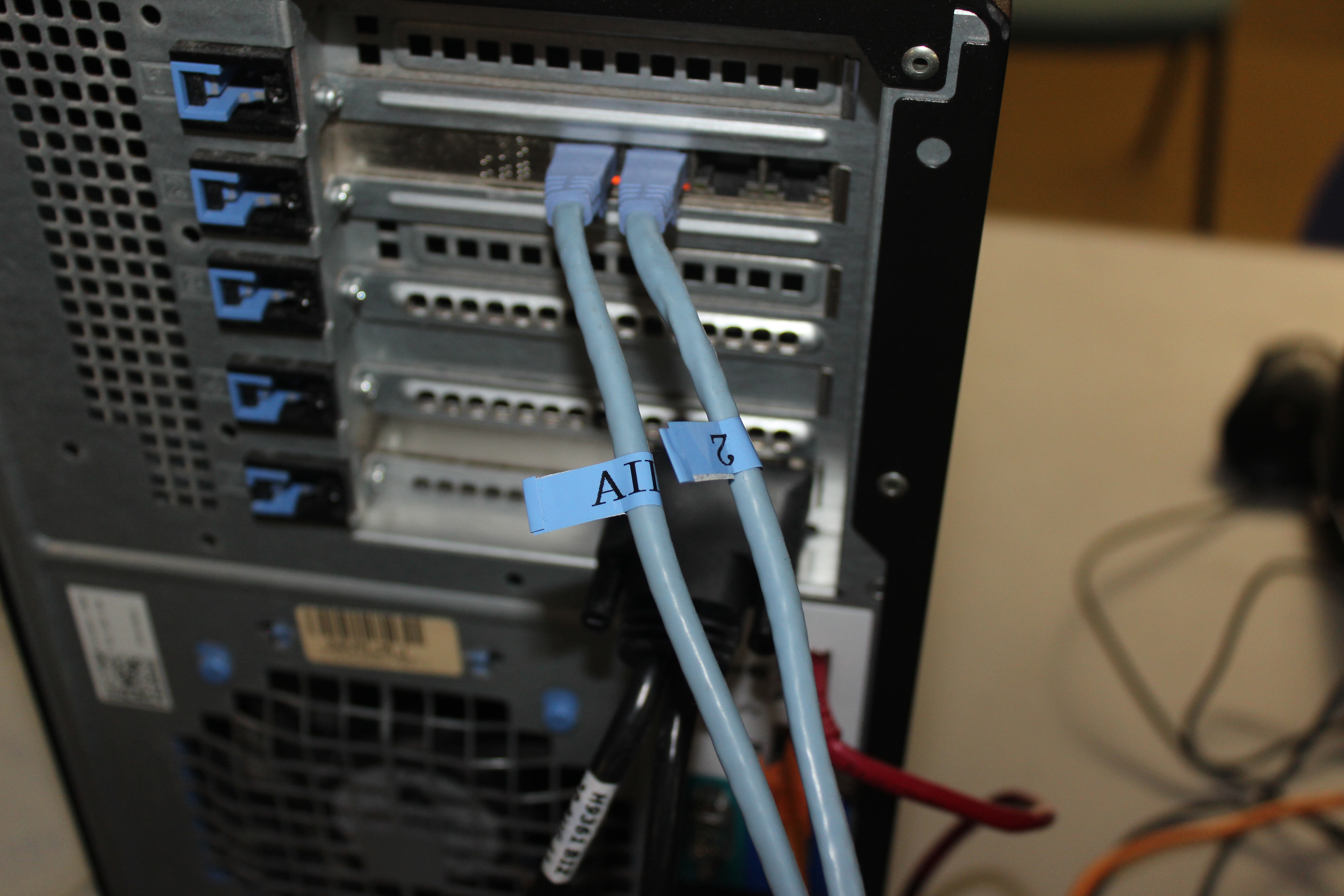
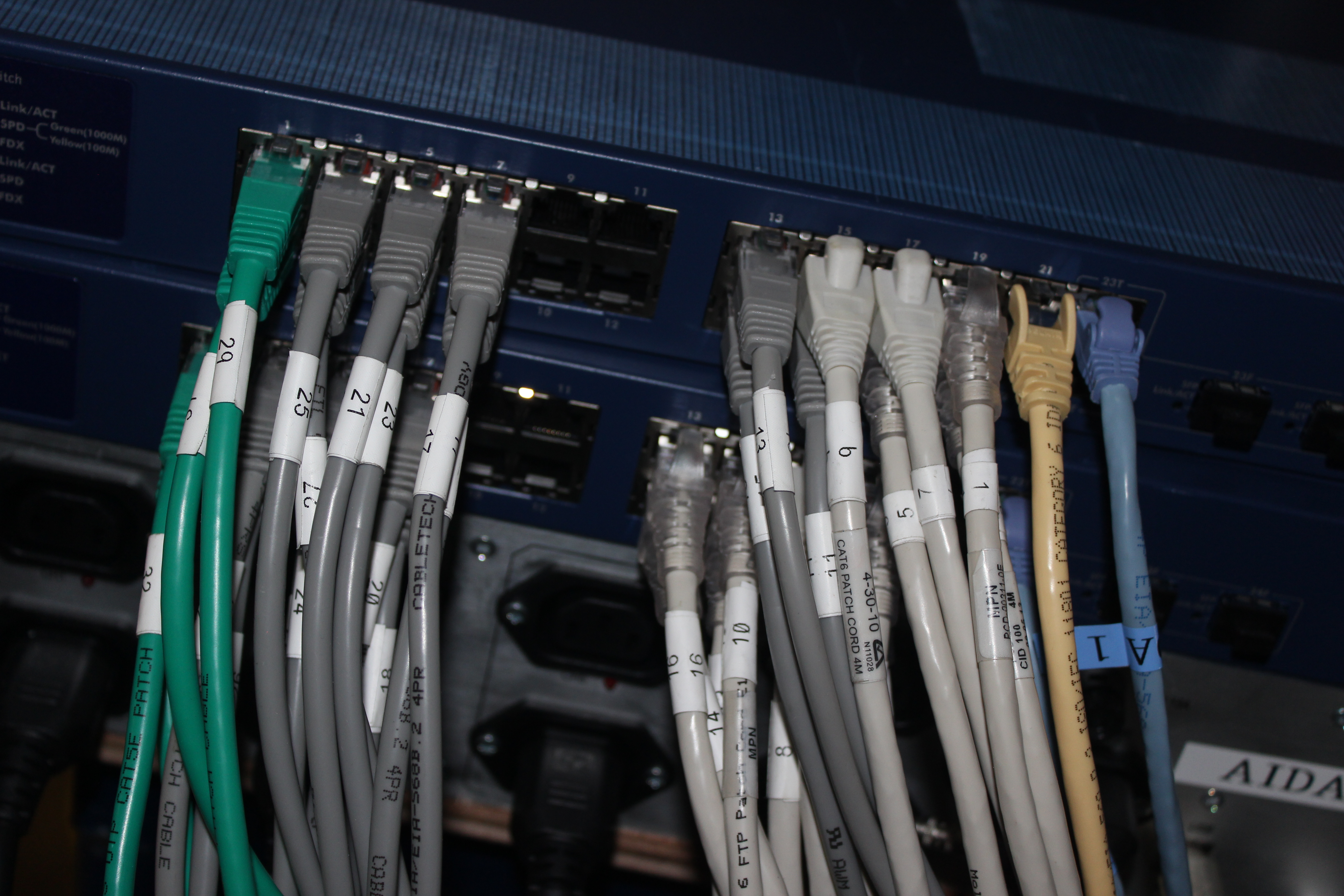
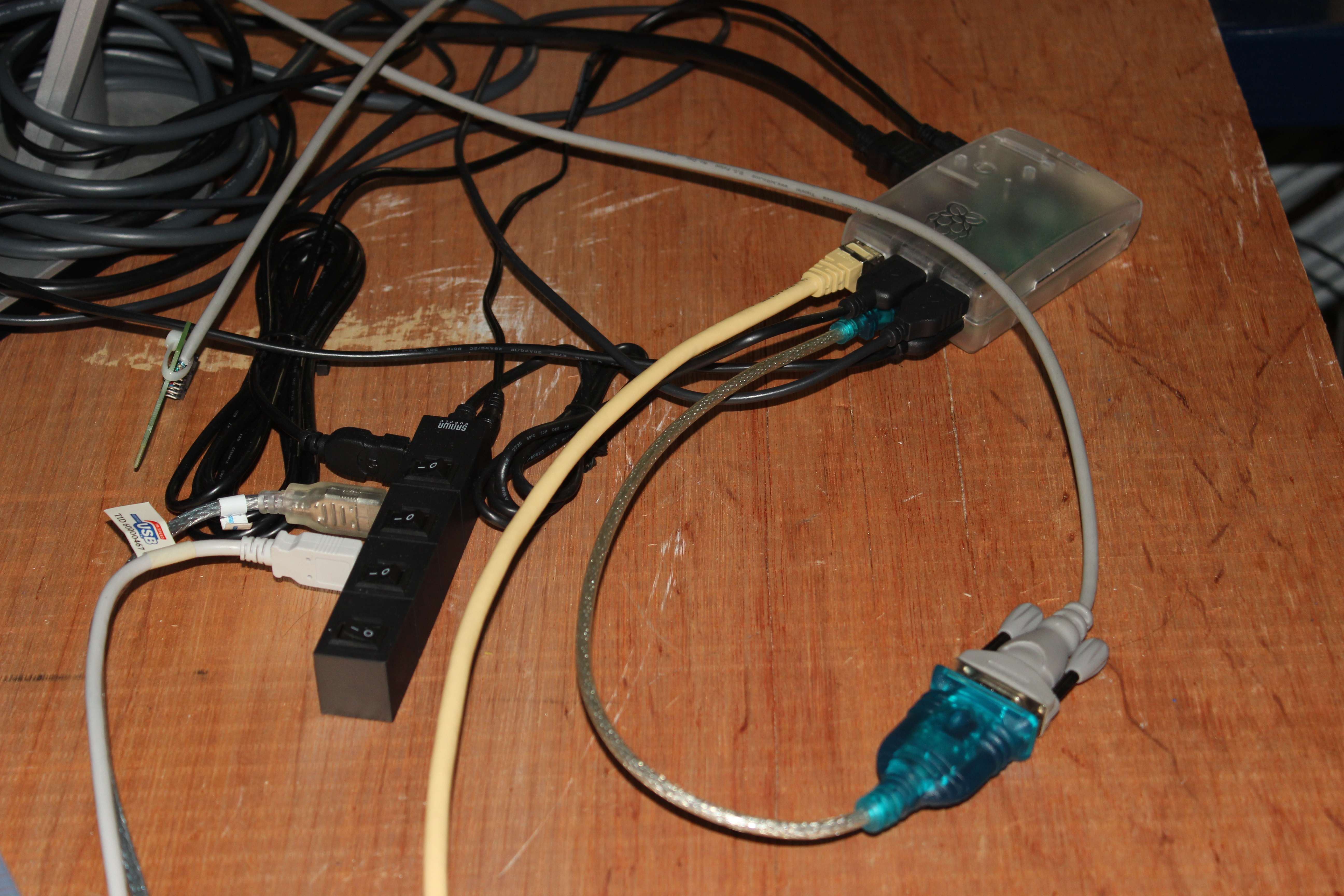
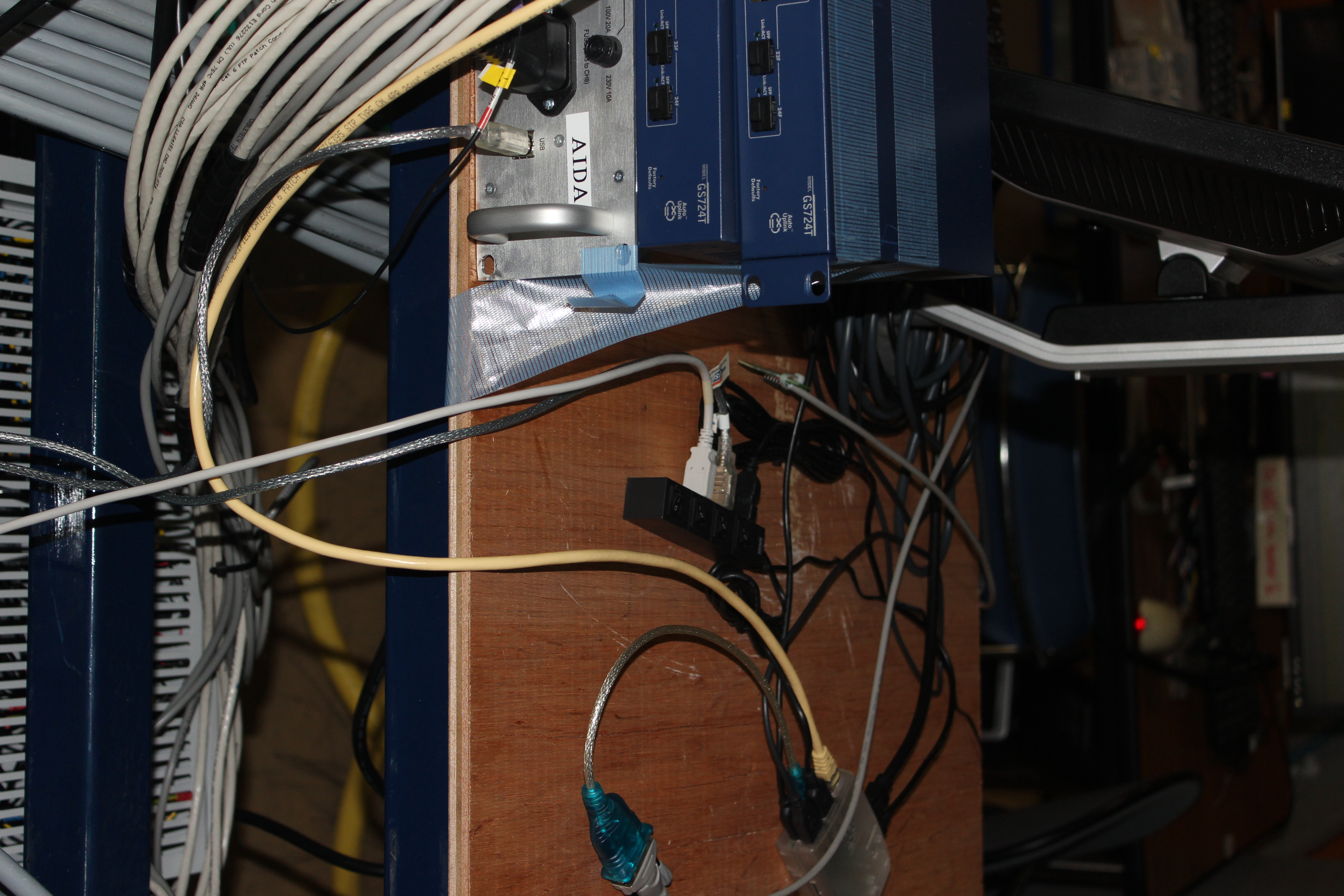
TD | Network cabling & Raspberry Pi configuration |
|
| Attachment 1: IMG_2907.JPG
|
|
| Attachment 2: IMG_2908.JPG
|
|
| Attachment 3: IMG_2909.JPG
|
|
| Attachment 4: IMG_2910.JPG
|
|
|
|
107
|
Sat May 9 23:40:49 2015 |
TD | Network cabling & Raspberry Pi configuration |
Hi Tom,
Please could you photo the power supply cabling and the MACBs.
Hope i'm not too late,
Thanks
Patrick |
|
|
435
|
Tue Nov 8 14:29:34 2016 |
TD, OH, DK | NP1412 Run 4 |
23:28 Run 4 Start
      Thick 6mm C target in beam

      Running with 3.2mm (variable) + 8mm (fixed) of Al degrader. Fixed degrader in same position as R3.
Variable degrader reduced to 1mm of Al. |
|
|
432
|
Tue Nov 8 13:06:18 2016 |
DK, TD, CG, OH | NP1412 Run 1 |
AIDA run with Takechi experiment. 71~73 Ni beam setting
F5 carbon target is: IN
F7 CH2 target is: OUT
F11 carbon target is: OUT
All variable Al degraders at F11 are OUT
When the run started, we had 1mm Al degrader in (count rate of AIDA was near the background rate)
Then we took out the final 1mm Al degrader, and we started to get counts on AIDA (600 Hz on detectors 1, 2, 3, very little on 4, 5, 6)
Run file: NP1412/R1
ASIC parameter file: 2016Nov07-23.03.06
5 mm thick Al stopper is at the center of BRIKEN, with AIDA slightly behind it
Run start: 8/11/2016 22:00
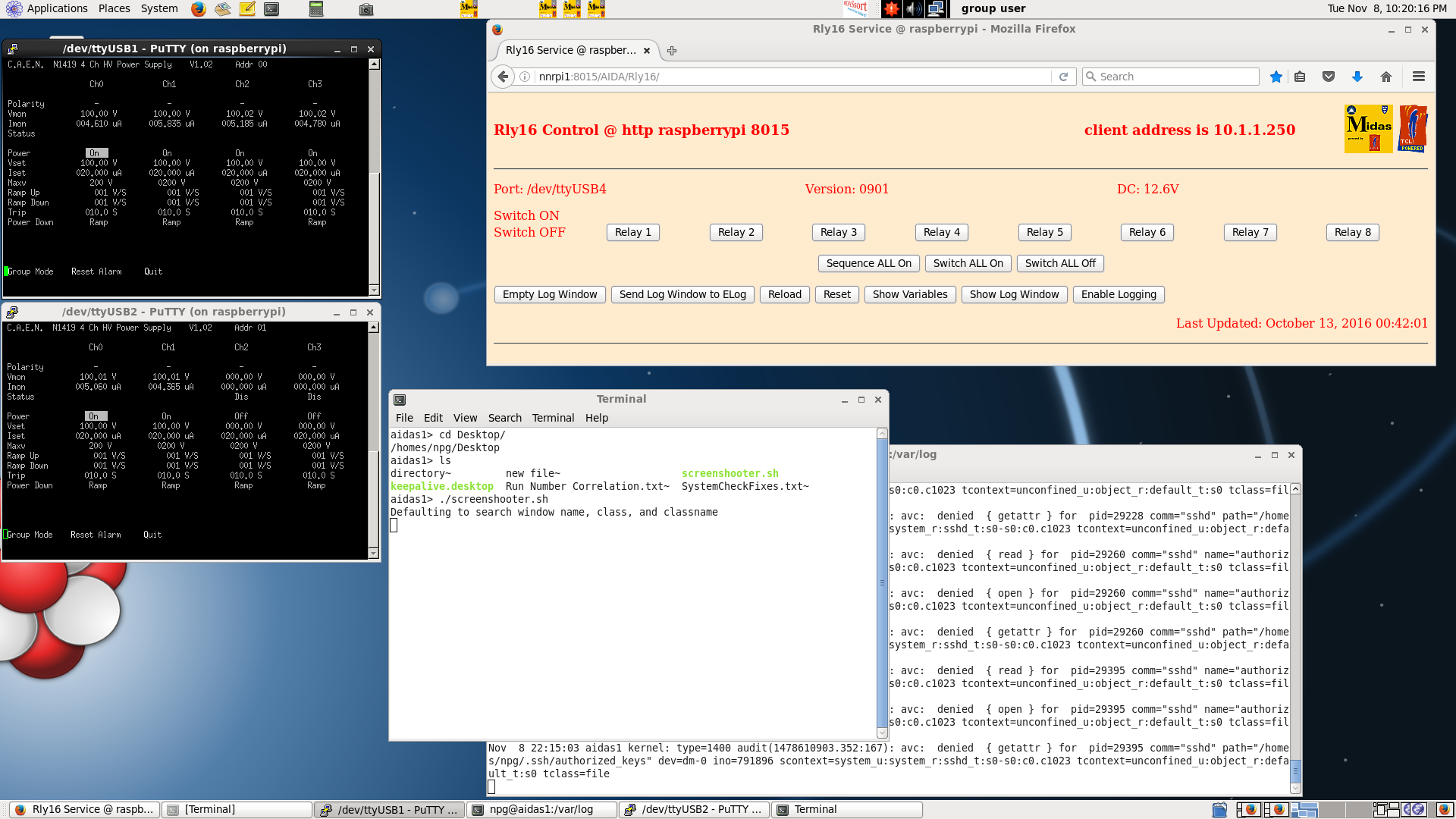
Leak currents (4 to 5 uA each) shown as Attachment #1
22:30 All degraders removed at end of run Run Stop time 22:30 |
| Attachment 1: 14_JST_2016.png
|
|
|
|
438
|
Tue Nov 8 21:01:40 2016 |
CG, DK | NP1412 R9 |
06.02 R9 started with Takechi group C target out and all variable degraders in.
      F5 C in. F7 empty. F11 empty.
      F11 plastic rate 1.1kHz.
      Offline sort rates below:
      *** DSSSD # 1 count:       636 old count:       317 dt:      1.01 s  HEC rate:    314.93 Hz
      *** DSSSD # 2 count:       544 old count:       267 dt:      1.01 s  HEC rate:    273.47 Hz
      *** DSSSD # 3 count:       628 old count:       308 dt:      1.01 s  HEC rate:    315.92 Hz
      *** DSSSD # 4 count:       532 old count:       267 dt:      1.01 s  HEC rate:    261.62 Hz
      *** DSSSD # 5 count:       146 old count:        76 dt:      1.01 s  HEC rate:     69.11 Hz
      *** DSSSD # 6 count:         6 old count:         3 dt:      1.01 s  HEC rate:      2.96 Hz

06.09 Removed 1mm of variable degrader.
      Offline sort rates/below:
      *** DSSSD # 1 count:      1501 old count:      1316 dt:      4.61 s  HEC rate:    325.34 Hz
      *** DSSSD # 2 count:      1231 old count:      1079 dt:      4.61 s  HEC rate:    266.82 Hz
      *** DSSSD # 3 count:      1498 old count:      1314 dt:      4.61 s  HEC rate:    324.69 Hz
      *** DSSSD # 4 count:      1502 old count:      1323 dt:      4.61 s  HEC rate:    325.55 Hz
      *** DSSSD # 5 count:      1346 old count:      1182 dt:      4.61 s  HEC rate:    291.74 Hz
      *** DSSSD # 6 count:       487 old count:       430 dt:      4.61 s  HEC rate:    105.56 Hz

06.20 Stopped the run preemptively to Ge LN2 autofill which is known to crash the DAQ |
|
|
437
|
Tue Nov 8 18:52:32 2016 |
CG, DK | NP1412 R7 R8 |
03.50 74-76Ni beam delivered to F11.
      F11 plastic rate ~1kHz.
      F5 C target in. F7 empty. F11 C target in.
      R7 started 03.51.
      Initial rate 0Hz in all DSSD.
      Removed all variable degraders and implant rate only up to ~1Hz in DSSD1.
      Will replace all variable degraders, enter B2F and remove fixed 5mm plate and work back from there.
      R7 stopped 04.00.

04.07 Beam returned to F11.
      F11 plastic rate 1.1kHz.
      R8 started normally.
      Will now gradually remove variable degraders.

04.18 Now removed all variable degraders.
      Implant rates from offline/full analysis below:
      *** DSSSD # 1 count:       697 old count:       354 dt:      1.03 s  HEC rate:    333.95 Hz
      *** DSSSD # 2 count:       592 old count:       308 dt:      1.03 s  HEC rate:    276.51 Hz
      *** DSSSD # 3 count:       696 old count:       349 dt:      1.03 s  HEC rate:    337.85 Hz
      *** DSSSD # 4 count:       688 old count:       348 dt:      1.03 s  HEC rate:    331.03 Hz
      *** DSSSD # 5 count:       609 old count:       312 dt:      1.03 s  HEC rate:    289.16 Hz
      *** DSSSD # 6 count:       229 old count:       116 dt:      1.03 s  HEC rate:    110.02 Hz

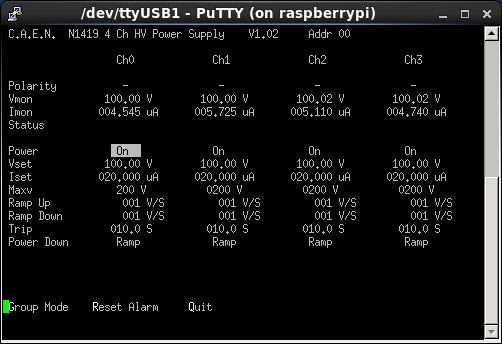
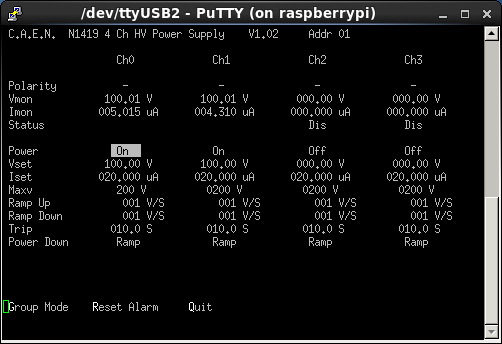
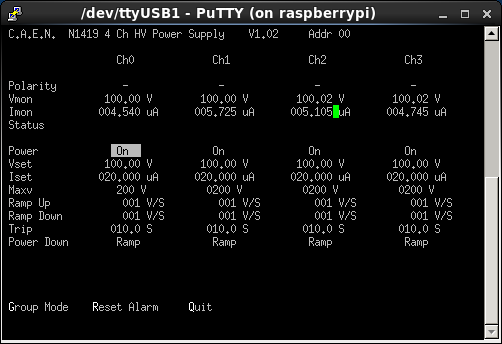
      Leakage currents @ 04.21 attachments 1+2.

05.55 Takechi group want to remove C target.
      Moving variable degraders back into place.
      R8 stopped 05.59.
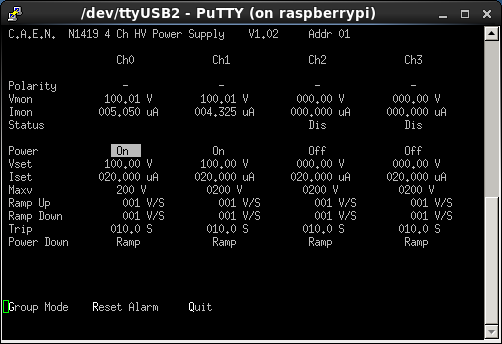
Leakage currents @ 05.55 attachments 3+4. |
| Attachment 1: bias1.png
|
|
| Attachment 2: bias2.png
|
|
| Attachment 3: bias1.png
|
|
| Attachment 4: bias2.png
|
|
|
|
436
|
Tue Nov 8 15:10:16 2016 |
CG, TD, DK, OH | NP1412 R5 R6 |
00.15 Setting changed to 71,72,73Ni. All variable degraders in.
      Will remove while watching rates to settle on degrader setting.
      F5 CH2 in. F7 CH2 out. F11 C target in.
      F11 plastic rate 1.2kHz.
      R5 started.

00.30 Cut F2 momentum slit. F11 plastic rate down to ~400cps.

00.34 Increased primary beam intensity by x2.
      F11 plastic rate increased to ~800cps.
      This setting should run until the beam change ~03.00.

00.47 R6 started.
      All degraders gradually removed but implant rate in DSSD1 only ~10s Hz.

01.03 71,72,73Ni beam stopped for tuning to next setting.
      R6 stopped.
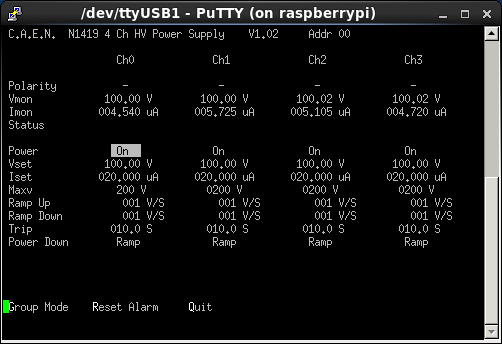
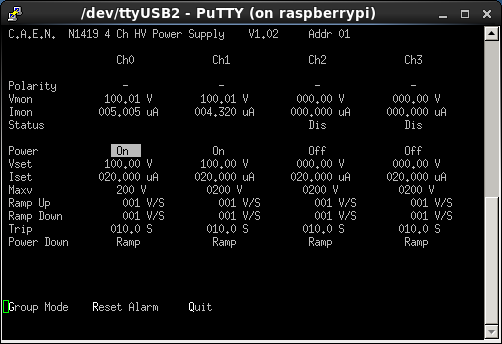
Leakage currents attachments 1+2 |
| Attachment 1: bias1.png
|
|
| Attachment 2: bias2.png
|
|
|
|
434
|
Tue Nov 8 14:22:16 2016 |
TD, OH, DK | NP1412 R3 |
11:21 Run 3 Started
      Degrader moved upstream. AIDA moved to centre of BRIKEN. Fixed degrader moved upstream from centre of BRIKEN.
11:25 Run 3 Stopped |
|
|
449
|
Thu Nov 10 09:56:20 2016 |
TD, OH, ML | NP1412 R26 R27 |
start 18.55 10.11.16
stop
AIDA filename R26_0
BRIKEN filename 161109_1852_767778Ni_045
BigRIPS filename 443
ASIC settings 2016Nov07_23.03.06
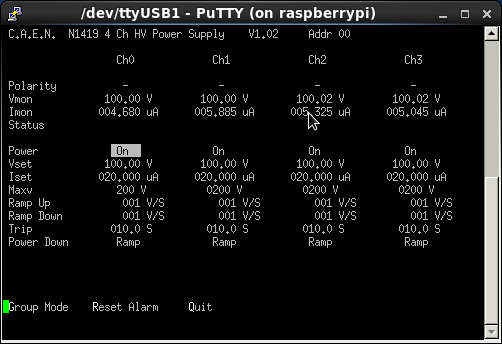
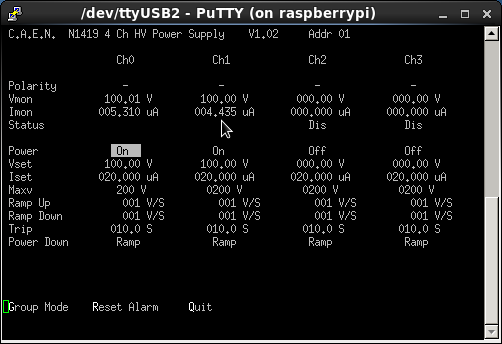
DSSSD bias & leakage currents OK attachments 1 and 2

Degrader all degraders out
F11 rate 430Hz
BigRIPS setting 767778Ni  F5  out, F7 CH2 in, F11 6mm C in

From offline analysis of R26_2

 *** DSSSD # 1 count:       459 old count:       225 dt:      1.02 s  HEC rate:    229.83 Hz
 *** DSSSD # 2 count:       385 old count:       191 dt:      1.02 s  HEC rate:    190.54 Hz
 *** DSSSD # 3 count:       461 old count:       228 dt:      1.02 s  HEC rate:    228.85 Hz
 *** DSSSD # 4 count:       403 old count:       197 dt:      1.02 s  HEC rate:    202.33 Hz
 *** DSSSD # 5 count:       218 old count:       121 dt:      1.02 s  HEC rate:     95.27 Hz
 *** DSSSD # 6 count:        87 old count:        42 dt:      1.02 s  HEC rate:     44.20 Hz

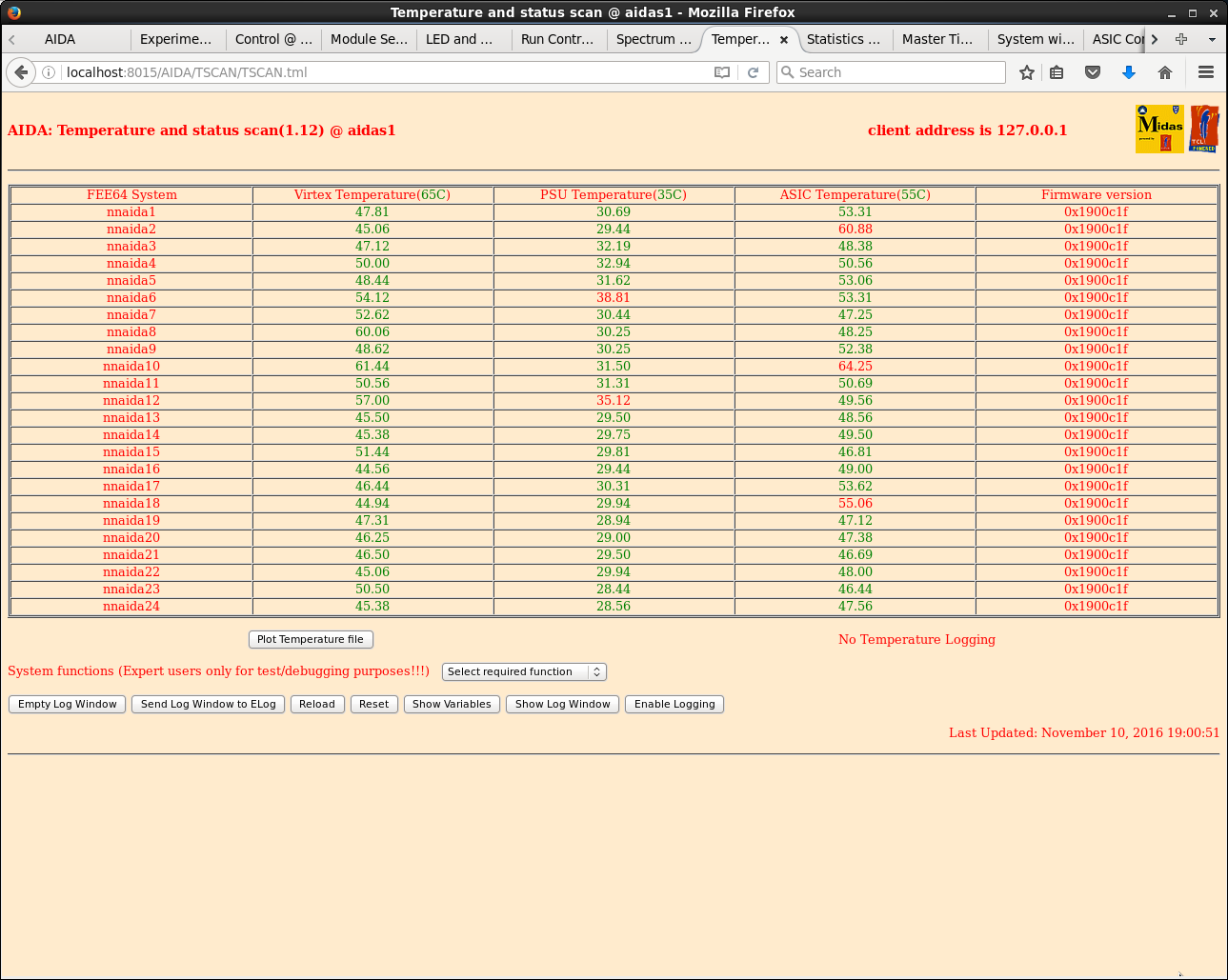
19.02 FEE64 temperature OK - see attachment 3

19.16 BRIKEN DAQ problems following restart - multiple correlation scaler reset requests issued - ignore data
before R26_5
      New BRIKEN data file 161109_1852_767778Ni_046

19.20 AIDA DAQ stalled (presumably *end* of LN2 fill cycle)

      Soft reset OK
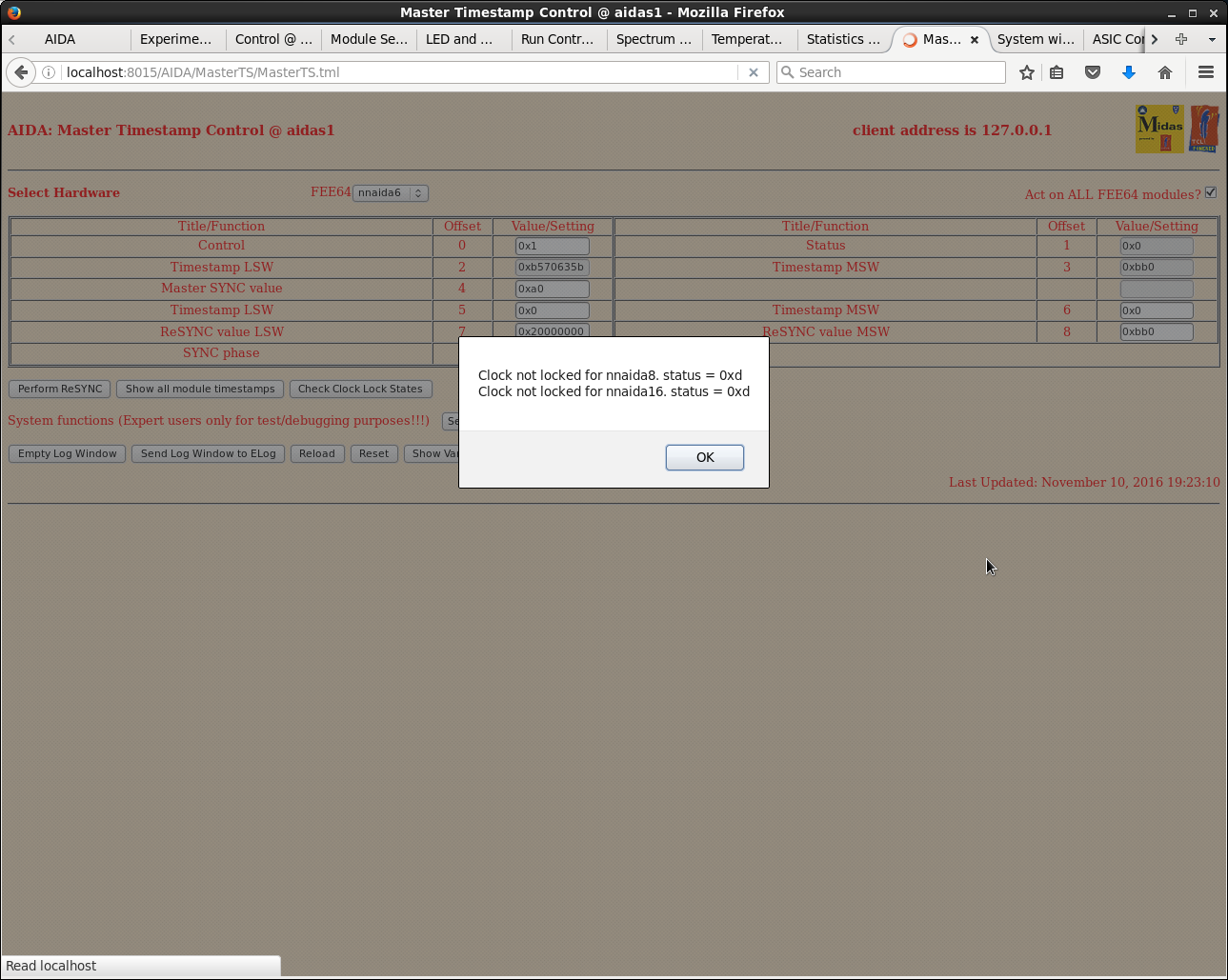
      Clock lock state status 0xd - see attachment 6

19.29 Start DAQ (R27)

19.35 BRIKEN DAQ problems starting SyncCheck program - - multiple correlation scaler reset requests issued -
ignore data before R27_2

19.37 All degraders (5.4mm Al) in for new Takechi et al. setting
      BigRIPS setting 767778Ni  F5 in, F7 out, F11 6mm C in

BRIKEN filename 161109_1852_767778Ni_045
AIDA fileame R27_3
BigRIPS filename 444

19.40 All degraders out

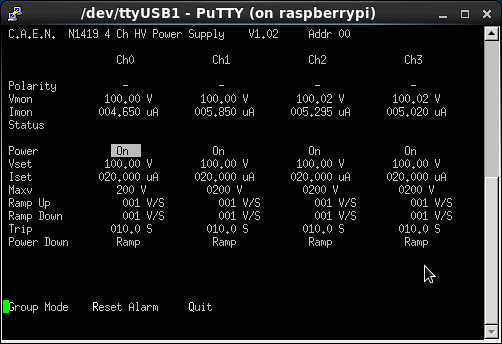
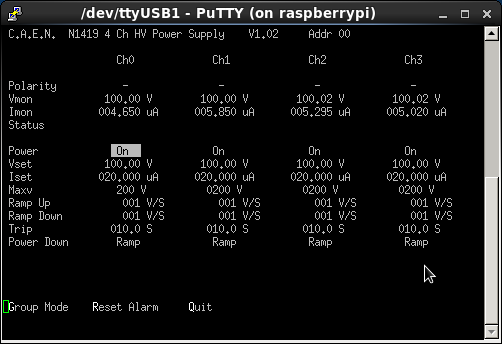
DSSSD bias & leakage currents OK attachments 4 & 5

From offline analysis of R27_4

 *** DSSSD # 1 count:       281 old count:       247 dt:      2.31 s  HEC rate:    121.43 Hz
 *** DSSSD # 2 count:       247 old count:       219 dt:      2.31 s  HEC rate:    106.74 Hz
 *** DSSSD # 3 count:       286 old count:       252 dt:      2.31 s  HEC rate:    123.59 Hz
 *** DSSSD # 4 count:       287 old count:       253 dt:      2.31 s  HEC rate:    124.02 Hz
 *** DSSSD # 5 count:       201 old count:       178 dt:      2.31 s  HEC rate:     86.86 Hz
 *** DSSSD # 6 count:        33 old count:        29 dt:      2.31 s  HEC rate:     14.26 Hz

20.36 Noted x4 increase in F11 rate to c. 2kHz
      All degraders in (5.4mm Al)

      BRIKEN DAQ shows x4-5 increase for c. 6 minutes
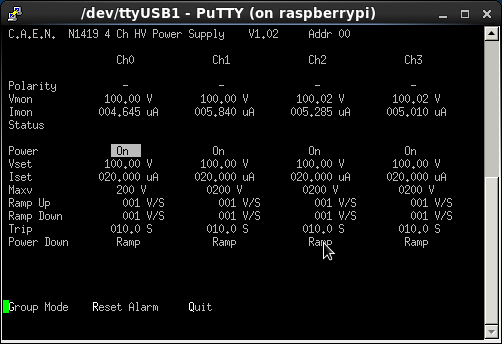
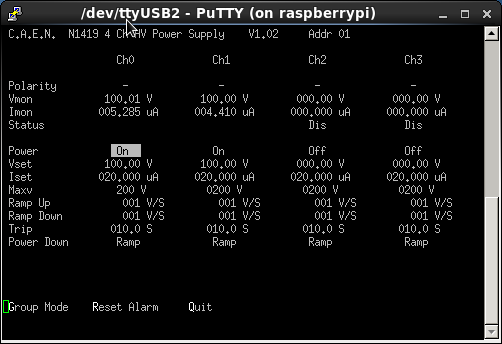
DSSSD bias & leakage currents OK attachments 7 & 8 |
| Attachment 1: 1.png
|
|
| Attachment 2: 2.png
|
|
| Attachment 3: 3.png
|
|
| Attachment 4: 10.png
|
|
| Attachment 5: 11.png
|
|
| Attachment 6: 4.png
|
|
| Attachment 7: 20.png
|
|
| Attachment 8: 21.png
|
|